

Yungas Tody-Tyrant vs Acre Tody-Tyrant
Hemitriccus spodiops versus Hemitriccus cohnhafti
Play a quiz with Yungas Tody-Tyrant and Acre Tody-Tyrant
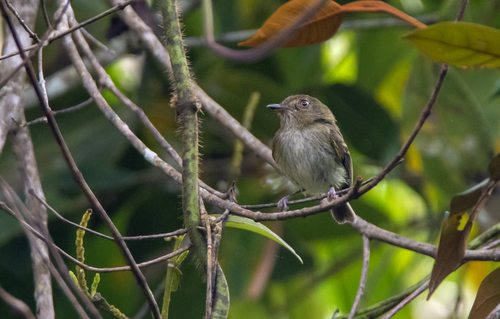 Yungas Tody-Tyrant
 Acre Tody-Tyrant
In short
The most reliable field mark to separate Yungas Tody-Tyrant from Acre Tody-Tyrant is the color and pattern of the underparts and wing edges in adults: Yungas shows a grayish olive breast with faint whitish streaks and a clear yellowish white belly, while Acre has olive-green breast with distinct creamy yellowish streaks and a sharply sulphur-yellow lower belly. In the wing, Acre Tody-Tyrant displays blackish flight feathers with yellow outer and whitish inner edges, creating a more contrasting pattern than the Yungas' dark olive-green wings with only indistinct yellowish olive wing bars. Both are small, short-tailed flycatchers with similar structure, but Acre is slightly heavier on average. Face and iris color also help: Yungas has grayish buff lores and a pale yellow iris, while Acre shows tawny lores and a cream to brownish hazel iris. Vocalizations differ, but are not always easy to use in the field.
Identification tips
- Underpart streaking and belly color: Yungas Tody-Tyrant has faint whitish streaks on a grayish olive breast and a clear yellowish white belly; Acre Tody-Tyrant shows creamy yellowish streaks on an olive-green breast and a distinctly sulphur-yellow lower belly and undertail coverts. This is often the most reliable field mark in good light.
- Wing pattern: Acre Tody-Tyrant's wings are blackish with yellow outer and whitish inner edges on the flight feathers, and two contrasting yellowish tawny wing bars. Yungas has dark olive-green wings with only somewhat indistinct yellowish olive wing bars. Look for the more contrasting, brighter wing pattern on Acre, especially in flight or when perched with wings closed.
- Face and lores: Yungas shows grayish buff lores on an olive-green face, while Acre has tawny lores and a tawny wash on the face. This can be subtle, but in close views the tawny tones of Acre are distinctive.
- Crown pattern: Acre Tody-Tyrant has darker streaks on the crown, while Yungas has a plain dark olive-green crown with a short bushy crest. In practice, the crest on Yungas may be visible when raised.
- Iris color: Yungas has a pale yellow iris; Acre's iris is cream to brownish hazel. This is best seen in good light and close views.
- Leg and foot color: Yungas has pinkish gray to pinkish legs and feet; Acre's are gray. This is subtle and not always visible in the field.
- Tail color: Acre has a blackish tail with dark green inner vanes; Yungas' tail is dark olive-green. This is a minor mark but may help in combination.
- Bill color: Both have a flattish, wide-based bill, but Acre's bill has a creamy base to the mandible, while Yungas' is blackish overall. This difference is subtle.
- Size and structure: Acre Tody-Tyrant is slightly heavier (9 g vs. 7 g for Yungas), but both are about 11 cm long and share a compact, short-tailed shape. Size is not a reliable field mark unless handled.
- Vocalizations: Acre's song is a short, low-pitched trill of "tick" notes, usually without introductory notes, plus single-note calls. Yungas' voice is not well described but is said to be similar to other Hemitriccus. Use voice only with caution unless well known.
- Geographic context: If seen in Brazil, it is Acre Tody-Tyrant. In Bolivia or Peru, both species may occur, so plumage is more important.
- Sex and age: Both species have similar plumage in both sexes; no sexual dimorphism is noted. No distinctive juvenile or immature marks are described, so adult field marks should be used for all ages.
- Pitfalls: Poor light can obscure the subtle differences in streaking and belly color. The wing bars on Yungas may appear more distinct in worn plumage, so use multiple marks. Face color differences can be subtle and variable.
- When in doubt: Focus on the combination of underpart streaking, belly color, and wing pattern. If these are ambiguous, use iris and face color as supporting marks.
Size
Both species are about 11 cm long, but Acre Tody-Tyrant is slightly heavier (one male weighed 9 g) compared to Yungas Tody-Tyrant's average of 7 g [wikidata]. In the hand or with experience, Acre may appear a bit bulkier, but this is subtle and not always reliable in the field.
Plumage
- Adults (both sexes):
- Head and Face: Yungas has a dark olive-green crown with a short bushy crest and grayish buff lores, while Acre has a greenish olive head with darker streaks on the crown and tawny lores plus a tawny wash on the face.
- Back and Rump: Yungas is dark olive-green; Acre is greenish olive, often appearing brighter.
- Wings: Yungas has dark olive-green wings with yellowish olive ends on the coverts, forming two indistinct wing bars. Acre's wings are blackish with yellow outer edges and whitish inner edges on the flight feathers, plus black coverts with yellowish tawny edges, forming two more contrasting wing bars.
- Tail: Yungas' tail is dark olive-green; Acre's is blackish with dark green inner vanes.
- Underparts: Yungas shows grayish olive throat and underparts with faint whitish streaks, except for a clear yellowish white belly. Acre has olive-green throat and breast with creamy yellowish streaks, unstreaked olive-green upper belly and flanks, and a sharply sulphur-yellow lower belly and undertail coverts.
- Iris and Bare Parts: Yungas has a pale yellow iris and pinkish gray to pinkish legs/feet; Acre has a cream to brownish hazel iris and gray legs/feet.
- Juvenile/Immature: No specific juvenile or immature wing pattern differences are described in the sources; all contrasts above apply to adults and presumed to immatures unless otherwise noted.
Behaviour
No significant behavioral differences are described in the sources. Both species are small, active flycatchers likely to be seen foraging in the midstory or lower canopy, often perched quietly or making short sallies for insects.
Habitat
Both species overlap in Bolivia and Peru, but Acre Tody-Tyrant also occurs in Brazil. Habitat preferences are not detailed in the sources, but both are associated with humid forest regions. Locality can help: if seen in Brazil, it is Acre; in Bolivia or Peru, both are possible.
Voice
Acre Tody-Tyrant gives a short, low-pitched trill of "tick" notes, usually without introductory notes, and also single-note calls like "skep," "keek," or "kup." The Yungas Tody-Tyrant's vocalizations are not described in detail in the sources, but are said to be similar to other Hemitriccus species. In practice, vocal differences may be subtle and require experience or recordings for confident separation.