

Golden Pheasant vs Swinhoe's Pheasant
Chrysolophus pictus versus Lophura swinhoii
Play a quiz with Golden Pheasant and Swinhoe's Pheasant
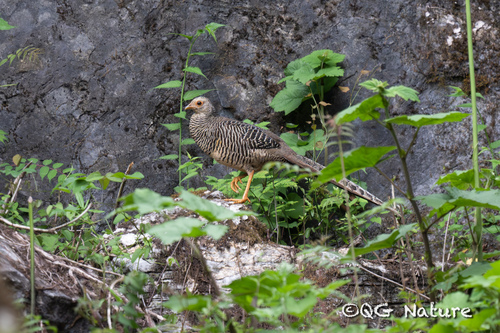 Golden Pheasant
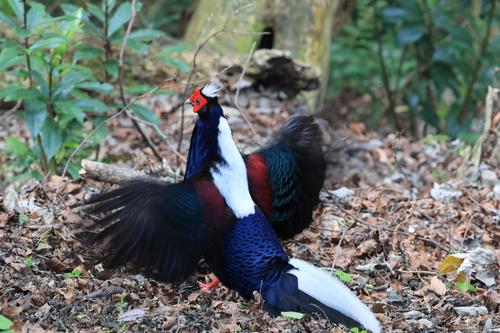 Swinhoe's Pheasant
In short
The most reliable field mark to separate Golden Pheasant from Swinhoe's Pheasant is the male's plumage: Golden Pheasant males have a golden crest and bright red body, while Swinhoe's Pheasant males show a glossy blue-purple chest, white tail, and white crest. Females of both are brown, but Golden Pheasant females are more uniformly barred and buff, whereas Swinhoe's females have yellow arrow-shaped spots and maroon outer tail feathers. Juvenile Swinhoe's males are dark blue with brown and yellow wing patterns, unlike the mottled brown juvenile Golden Pheasant. In flight or at a distance, tail color and length, as well as overall body hue, are key. Both species are terrestrial pheasants, but Swinhoe's is endemic to Taiwan and Golden Pheasant is introduced in some regions.
Identification tips
- Adult male crest color: Golden Pheasant males have a golden-yellow crest, while Swinhoe's males have a white crest and nape. This is a quick check at any distance if the crest is visible.
- Body color in males: Golden Pheasant males show a bright red body and golden rump; Swinhoe's males are glossy blue-purple on the chest, belly, and rump, with no red or gold.
- Tail color and pattern: Golden Pheasant males have a very long tail (up to two-thirds of total length), black spotted with cinnamon, and cinnamon-buff at the tip. Swinhoe's males have a white tail with less extreme length.
- Ruff/cape display: Only Golden Pheasant males have an orange ruff that can be fanned over the face, forming a striking black-and-orange fan. Swinhoe's males do not have this feature.
- Wattles: Swinhoe's males have prominent red wattles, especially during display. Golden Pheasant wattles are yellow and less obvious.
- Female plumage: Golden Pheasant females are dull brown with barred buff and blackish brown, and a plain buff abdomen. Swinhoe's females have yellow, arrow-shaped spots and maroon outer tail feathers, giving a more patterned and colorful look.
- Juvenile/immature males: Juvenile Swinhoe's males are dark blue with brown and yellow wing patterns, while Golden Pheasant immatures are more uniformly brown and barred, lacking blue or yellow.
- Leg color: Both species are described with yellow legs in these sources; do not rely on this mark for separation.
- Bill color: Both have yellow bills; not useful for separation.
- Size and structure: Golden Pheasant is larger and longer, especially the tail. Swinhoe's is more compact, with a shorter tail relative to body.
- Flight and jizz: Both are reluctant fliers, but Golden Pheasant's longer tail is obvious in flight or when running. Swinhoe's has a more balanced, less tail-heavy profile.
- Habitat and range: Swinhoe's is only wild in Taiwan; Golden Pheasant is native to China but introduced in the UK and Hawaii. If seen in the wild outside Taiwan, Golden Pheasant is far more likely.
- Display behavior: Golden Pheasant males fan their ruff over the face; Swinhoe's males hop, run in circles, and whirr wings, with frontal tail-fanning.
- Female confusion: Both females are brown, but Swinhoe's has more yellow spotting and maroon in the tail, while Golden Pheasant is more uniformly barred and buff.
- Hybrid confusion: In the UK, some Golden Pheasants may show hybrid features with Lady Amherst's Pheasant, but Swinhoe's is not part of these hybrid populations.
Size
Golden Pheasant is generally larger and longer, especially in males, with a body mass around 625 g and a total length up to 100 cm (mostly tail). Swinhoe's Pheasant males reach up to 79 cm in length, making them noticeably shorter and more compact. Female Golden Pheasants are also longer (60–80 cm) than Swinhoe's, though both are similar in being slimmer and less showy than males. Tail length is proportionally greater in Golden Pheasant, especially in males.
Plumage
- Juveniles/Immatures: Juvenile Swinhoe's males are dark blue with brown and yellow wing patterns, while Golden Pheasant juveniles (especially females) are mottled brown and barred buff, lacking strong blue or yellow contrasts. No distinctive upperwing pattern is described for Golden Pheasant immatures, but Swinhoe's juvenile males may show more contrast on the wing.
- Adult Males: Golden Pheasant males are unmistakable with a golden crest, orange ruff, bright red body, green upper back, blue tertials, and a long, cinnamon-black spotted tail. Swinhoe's males have a white crest and nape, glossy blue-purple chest and belly, white tail, and red wattles. The Swinhoe's lacks the golden or red tones of Golden Pheasant, instead showing a tricolored (red, white, blue) appearance.
- Adult Females: Golden Pheasant females are duller, with overall brown, barred buff and blackish brown breast and sides, and a plain buff abdomen. Swinhoe's females are brown but marked with yellow, arrow-shaped spots and complex barring, plus maroon outer tail feathers. Swinhoe's females are less uniformly barred and show more patterning on the wings and tail.
- Legs and Bill: Both species have yellow legs, but Swinhoe's is specifically noted for red legs (possibly a confusion with Mikado Pheasant; for these two, both are described as yellow). Both have yellow bills.
Behaviour
Both species are terrestrial and perform elaborate courtship displays. Golden Pheasant males spread their orange ruff to form a fan over the face, while Swinhoe's males display by hopping, running in circles, fanning the tail, and whirring their wings. Swinhoe's display is more active and involves prominent red wattles. In the field, both species tend to be shy and may flush into cover rather than fly far.
Habitat
Golden Pheasant is native to forests in mountainous western China but is introduced in parts of the UK and Hawaii, often in woodlands or estates. Swinhoe's Pheasant is endemic to Taiwan and found in broadleaf forests at mid-elevations. If observed outside Taiwan, Swinhoe's is almost certainly captive or escaped, while Golden Pheasant may be feral in some regions. Habitat alone is rarely diagnostic unless in Taiwan.