

Western Tanager vs Flame-coloured Tanager
Piranga ludoviciana versus Piranga bidentata
Play a quiz with Western Tanager and Flame-coloured Tanager
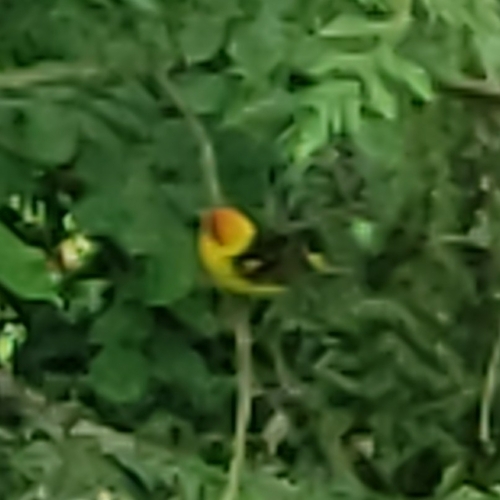 Western Tanager
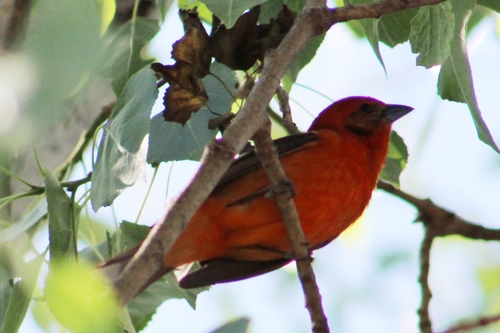 Flame-coloured Tanager
In short
The most reliable field mark between Western Tanager and Flame-colored Tanager is the overall coloration and pattern of the head and back: Western Tanager males show a yellow body with a bright red head (in breeding plumage), while Flame-colored Tanager males are more uniformly red-orange to orange, with a dusky orange back and a brownish patch below the eye. Females are trickier, but Western Tanager females are generally paler yellow with less streaking above, whereas Flame-colored Tanager females show a yellow head and underparts with a distinctly olive and black-streaked back. Immature and female birds are the most likely to be confused, especially in flight, but careful attention to back color and streaking, as well as head pattern, will usually separate them. Both are medium-sized Piranga tanagers, but subtle differences in structure and habitat can also help.
Identification tips
- Male head color (breeding): Western Tanager males have a sharply defined red head with yellow body—unique among North American Piranga. Flame-colored Tanager males are more uniformly red-orange to orange, with the color extending through the underparts and back, lacking the sharply demarcated red head.
- Back pattern (females/immatures): Female and immature Flame-colored Tanagers have a distinctly olive back with black streaks, while Western Tanager females/immatures have a plain olive-yellow back with little or no streaking. This is the best mark for non-breeding or young birds.
- Facial pattern: Flame-colored Tanager (especially males) shows a brownish patch below and behind the eye, which is absent in Western Tanager.
- Wingbars: Western Tanager (both sexes) shows two pale wingbars on blackish wings, which can be bold in males and less distinct in females. Flame-colored Tanager may show less contrasting wingbars, but this is not a primary separator.
- Underparts color: Western Tanager males are bright yellow below, while Flame-colored males are orange to red-orange below. Females of both are yellowish, but Flame-colored is more orange/yellow, Western Tanager more lemon-yellow.
- Back color (males): Western Tanager males have a yellowish or olive back, contrasting with the red head. Flame-colored Tanager males have a dusky orange back, less contrasting with the head.
- Size and structure: Both are similar in size and shape; do not rely on this in the field.
- Habitat and range: In the U.S., Western Tanager is widespread in the West; Flame-colored Tanager is a rare vagrant, mostly in Arizona and Texas, always check for back streaking and head color if out of expected range.
- Vocalizations: If you hear a vireo-like, rich, musical song, consider Flame-colored Tanager, especially in the Southwest. Western Tanager's song is less vireo-like.
- Season: Western Tanagers are present in the U.S. mainly during spring and summer. Flame-colored Tanagers are rare north of Mexico, so season and location can help.
- Foraging height: Western Tanagers are often high in the canopy of large trees; Flame-colored Tanagers may be lower, especially at forest edges, but this is not a strong separator.
- Sex differences: Female Western Tanagers are plainer and less streaked above than female Flame-colored Tanagers. Always check the back for streaking in dull birds.
- Immature confusion: Immature Western Tanagers lack strong back streaking; if you see a streaked back on a yellowish bird, lean toward Flame-colored.
- Bill color and shape: Not described as diagnostic in these sources—do not use.
- Flight views: No unique upperwing or flight pattern marks are described; rely on back and head pattern even in brief views.
Size
Both species are medium-sized songbirds in the Piranga genus and are very similar in length (Flame-colored Tanager: 18–19 cm). Flame-colored Tanager has a reported body mass of about 34.7 g [wikidata], which is typical for Piranga tanagers and likely overlaps with Western Tanager. In the field, size is not a reliable separator between these two.
Plumage
- Adult males: Western Tanager males in breeding plumage have a bright red head, yellow underparts, and a yellowish back with black wings and two bold wingbars. Flame-colored Tanager males are more uniformly red-orange to orange on the head and underparts, with a dusky orange back (sometimes olive-tinged), and lack the sharply defined red head of Western Tanager. The back of Flame-colored Tanager is less contrasting and may show a brownish patch below the eye.
- Adult females: Western Tanager females are generally dull yellow below and olive-yellow above, with faint or no streaking on the back. Flame-colored Tanager females have a yellow head and underparts but a distinctly olive back with black streaks, making the back appear more patterned than on Western Tanager females.
- Immatures and non-breeding birds: Both can appear duller, but the streaked back of Flame-colored Tanager (female/immature) is a key mark. Western Tanager immatures lack strong back streaking and are plainer.
- Wing pattern: No distinctive juvenile upperwing marks are described for either species in these sources, so focus on back and head pattern for immature birds.
Behaviour
Both species are arboreal and forage in the canopy, often in tall trees. Western Tanagers are noted for preferring large trees and moderate canopy cover, foraging high in the canopy. Flame-colored Tanagers also forage in trees but are more often found in montane forests and edges in their Central American range. Behavior is broadly similar and not a strong separator in the field.
Habitat
Western Tanager is strongly associated with mature coniferous and mixed forests in western North America, especially areas with large trees and moderate canopy cover. They avoid dense, closed-canopy forests and are more common in open or thinned stands. Flame-colored Tanager is found from Mexico to Panama, favoring montane forests, forest edges, and sometimes gardens at higher elevations. In the U.S., it is a rare vagrant, usually in similar forested or edge habitats. If seen in the U.S. outside the Southwest or at higher elevations, Western Tanager is far more likely.
Voice
Flame-colored Tanager has a song described as vireo-like: a rich, musical series of phrases ("chewee-very-vire, chewee-very-vire-very, cheery-cheweea...") and a call of "per-dick" or "chi-dick". Western Tanager's song and calls are not described here, but both have typical Piranga vocalizations. Song is not a strong field separator unless you are familiar with the vireo-like quality of Flame-colored Tanager.