

Stock Dove vs Rufous Turtle Dove
Columba oenas versus Streptopelia orientalis
Play a quiz with Stock Dove and Rufous Turtle Dove
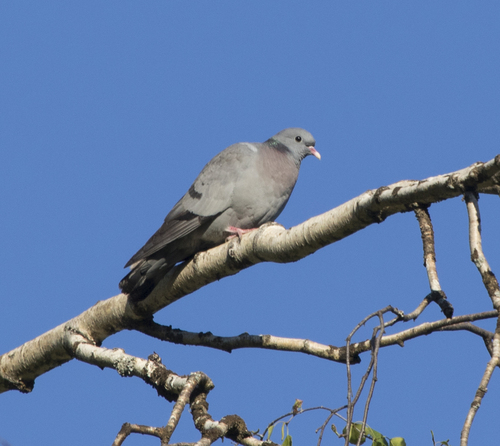 Stock Dove
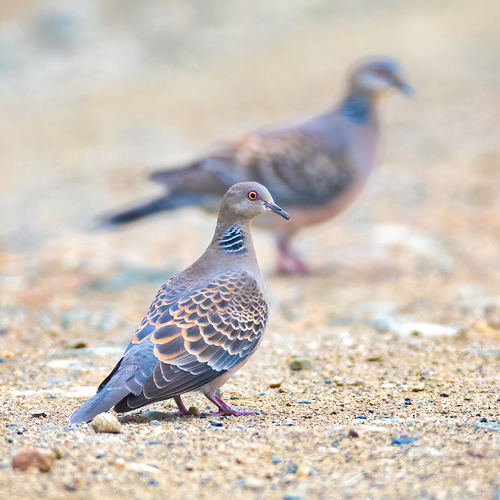 Rufous Turtle Dove
In short
The most reliable field mark to separate Stock Dove from Rufous Turtle Dove is the wing and rump pattern in flight: Stock Dove shows a plain grey rump and incomplete, short dark wingbars, while Rufous Turtle Dove has a scaly, orange-brown upperwing and a wedge-shaped tail with a contrasting terminal band. Juvenile Stock Doves lack iridescent neck patches, but still show the plain grey upperparts and dark underwing, unlike the more patterned and rufous-toned Rufous Turtle Dove. Perched, Stock Dove is blue-grey with a subtle iridescent neck patch (adults), while Rufous Turtle Dove is browner with a bold black-and-white striped neck patch. The Stock Dove’s dark eyes and plain face contrast with the more patterned face and bare skin around the eyes (in Turtle Dove, not Oriental), but the Oriental lacks this bare skin. In flight, Stock Dove has a quick, flicking action and dark underwings, while Rufous Turtle Dove flies more directly and shows a wedge-shaped tail.
Identification tips
- Upperwing and rump in flight (all ages): Stock Dove shows a plain grey rump and incomplete, short dark wingbars; Rufous Turtle Dove has a scaly, orange-brown upperwing and a wedge-shaped tail with a contrasting terminal band. This is the most reliable field mark in flight.
- Underwing color: Stock Dove has a dark grey underwing, while Rufous Turtle Dove’s underwing is less distinctly described but is not as dark and uniform as Stock Dove’s.
- Tail shape and pattern: Stock Dove has a broad dark grey bar at the tip of the tail but the tail is not wedge-shaped; Rufous Turtle Dove has a wedge-shaped tail with a contrasting terminal band (white or grey, depending on subspecies). Look for the wedge and band in flight or when fanned during display.
- Neck patch: Adult Stock Dove has a subtle, iridescent green/purple patch on the side of the neck (absent in juveniles), while Rufous Turtle Dove has a bold black-and-white striped patch made of silver-tipped feathers. This mark is prominent in all but the youngest Rufous Turtle Doves.
- Wingbars: Stock Dove’s two short, incomplete dark wingbars are on the tertials and greater coverts, not extending across the wing. Rufous Turtle Dove’s upperwing is scaly with dark-centered coverts, not true wingbars.
- Breast color: Stock Dove’s breast is lightly suffused pinkish-purple; Rufous Turtle Dove’s breast is less pink and more brownish.
- Face and eye color: Stock Dove has a plain face with dark eyes; Rufous Turtle Dove lacks the bare skin around the eye seen in European Turtle Dove, but may show a more patterned face due to the neck patch.
- Bill color: Stock Dove’s bill is pink with a yellow tip; bill color is not specified for Rufous Turtle Dove but is not a primary field mark.
- Flight style: Stock Dove’s flight is quick and flicking, with sharp wing flicks; Rufous Turtle Dove’s flight is more relaxed and direct.
- Display behavior: Stock Dove displays by walking on a branch with a swollen neck and fanned tail; Rufous Turtle Dove displays by flapping noisily and gliding down with an outspread tail.
- Size and structure: Stock Dove is slightly smaller and more compact than Rufous Turtle Dove, but size overlap means this is only useful in direct comparison.
- Habitat context: Stock Dove is more likely in European open woodland and farmland with tree holes; Rufous Turtle Dove is more likely in Asian woodlands and open country with trees.
- Vocalization: Stock Dove’s deep, grunting 'Ooo-uu-ooh' call is distinctive; Rufous Turtle Dove’s voice is not described here but is unlikely to match the Stock Dove’s call.
- Juvenile marks: Juvenile Stock Dove lacks the iridescent neck patch but otherwise resembles adults; Rufous Turtle Dove juveniles already show the scaly upperwing and wedge-shaped tail.
- Pitfalls: Beware confusion with domestic or feral pigeons (Rock Dove), which have a white rump and brighter eyes, unlike Stock Dove’s grey rump and dark eyes. Rufous Turtle Dove is browner and more patterned than Stock Dove, especially on the wing and tail.
Size
Stock Dove is 28–34 cm long with a wingspan of 60–66 cm and weighs 286–365 g [wikipedia, avonet]. Rufous Turtle Dove is a little larger than European Turtle Dove and about the same size as Eurasian Collared Dove, so slightly larger than Stock Dove, but there is some overlap. Both are medium-sized pigeons, but Stock Dove is more compact and slightly smaller overall. Size alone is not always reliable due to overlap and posture.
Plumage
-
Juvenile/immature birds: Juvenile Stock Doves lack the iridescent neck patch but otherwise resemble adults, with plain blue-grey upperparts, incomplete short dark wingbars, and a grey rump. In flight, their wings show a dark trailing edge and the underwing is dark grey. Rufous Turtle Dove (all ages) shows a scaly, orange-brown upperwing with dark-centered coverts, a wedge-shaped tail with a contrasting terminal band (white or grey depending on subspecies), and a more patterned appearance overall. The neck patch is black-and-white striped and prominent in all but the youngest juveniles.
-
Adults: Stock Dove adults are blue-grey with a subtle pinkish-purple suffusion on the breast, a green/purple iridescent neck patch, and two short, incomplete dark wingbars. The rump is plain grey, and the underwing is dark. Rufous Turtle Dove adults are browner, with a bold black-and-white striped neck patch, a scaly orange-brown upperwing, and a wedge-shaped tail with a contrasting terminal band. The breast is less pink than Turtle Dove, and the face lacks bare skin around the eye (unlike European Turtle Dove, but similar to Stock Dove).
-
In flight: Stock Dove shows a plain grey rump, dark trailing edge to the wing, and dark underwing. Rufous Turtle Dove shows a wedge-shaped tail with a terminal band and a scaly upperwing. The tail band color varies by subspecies but is always contrasting.
Behaviour
Stock Dove has a quick, regular flight with sharp flicks of the wings, and often perches in trees or on branches, especially during display. Its nuptial display involves walking on a branch with a swollen neck, lowered wings, and fanned tail. Rufous Turtle Dove’s flight is more relaxed and direct, and its display involves noisy wing flaps and gliding down with an outspread tail. Both species perch well, but Stock Dove is more likely to be seen entering tree holes or perching on horizontal branches.
Habitat
Stock Dove is widely distributed in the western Palearctic, favoring open woodlands, farmland with scattered trees, and parkland, often nesting in hollow trees. Rufous Turtle Dove ranges across Central and East Asia, breeding in woodlands and open country with trees, and wintering in a variety of wooded habitats. Both may occur in similar open woodland habitats, but Stock Dove is more closely tied to tree holes and European landscapes, while Rufous Turtle Dove is more Asian in distribution.
Voice
Stock Dove gives a short, deep, grunting 'Ooo-uu-ooh' call, quite distinct from the modulated cooing of Wood Pigeon. Rufous Turtle Dove’s voice is not described in detail in the provided notes, but is not likely to be confused with the Stock Dove’s deep, grunting call.