

Siberian House Martin vs Nepal House Martin
Delichon lagopodum versus Delichon nipalense
Play a quiz with Siberian House Martin and Nepal House Martin
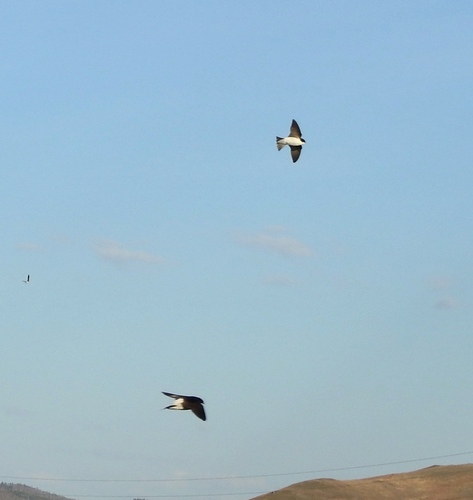 Siberian House Martin
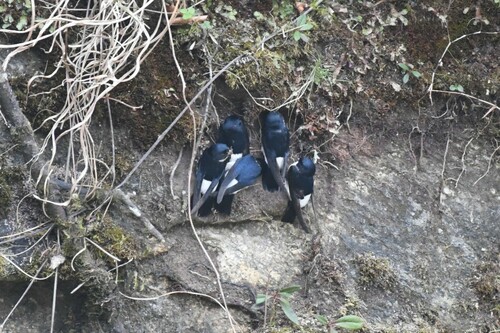 Nepal House Martin
In short
The best field mark to separate Nepal House Martin from Siberian House Martin is the combination of a black chin and throat (especially in the eastern subspecies) and a much squarer tail in Nepal House Martin, compared to the cleaner white throat and more forked tail of Siberian House Martin. Juvenile Nepal House Martins are duskier below and less glossy above, but the throat and undertail coverts remain diagnostic. Both species are superficially similar in size and overall coloration, but careful attention to throat color, tail shape, and undertail coverts is key. Habitat can also help: Nepal House Martin is a non-migratory Himalayan breeder, while Siberian House Martin is a long-distance migrant from northeastern Asia.
Identification tips
- Chin and throat color: Nepal House Martin (especially the eastern D. n. cuttingi) shows a black chin and often a black throat or upper breast, while Siberian House Martin has a clean white throat. This is the most reliable mark at all ages.
- Undertail coverts: Nepal House Martin has black undertail coverts, contrasting with the white undertail of Siberian House Martin. This is visible in flight and when perched.
- Tail shape: Nepal House Martin has a much squarer tail compared to the more forked tail of Siberian House Martin. Look for this in flight or when tail is spread.
- Rump color: Both species have a pure white rump, so this is not useful for separation.
- Juvenile plumage: Juvenile Nepal House Martins are less glossy above, duskier on the throat, and have buff-washed underparts, but still retain the black chin and undertail coverts. Siberian House Martin juveniles are not described, but are expected to lack the black chin.
- Upperwing and underwing color: Nepal House Martin has brownish-black upperwings and grey-brown underwings, but these are not distinctive from Siberian House Martin in the field.
- Legs and feet: Nepal House Martin has brownish-pink legs and feet covered with white feathers, but this is rarely visible in the field and not a reliable separator.
- Sex and age: Both species are sexually monomorphic; age differences are subtle except for the glossiness and throat color in Nepal House Martin juveniles.
- Habitat and range: Nepal House Martin is a non-migratory Himalayan specialist, breeding and residing in high-altitude river valleys and cliffs. Siberian House Martin breeds much further north and is only present in the Himalayas as a rare migrant, if at all.
- Nesting sites: Nepal House Martin nests almost exclusively under overhangs on vertical cliffs, rarely using buildings, while Siberian House Martin may nest on buildings in its breeding range.
- Flight style: Nepal House Martin is described as exceptionally fast-flying, but both species are agile aerial foragers and this is not a strong separator.
- Vocalization: Nepal House Martin is generally quiet, with a short chi-i call and brief song. No distinctive vocal differences are noted for Siberian House Martin.
- Seasonal context: If seen in the Himalayas outside the migration season, it is almost certainly Nepal House Martin. Siberian House Martin is absent from the Himalayas except as a possible migrant.
- Pitfalls: Do not rely on overall blue-black and white coloration or white rump, as both species share these features. Focus on chin/throat and undertail coverts for reliable separation.
- Subspecies variation: In Nepal House Martin, the extent of black on the throat varies geographically, but even the western birds have at least a black chin, which Siberian House Martin lacks.
Size
Both species are close in size, with Nepal House Martin (nominate) at 13 cm in length and wing lengths ranging from 90–106 mm depending on subspecies. Siberian House Martin is not given a precise measurement here, but is similar as a Delichon martin. No reliable size difference is noted in the sources; structure and plumage are more helpful for separation.
Plumage
- Juvenile/immature birds: Nepal House Martin juveniles are less glossy above, have a duskier (not clean white) throat, and buff-washed underparts. However, even in juveniles, the blackish chin and undertail coverts are present and diagnostic. Siberian House Martin juveniles are not described in detail here, but are expected to resemble adults with a clean white throat and undertail.
- Adults: Nepal House Martin shows a blue-black upperparts, pure white rump, brownish-black tail and upperwings, grey-brown underwings, and a black chin (which can extend to the upper breast in the eastern subspecies D. n. cuttingi). The undertail coverts are black, and the tail is notably square. Siberian House Martin is similar above and below, but lacks the black chin and undertail coverts, and has a more forked tail. Both sexes look alike in both species.
Behaviour
Nepal House Martin is described as an exceptionally fast-flying martin, often quiet except for a short chi-i call and a brief three-note breeding song. Both species are colonial nesters, but Nepal House Martin is more strictly associated with cliff faces and rugged mountain ridges, rarely using buildings. Siberian House Martin's behavior is not detailed here, but as a Delichon martin, it is expected to forage in flocks and nest colonially, sometimes on buildings.
Habitat
Nepal House Martin is a non-migratory resident of the Himalayas, breeding from NW India through Nepal to northern Vietnam and just into China, at elevations of 1,000–4,000 m, nesting under overhangs on vertical cliffs in rugged, wooded mountain valleys. Siberian House Martin breeds in rocky areas of northeastern Russia, Mongolia, and northern China, and winters much further south in Southeast Asia (Myanmar, Laos, Vietnam, Cambodia). Thus, Nepal House Martin is found year-round in the Himalayas, while Siberian House Martin is a long-distance migrant, absent from the Himalayas except possibly as a rare migrant.
Voice
Nepal House Martin is generally quiet, with an occasional short chi-i call in flight, and a brief three-note breeding song. No vocal details are provided for Siberian House Martin, and vocalization is not a reliable separator in the field based on available information.
Siberian House Martin · Nepal House Martin · My Tricky Birds