

Lesser Redpoll vs Citril Finch
Acanthis cabaret versus Carduelis citrinella
Play a quiz with Lesser Redpoll and Citril Finch
 Lesser Redpoll
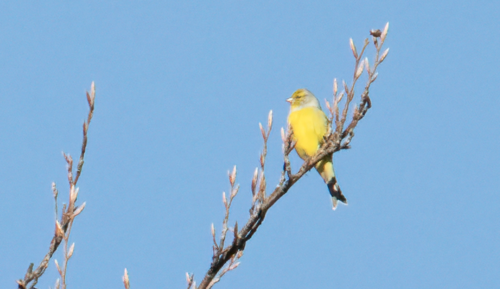 Citril Finch
In short
The most reliable field mark to separate Lesser Redpoll from Citril Finch is the presence of a bright red forehead patch and black bib on the redpoll, features entirely absent in Citril Finch. Juvenile Citril Finches are brown and lack any yellow or green, while even young Lesser Redpolls show some streaking and the beginnings of the red forehead. In flight or perched, Lesser Redpolls appear more streaked and brownish-grey, while Citril Finches are cleaner grey above with a yellow face mask and yellow underparts. Both are small finches, but their coloration and face patterns are distinct when seen well.
Identification tips
- Red Forehead Patch (Lesser Redpoll): Look for a bright red patch on the forehead, present in all but the youngest juveniles. Citril Finch never shows red on the head.
- Black Bib (Lesser Redpoll): A distinctive black patch under the bill is always present on Lesser Redpoll, lacking in Citril Finch.
- Yellow Face Mask (Citril Finch): Adult Citril Finches have a clear yellow face mask, extending to the throat and underparts. Lesser Redpolls never show a yellow face.
- Breast Color: Male Lesser Redpolls often show a pinkish-red suffusion on the breast, while Citril Finches have yellow underparts in both sexes (though duller in young females). Juvenile Citril Finches are brown below, lacking yellow or green.
- Upperpart Streaking: Lesser Redpolls are heavily streaked above and below, giving a messy, streaky look. Citril Finches are greyer above with only a brown tinge and less obvious streaking.
- Wing Bars: Both species have two pale wingbars, but in Citril Finch these are yellowish and match the yellow underparts, while in Lesser Redpoll they are paler and contrast with the brownish wing.
- Rump and Vent: Lesser Redpolls have a streaked rump and a broad dark streak across the vent; Citril Finch lacks these features.
- Bill Color: Lesser Redpolls have a yellowish bill with a dark tip; Citril Finch's bill is not described as yellowish and blends with the face mask.
- Juvenile Plumage: Juvenile Citril Finches are brown and lack yellow or green, while juvenile Lesser Redpolls are streaky and may show the start of the red forehead and always have the black bib.
- Habitat Context: If you are in high mountain meadows or open coniferous forests in southwestern Europe, expect Citril Finch. In boreal forests, especially with birch or alder, or in New Zealand, expect Lesser Redpoll.
- Flight Jizz: Both are small and agile, but Lesser Redpolls often appear more compact and streaky in flight, while Citril Finches show a cleaner, greyer look with yellow underparts flashing.
- Sex Differences: Both species are similar between sexes, but male Lesser Redpolls can show more red on the breast, while female Citril Finches may be slightly duller below.
- Vocalizations: Citril Finch's song is a silvery twitter, while Lesser Redpoll gives metallic chatters and dry trills. Use with caution unless familiar with both.
- Seasonal Pitfalls: In winter, both species can appear duller, but the key facial and underpart colors persist. Juvenile Citril Finches are most likely to be confused with other brown finches, but not with redpolls if the black bib or red forehead is seen.
- Geographic Range: Always consider location: Citril Finch is a mountain specialist in southwestern Europe, while Lesser Redpoll is widespread in northern forests and introduced to New Zealand.
Size
Both species are very similar in size: Lesser Redpolls measure 11.5–14 cm in length and weigh 12–16 g, while Citril Finches are about 12 cm and 12.5 g. In the hand or at a feeder, size is not a reliable separator. Both are small, delicate finches with similar proportions.
Plumage
- Juvenile/immature birds: Juvenile Citril Finches are brown overall and lack any yellow or green in the plumage, making them look plain compared to adults. Juvenile Lesser Redpolls, while also streaky and brownish, often show the start of a red forehead and always have a streaked rump and two pale wing bars. The black bib is usually present even in young redpolls.
- Adults: Lesser Redpolls are brownish-grey with heavy dark streaking, a bright red forehead, black bib, and two pale wingbars. Males often have a pinkish-red suffusion on the breast. The rump is streaked, and the vent has a broad dark brown streak. Citril Finches are greyish above with a brown-tinged, streaked back, but their underparts and face mask are yellow, and they have two yellowish wing bars. The sexes are similar, though young females may be duller below.
- In flight: Lesser Redpolls show strong streaking and a small, compact appearance. Citril Finches in flight show a cleaner, greyer upperpart with yellow on the underparts and face, lacking the redpoll's red or black facial marks.
Behaviour
Both species forage mainly in trees but will come to the ground for seeds. Lesser Redpolls are often seen in flocks, especially in winter, feeding acrobatically on birch and alder catkins. Citril Finches are also social and may be seen in groups, especially outside the breeding season, but are more often found in mountain meadows and open coniferous woodland. Neither species has a particularly distinctive flight style compared to other small finches.
Habitat
Lesser Redpolls are found in boreal forests, especially among birch, alder, and other northern trees, and are widespread in northern Europe and Asia, as well as introduced populations in New Zealand. Citril Finches are restricted to mountain regions of southwestern Europe, from Spain to the Alps, and are most often found in open coniferous forests and alpine meadows. If you are in the Alps or Pyrenees, Citril Finch is far more likely; in northern forests or New Zealand, only Lesser Redpoll occurs.
Voice
Citril Finch has a silvery, twittering song reminiscent of European Goldfinch or Serin, and a main call described as a 'tee-ee', similar to Eurasian Siskin. Lesser Redpolls have a more metallic, chattering call and a simple, dry trill. The vocalizations are different, but confusion is possible with other finches; neither is likely to be confused with the other on voice alone unless you are familiar with both.