

White-throated Mountain-gem vs Volcano Hummingbird
Lampornis castaneoventris versus Selasphorus flammula
Play a quiz with White-throated Mountain-gem and Volcano Hummingbird
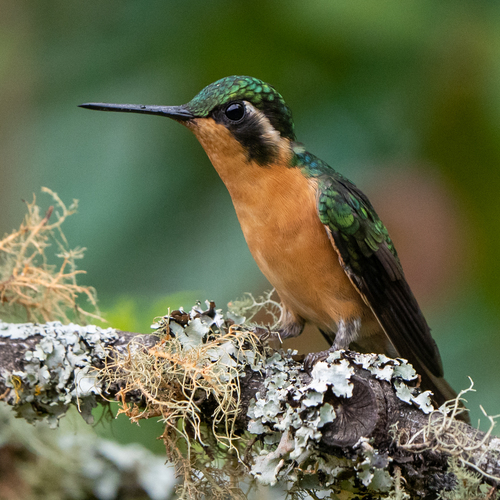 White-throated Mountain-gem
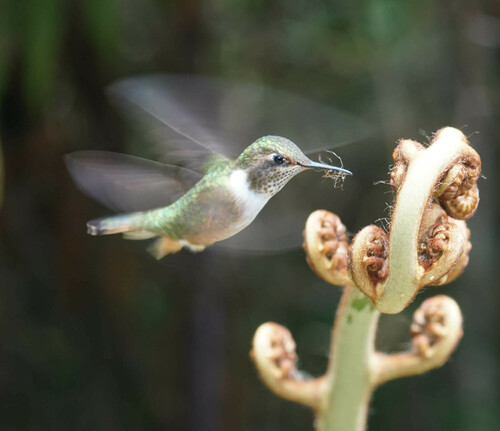 Volcano Hummingbird
In short
The most reliable field mark to separate White-throated Mountain-gem from Volcano Hummingbird is size: the Mountain-gem is noticeably larger and bulkier, with a longer, thicker bill and a more robust jizz both perched and in flight. For plumage, adult male Mountain-gems have a striking white throat and green crown, while Volcano Hummingbird males show a small, colorful gorget (mauve-purple or rose-red depending on subspecies) and mostly white underparts. Females and immatures can be trickier, but the Mountain-gem female is much larger and has a dark rufous belly, unlike the Volcano Hummingbird's mostly white underparts with buffy sides. Tail pattern is also key: Volcano Hummingbird (both sexes) shows rufous and black in the tail, while Mountain-gem females have more uniform green or bronze tails. In the field, context helps—Volcano Hummingbird is tiny, quick, and often feeds low, while Mountain-gem is dominant at flowers and appears much more substantial.
Identification tips
- Size is the first check: White-throated Mountain-gem is nearly twice the mass and much longer than Volcano Hummingbird. If the bird looks tiny and delicate, it's almost certainly Volcano Hummingbird.
- Bill shape and length: Mountain-gem has a noticeably longer, thicker, and straighter black bill; Volcano Hummingbird's bill is short, fine, and straight.
- Tail pattern (all ages, both sexes): Volcano Hummingbird always shows rufous and black in the tail (rufous bases, black band, buffy/white tips), visible in flight or when fanned. Mountain-gem females have more uniform green or bronze tails, and males have a blackish tail with no rufous.
- Adult male throat color: Mountain-gem males have a bold white throat and chin, contrasting with green sides of neck and upper breast. Volcano Hummingbird males have a small, iridescent gorget (mauve-purple or rose-red) and otherwise white underparts.
- Female/immature underparts: Mountain-gem females have a dark rufous throat and belly, while Volcano Hummingbird females and immatures are mostly white below with buffy or cinnamon-washed sides and a whitish throat with bronze speckles.
- Crown color: Only Mountain-gem males show an emerald green crown; Volcano Hummingbird lacks this feature.
- Cheek and face pattern: Both have a white spot or stripe behind the eye, but Mountain-gem's is part of a more contrasting dark-cheeked face, while Volcano Hummingbird's is subtler.
- Upperpart color: Both are green above, but Mountain-gem is darker and more bronzy, especially in males; Volcano Hummingbird is bronze-green but paler and less robust.
- Behavior at flowers: Mountain-gem is aggressive and dominant, often chasing other hummingbirds; Volcano Hummingbird is shy, quick, and rarely holds territory for long.
- Flight style: Volcano Hummingbird is rapid, agile, and often hovers low among shrubs; Mountain-gem is steadier and more direct, with a heavier jizz.
- Habitat context: In dense oak forest or at forest edge, expect Mountain-gem; in open shrubby or high-altitude paramo, Volcano Hummingbird is more likely.
- Vocalizations: Listen for high, sharp 'ziit' or 'ziip' from Mountain-gem versus soft chips, thin whistles, and mechanical tail sounds from Volcano Hummingbird.
- Juvenile/immature confusion: Young Volcano Hummingbirds have buffy fringes on upperparts but still show the distinctive tail pattern; Mountain-gem juveniles are not described in detail but should be much larger and lack rufous/black tail.
- Perched posture: Mountain-gem appears heavyset and upright; Volcano Hummingbird is dainty and often perches low in shrubs.
- Pitfall—female confusion: If you see a small hummingbird with a white throat and rufous/black tail, it's Volcano Hummingbird, not a Mountain-gem female, regardless of green upperparts.
Size
White-throated Mountain-gem is significantly larger, at about 12 cm in length and 5–6 g in weight, with a medium-length, straight black bill. Volcano Hummingbird is much smaller, only 7.5–8 cm long and weighing 2.5–2.8 g. The Mountain-gem looks robust and heavyset for a hummingbird, while the Volcano Hummingbird is tiny, delicate, and short-billed. This size difference is obvious even at a distance, especially when both species are present at the same feeding site.
Plumage
No distinctive juvenile or immature upperwing pattern is described for either species, so separation relies on body and tail plumage. Adult male Mountain-gems have a bold white throat, emerald green crown, and dark bronzy green upperparts, with a blackish tail. Females are entirely bright green above with a dark rufous throat and belly, and greenish to bronze tails. Volcano Hummingbird males (nominate) have bronze-green upperparts, a small mauve-purple gorget, mostly white underparts with buffy or cinnamon-washed sides, and rufous-edged black outer tail feathers. Females are similar above but have a whitish throat with dusky bronze speckles, mostly white underparts, and a tail with green central feathers and rufous bases, black bands, and buffy to white tips. Juveniles resemble adult females but have buffy fringes on the upperparts. The Volcano Hummingbird always shows some rufous and black in the tail, which is lacking in Mountain-gem. Subspecies variation in Volcano Hummingbird affects gorget color and underpart tone but not the key contrast with Mountain-gem.
Behaviour
White-throated Mountain-gem is dominant at flower patches, especially males, and is aggressive toward smaller hummingbirds like Volcano Hummingbird. It often feeds at epiphytes in the forest interior or at forest edge. Volcano Hummingbird is much less dominant, foraging mostly at small flowers on shrubs, vines, and herbs, and is quick and agile, often hovering low or darting between perches. Both species glean small arthropods, but the Mountain-gem is more likely to be seen defending a territory, while Volcano Hummingbird is more furtive and less confrontational.
Habitat
Both species occur in highland Costa Rica and western Panama, but Mountain-gem is more closely tied to the interior, edges, and shrubby clearings of oak forest, as well as gardens near forest. Volcano Hummingbird is also a highland species but is more frequently found in open shrubby areas, paramo, and at higher elevations, often above the treeline. Overlap occurs, but Mountain-gem is more likely in denser forest or forest edge, while Volcano Hummingbird prefers open, brushy, or high-altitude habitats.
Voice
White-throated Mountain-gem gives high-pitched 'ziit' or 'ziip' calls and a sputtery, bubbly song. Volcano Hummingbird produces soft chip notes while foraging, a thin whistled 'teeeeeuu', and a twittering 'scolding' call during male disputes. In display, Volcano Hummingbird males make mechanical tail sounds. The Mountain-gem's calls are sharper and higher, while Volcano Hummingbird's are softer and include distinctive mechanical sounds during display.
White-throated Mountain-gem · Volcano Hummingbird · My Tricky Birds