

Seychelles Bulbul vs Malagasy White-eye
Hypsipetes crassirostris versus Zosterops maderaspatanus
Play a quiz with Seychelles Bulbul and Malagasy White-eye
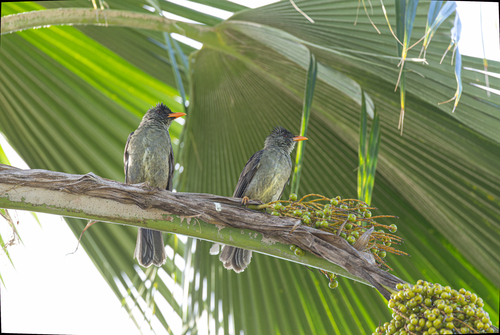 Seychelles Bulbul
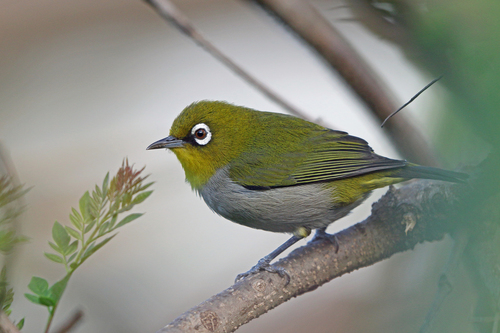 Malagasy White-eye
In short
The most reliable way to separate Seychelles Bulbul from Malagasy White-eye is by overall structure and bill shape: the bulbul is much larger, with a thick, heavy bill, while the white-eye is tiny and delicate with a fine, pointed bill. In all plumages, the Malagasy White-eye shows a distinctive incomplete white eye-ring and yellow throat, which the bulbul lacks. Both may be found on the Seychelles, but their size, jizz, and head pattern are unmistakably different at any age or season. Even at a distance, the bulbul’s bulk and strong bill contrast sharply with the white-eye’s dainty build.
Identification tips
- Size and structure: Seychelles Bulbul is much larger and bulkier than Malagasy White-eye. If you see a bird that looks small, delicate, and quick, it is almost certainly the white-eye.
- Bill shape: The bulbul has a thick, heavy, and strong bill, while the white-eye’s bill is fine, pointed, and much shorter relative to head size. Bill shape is visible even at moderate range.
- Eye-ring: Malagasy White-eye has a distinctive incomplete white eye-ring (broken at the front), which is never present in the bulbul. This is a key field mark at all ages and seasons.
- Head pattern: The bulbul’s head is uniformly dark with no pale or white markings, while the white-eye’s face is set off by the white eye-ring and yellow throat.
- Throat color: The white-eye shows a bright yellow throat, contrasting with its pale grey underparts. The bulbul lacks any yellow on the throat or underparts.
- Underparts: Malagasy White-eye has pale grey underparts, while the bulbul is more uniformly dark below.
- Upperparts: The white-eye’s back, wings, and tail are dark olive-green; the bulbul is generally darker and lacks the olive tone.
- Leg color: The white-eye has greyish-blue legs and feet. While not always visible, this can help at close range.
- Bill color: The white-eye’s bill is bicolored (black upper, grey lower), while the bulbul’s is uniformly dark and much thicker.
- Behavior: White-eyes are typically active, moving quickly through foliage, often in small groups. Bulbuls are more robust and may be seen singly or in pairs, moving more deliberately.
- Perched posture: Bulbuls perch upright and appear robust; white-eyes are more horizontal and dainty.
- Flight: No distinctive wing or flight pattern marks are described for either species, so rely on size and structure in flight.
- Habitat: Both can be found in similar habitats on the Seychelles, so do not rely on habitat alone for separation.
- Voice: Not described in the sources; do not use for separation here.
- Pitfalls: Do not be misled by overall darkness; focus on the presence or absence of the white eye-ring and yellow throat, and always check bill shape and size for confirmation.
Size
Seychelles Bulbul is substantially larger and heavier than Malagasy White-eye. The white-eye has a body mass of about 11.2 g [wikidata], and is described as growing to about 10 cm (4 in) in length [wikipedia]. The bulbul, while not given a specific mass here, is a typical member of its family and is much bulkier and longer than any white-eye. In the field, this size difference is immediately apparent when the two are seen in the same area: the bulbul is robust, broad-bodied, and thick-billed, while the white-eye is petite and slender.
Plumage
- Juvenile/immature plumages: No age-specific upperwing or flight marks are described for either species in the sources, so separation relies on overall coloration and head pattern at all ages.
- Adult (and presumed immature) Seychelles Bulbul: Lacks any white eye-ring; the head is dark, and the bill is thick and heavy. The overall coloration is dark and uniform, with no yellow throat or pale belly.
- Adult Malagasy White-eye: Shows a dark olive-green back, wings, and tail, a yellow throat, pale grey underparts, and a distinctive incomplete white eye-ring (broken at the front). The bill is fine and pointed, with a black upper mandible and grey lower mandible. The legs are greyish-blue. These features are present in all observed ages and seasons.
- Key contrast: The white-eye’s incomplete white eye-ring and yellow throat are unique and never shown by the bulbul, while the bulbul’s thick bill and lack of any eye-ring or yellow throat are diagnostic.
Behaviour
No direct behavioral differences are described in the sources. However, based on structure and family, the Seychelles Bulbul is likely to move more deliberately and may be seen perching upright or foraging in a more robust, assertive manner. The Malagasy White-eye, being much smaller and lighter, is typically more active, flitting rapidly among foliage, often in small groups. These differences in movement and posture can help reinforce identification, especially when both species are present.
Habitat
Both species can be found in the Seychelles, but the Malagasy White-eye is also present in Madagascar and occupies a broader range of habitats, including dry forests, moist lowland and montane forests, and mangroves [wikipedia]. The Seychelles Bulbul is endemic to the Seychelles and breeds on several main islands. In overlapping areas, habitat alone is not diagnostic, but the white-eye may be encountered in a wider variety of forest types, while the bulbul is more tied to the islands’ core habitats.