

Scarlet-breasted Flowerpecker vs Thick-billed Flowerpecker
Prionochilus thoracicus versus Pachyglossa agilis
Play a quiz with Scarlet-breasted Flowerpecker and Thick-billed Flowerpecker
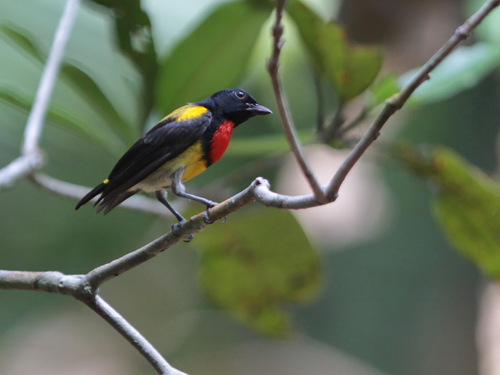 Scarlet-breasted Flowerpecker
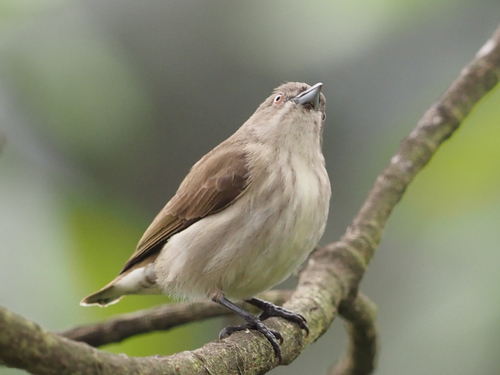 Thick-billed Flowerpecker
In short
The most reliable way to separate Scarlet-breasted Flowerpecker from Thick-billed Flowerpecker is by the presence of a bold scarlet patch on the breast in adult Scarlet-breasted, which is completely absent in Thick-billed. Juvenile and non-breeding birds can be trickier, but Thick-billed always shows a heavier, dark bill and a short tail with distinctive whitish spots at the tail tips, while Scarlet-breasted is more compact and lacks these tail spots. In flight or at a distance, look for the overall dark, streaky, and rather plain underparts of Thick-billed versus the cleaner, more contrasting look of Scarlet-breasted. Habitat can help: Scarlet-breasted is a lowland forest specialist, while Thick-billed is more widespread and often found in open or cultivated areas as well as forest canopy.
Identification tips
- Scarlet breast patch: Adult Scarlet-breasted Flowerpecker males have a bright scarlet patch on the breast; Thick-billed never shows this at any age or sex.
- Tail spots: Thick-billed Flowerpecker always shows whitish spots at the tips of the tail feathers, visible in flight or when the tail is fanned. Scarlet-breasted lacks these tail spots completely.
- Bill structure: Thick-billed has a noticeably thick, heavy, and dark bill, giving it a chunky-headed look. Scarlet-breasted's bill is finer and less prominent.
- Underpart pattern: Thick-billed is dull greyish below with diffuse streaking, giving a smudgy, streaked look to the underparts. Scarlet-breasted is cleaner below, with a strong color contrast (especially in males).
- Juvenile marks: Juvenile Thick-billed has a paler base to the mandible and less streaking below than adults, but still shows tail spots and a heavy bill. Scarlet-breasted juveniles are not described, but should lack tail spots and streaking.
- Tail length and shape: Thick-billed has a short, stubby tail, often flicked side to side. Scarlet-breasted's tail is proportionately longer and less stubby.
- Rump color: Thick-billed may show a slightly olive rump in some subspecies, but this is subtle and not always visible.
- Sex differences: Both species are sexually monomorphic in the field except for the male Scarlet-breasted's scarlet patch. Female Scarlet-breasted and all Thick-billed lack bright colors.
- Foraging behavior: Thick-billed is more likely to be seen high in the canopy, actively flicking its tail and calling. Scarlet-breasted may be lower or in denser vegetation.
- Habitat context: Scarlet-breasted is a specialist of lowland forest and swamps in Southeast Asia; Thick-billed is widespread and can be found in open, cultivated, or edge habitats as well as forest.
- Geographic range: If outside Brunei, Indonesia, Malaysia, or Thailand, Scarlet-breasted is unlikely; Thick-billed is the default in India, Sri Lanka, and much of Southeast Asia.
- Vocalizations: If you hear a frequent 'spick' call or a rambling song with Ashy Prinia-like notes, it's Thick-billed. Scarlet-breasted's voice is not described.
- Crown display: Thick-billed males may erect crown feathers in display, showing a white crown stripe—rarely seen, but diagnostic if observed.
- Nest association: Thick-billed sometimes nests among Oecophylla smaragdina ant nests, but this is not a field mark for individual ID.
- Pitfalls: Immature or female Scarlet-breasted lacking a scarlet patch can be confused with Thick-billed, but check for tail spots (only in Thick-billed) and bill thickness.
Size
Thick-billed Flowerpecker is slightly larger (about 10 cm in length) and appears bulkier, with a notably thick, heavy bill and a short, stubby tail. Scarlet-breasted Flowerpecker is compact and small, but precise measurements are not provided in the notes. Both are tiny birds, but the Thick-billed's proportions—especially its bill and tail—make it look more robust and less delicate than Scarlet-breasted.
Plumage
- Juveniles/immatures: Thick-billed juvenile has a paler base to the mandible and less streaking below than adults, but still lacks any scarlet on the breast. Whitish spots at the tips of the tail feathers are visible in all ages of Thick-billed, a key point in flight or when tail is fanned. Scarlet-breasted juveniles are not described in detail, but the absence of tail spots and any streaking below is expected.
- Adults: Scarlet-breasted Flowerpecker males have a bold scarlet breast patch, which is never present in Thick-billed. Thick-billed adults are dark grey-brown above, dull greyish below with diffuse streaking, and have a slightly olive rump in some subspecies. Both sexes of Thick-billed look alike, and the underparts are always streaked and never show a bright patch. Scarlet-breasted is cleaner below with a strong color contrast.
- Tail: Thick-billed always shows whitish tail tips; Scarlet-breasted does not.
Behaviour
Thick-billed Flowerpecker is very active, often seen high in the canopy, flicking its tail from side to side and frequently calling. It forages mainly on berries and nectar, sometimes wiping seeds on branches. Scarlet-breasted Flowerpecker's behavior is less detailed in the notes, but as a typical flowerpecker, it is likely to be active and agile as well. However, Thick-billed's constant tail movement and higher foraging height (especially in Sri Lanka) are more pronounced. Both can be seen in the forest canopy, but Thick-billed is more likely to be found in open or cultivated areas as well.
Habitat
Scarlet-breasted Flowerpecker is restricted to subtropical or tropical moist lowland forests and swamps in Brunei, Indonesia, Malaysia, and Thailand. Thick-billed Flowerpecker is much more widespread across southern Asia, including India, Indonesia, and Timor, and is found in a wider variety of habitats: dense lowland forests, open forests, and even cultivated areas. If you are in a swampy or dense lowland forest in Southeast Asia, Scarlet-breasted is more likely; in open, cultivated, or edge habitats, especially outside the core range of Scarlet-breasted, Thick-billed is the default.
Voice
Thick-billed Flowerpecker gives a frequent 'spick' call and, when displaying, produces a rambling song with notes reminiscent of Ashy Prinia. Scarlet-breasted's vocalizations are not described in the notes, so voice is only diagnostic if you hear the typical Thick-billed calls or song.
Scarlet-breasted Flowerpecker · Thick-billed Flowerpecker · My Tricky Birds