

Motmot

Ruby-throated Hummingbird vs Bumblebee Hummingbird

Archilochus colubris versus Selasphorus heloisa

Play a quiz with Ruby-throated Hummingbird and Bumblebee Hummingbird
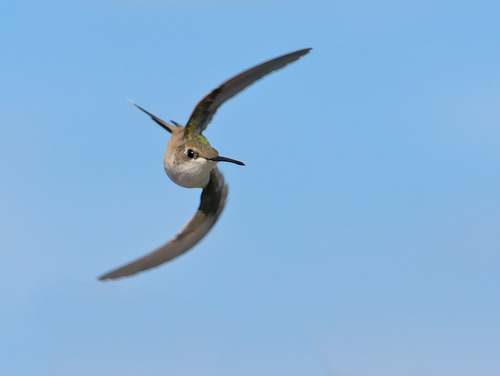
Ruby-throated Hummingbird (Archilochus colubris) Ruby-throated Hummingbird
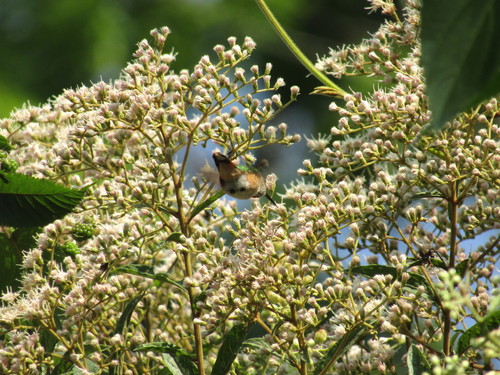
Bumblebee Hummingbird (Selasphorus heloisa) Bumblebee Hummingbird

Media

Loading…

In short

The most reliable separation in the field is the adult male's throat: Ruby-throated Hummingbird shows a sharply defined, highly iridescent ruby-red gorget (throat patch) that appears blackish from some angles, while Bumblebee Hummingbird males have a magenta to bluish-purple gorget with flared hind feathers. Females and immatures are trickier, but Bumblebee Hummingbird always shows a small white spot behind the eye and more extensive cinnamon or buff on the flanks, while Ruby-throated lacks the eye spot and has plainer underparts. Size is also a strong clue: Bumblebee Hummingbird is noticeably smaller and more compact, with a shorter bill and tail. In flight, tail shape and color pattern are important—Ruby-throated females and juveniles have notched tails with white tips, while Bumblebee Hummingbird shows a more complex tail pattern with cinnamon, black, and bronzy green, plus a wide white tip. Range is a major factor: Ruby-throated is common in eastern North America, while Bumblebee Hummingbird is endemic to Mexico and only a rare vagrant north of there.

Identification tips

  1. Adult male throat color: Ruby-throated shows a sharply defined, iridescent ruby-red gorget that appears blackish from some angles; Bumblebee Hummingbird has a metallic magenta to bluish-purple (or amethyst violet) gorget with flared hind feathers. Only males show these features.
  2. White spot behind the eye: Present in all Bumblebee Hummingbirds (both sexes, all ages), absent in Ruby-throated. This is a key mark for females and immatures.
  3. Flank color: Bumblebee Hummingbird shows extensive reddish cinnamon or buff on the flanks (light buff in S. h. margarethae), while Ruby-throated has plainer, whitish or grayish underparts with little or no color on the flanks.
  4. Tail pattern (female/immature): Ruby-throated females and juveniles have a notched tail with outer feathers banded in green, black, and white. Bumblebee Hummingbird has a more complex tail: central feathers bronzy green with cinnamon at the base, outer feathers with cinnamon, black, bronzy green, and a wide white (or off-white) tip. Female Bumblebee has more black and less cinnamon in the tail than the male.
  5. Tail shape: Ruby-throated female/immature tails are notched; Bumblebee Hummingbird tails are more squared or slightly rounded, with the flared white tip more prominent in S. h. margarethae.
  6. Bill structure: Bumblebee Hummingbird has a short, straight, blackish bill; Ruby-throated's bill is slightly longer and more slender, especially in females.
  7. Size and structure: Bumblebee Hummingbird is noticeably smaller and more compact, with a shorter bill and tail. Ruby-throated is larger and appears slimmer, especially when perched.
  8. Gorget shape (male): Bumblebee Hummingbird's gorget feathers flare out and back, creating a spiky or flared appearance; Ruby-throated's gorget is flat and sharply bordered.
  9. Throat markings (female/juvenile): Ruby-throated females/juveniles have a white throat, sometimes with dusky streaks or stipples; Bumblebee Hummingbird females have metallic bronze spots on the throat.
  10. Underpart color: Bumblebee Hummingbird (especially S. h. margarethae) can show pure white underparts, while Ruby-throated is more grayish or dingy below.
  11. Vocalizations: If heard, Bumblebee Hummingbird's high, thin, whining song and loud wing buzz (especially during display) are distinctive; Ruby-throated is quieter and less likely to be identified by sound.
  12. Display behavior: Bumblebee Hummingbird males hover in front of females with gorget spread and tail cocked up, sometimes moving vertically; Ruby-throated males perform dive displays and rapid horizontal arcs.
  13. Range and context: Ruby-throated is the default hummingbird in eastern North America; Bumblebee Hummingbird is endemic to Mexico and only a rare vagrant north of there. If seen in the U.S. outside Mexico, Bumblebee is extremely unlikely except in southern Arizona or Texas.
  14. Habitat: Ruby-throated favors gardens, parks, and woodlands in its range; Bumblebee Hummingbird is more often found at a variety of flowering plants, especially at low to mid-levels in Mexican habitats.
  15. Pitfalls: Immature male Ruby-throateds can show heavy throat markings, but never the metallic purple or flared gorget of Bumblebee. Female Bumblebee's throat spots are metallic, not dusky as in Ruby-throated. Always check for the white eye spot and flank color.

Size

Bumblebee Hummingbird is one of the smallest hummingbirds, measuring 5.9–7.5 cm in length and weighing 2–2.7 g. Ruby-throated Hummingbird is larger (not specified here, but typically around 7–9 cm and 2.5–4.5 g [avonet]), with males smaller than females. In direct comparison, Bumblebee Hummingbird appears noticeably tinier and more compact, with a proportionally shorter bill and tail. This size difference is often apparent even at a distance, especially when both species are seen at the same feeder or flower patch.

Plumage

Juvenile and female Ruby-throated Hummingbirds lack the adult male's red throat and instead show a white or lightly streaked throat, a notched tail with outer feathers banded in green, black, and white, and a generally plain appearance. Juvenile males may show heavier throat markings but do not have the full red gorget. Bumblebee Hummingbird of both sexes and all ages shows a small white spot behind the eye, a feature absent in Ruby-throated. Males have a metallic magenta to bluish-purple gorget (dark amethyst violet in S. h. margarethae), with flared hind feathers, and cinnamon or buff flanks. Females have metallic spots on the throat and more cinnamon or buff on the flanks and undertail coverts, with a tail that has more black and less cinnamon than the male's, and tips that are off-white or pure white depending on subspecies. The tail pattern in Bumblebee is more complex, with bronzy green, black, and reddish cinnamon, and a wide white tip, while Ruby-throated female/immature tails are notched and simply banded. Upperwing pattern is not described as diagnostic for either species.

Behaviour

Both species hover to feed and perform courtship displays, but Bumblebee Hummingbird males are noted for hovering in front of females with the gorget spread and tail cocked up, as well as making rhythmic vertical movements. Ruby-throated males perform dramatic dive displays and rapid horizontal arcs in front of perched females. Bumblebee Hummingbird is often dominated by larger hummingbirds but can sneak into their territories due to its small size. Ruby-throated is more likely to be seen as the dominant hummingbird in eastern North America. Both species can shuffle along a branch, but neither walks or hops.

Habitat

Ruby-throated Hummingbird is widespread and common in eastern North America during the breeding season, favoring deciduous or mixed woodlands, gardens, and parks, and winters in Central America, Mexico, and Florida. Bumblebee Hummingbird is endemic to Mexico, favoring a variety of flowering plants at low to middle vegetation heights, and is only a rare vagrant in the United States. Habitat overlap is extremely rare except in vagrancy situations.

Voice

Bumblebee Hummingbird's song is a high, thin, whining 'sss ssssssssis' or 'seeuuuuu,' fading at the end, and its calls are high chips similar to other Selasphorus species. The male's wings produce a loud, insect-like buzz, especially during display. Ruby-throated Hummingbird's vocalizations are not described here, but are generally less distinctive and quieter; wing sounds are not highlighted as a field mark.

Submit a better description

Use the same sections as the comparison. Your text is published immediately.

The most reliable separation in the field is the adult male's throat: Ruby-throated Hummingbird shows a sharply defined, highly iridescent ruby-red gorget (throat patch) that appears blackish from some angles, while Bumblebee Hummingbird males have a magenta to bluish-purple gorget with flared hind feathers. Females and immatures are trickier, but Bumblebee Hummingbird always shows a small white spot behind the eye and more extensive cinnamon or buff on the flanks, while Ruby-throated lacks the eye spot and has plainer underparts. Size is also a strong clue: Bumblebee Hummingbird is noticeably smaller and more compact, with a shorter bill and tail. In flight, tail shape and color pattern are important—Ruby-throated females and juveniles have notched tails with white tips, while Bumblebee Hummingbird shows a more complex tail pattern with cinnamon, black, and bronzy green, plus a wide white tip. Range is a major factor: Ruby-throated is common in eastern North America, while Bumblebee Hummingbird is endemic to Mexico and only a rare vagrant north of there.

  1. Adult male throat color: Ruby-throated shows a sharply defined, iridescent ruby-red gorget that appears blackish from some angles; Bumblebee Hummingbird has a metallic magenta to bluish-purple (or amethyst violet) gorget with flared hind feathers. Only males show these features.
  2. White spot behind the eye: Present in all Bumblebee Hummingbirds (both sexes, all ages), absent in Ruby-throated. This is a key mark for females and immatures.
  3. Flank color: Bumblebee Hummingbird shows extensive reddish cinnamon or buff on the flanks (light buff in S. h. margarethae), while Ruby-throated has plainer, whitish or grayish underparts with little or no color on the flanks.
  4. Tail pattern (female/immature): Ruby-throated females and juveniles have a notched tail with outer feathers banded in green, black, and white. Bumblebee Hummingbird has a more complex tail: central feathers bronzy green with cinnamon at the base, outer feathers with cinnamon, black, bronzy green, and a wide white (or off-white) tip. Female Bumblebee has more black and less cinnamon in the tail than the male.
  5. Tail shape: Ruby-throated female/immature tails are notched; Bumblebee Hummingbird tails are more squared or slightly rounded, with the flared white tip more prominent in S. h. margarethae.
  6. Bill structure: Bumblebee Hummingbird has a short, straight, blackish bill; Ruby-throated's bill is slightly longer and more slender, especially in females.
  7. Size and structure: Bumblebee Hummingbird is noticeably smaller and more compact, with a shorter bill and tail. Ruby-throated is larger and appears slimmer, especially when perched.
  8. Gorget shape (male): Bumblebee Hummingbird's gorget feathers flare out and back, creating a spiky or flared appearance; Ruby-throated's gorget is flat and sharply bordered.
  9. Throat markings (female/juvenile): Ruby-throated females/juveniles have a white throat, sometimes with dusky streaks or stipples; Bumblebee Hummingbird females have metallic bronze spots on the throat.
  10. Underpart color: Bumblebee Hummingbird (especially S. h. margarethae) can show pure white underparts, while Ruby-throated is more grayish or dingy below.
  11. Vocalizations: If heard, Bumblebee Hummingbird's high, thin, whining song and loud wing buzz (especially during display) are distinctive; Ruby-throated is quieter and less likely to be identified by sound.
  12. Display behavior: Bumblebee Hummingbird males hover in front of females with gorget spread and tail cocked up, sometimes moving vertically; Ruby-throated males perform dive displays and rapid horizontal arcs.
  13. Range and context: Ruby-throated is the default hummingbird in eastern North America; Bumblebee Hummingbird is endemic to Mexico and only a rare vagrant north of there. If seen in the U.S. outside Mexico, Bumblebee is extremely unlikely except in southern Arizona or Texas.
  14. Habitat: Ruby-throated favors gardens, parks, and woodlands in its range; Bumblebee Hummingbird is more often found at a variety of flowering plants, especially at low to mid-levels in Mexican habitats.
  15. Pitfalls: Immature male Ruby-throateds can show heavy throat markings, but never the metallic purple or flared gorget of Bumblebee. Female Bumblebee's throat spots are metallic, not dusky as in Ruby-throated. Always check for the white eye spot and flank color.

Bumblebee Hummingbird is one of the smallest hummingbirds, measuring 5.9–7.5 cm in length and weighing 2–2.7 g. Ruby-throated Hummingbird is larger (not specified here, but typically around 7–9 cm and 2.5–4.5 g [avonet]), with males smaller than females. In direct comparison, Bumblebee Hummingbird appears noticeably tinier and more compact, with a proportionally shorter bill and tail. This size difference is often apparent even at a distance, especially when both species are seen at the same feeder or flower patch.

Juvenile and female Ruby-throated Hummingbirds lack the adult male's red throat and instead show a white or lightly streaked throat, a notched tail with outer feathers banded in green, black, and white, and a generally plain appearance. Juvenile males may show heavier throat markings but do not have the full red gorget. Bumblebee Hummingbird of both sexes and all ages shows a small white spot behind the eye, a feature absent in Ruby-throated. Males have a metallic magenta to bluish-purple gorget (dark amethyst violet in S. h. margarethae), with flared hind feathers, and cinnamon or buff flanks. Females have metallic spots on the throat and more cinnamon or buff on the flanks and undertail coverts, with a tail that has more black and less cinnamon than the male's, and tips that are off-white or pure white depending on subspecies. The tail pattern in Bumblebee is more complex, with bronzy green, black, and reddish cinnamon, and a wide white tip, while Ruby-throated female/immature tails are notched and simply banded. Upperwing pattern is not described as diagnostic for either species.

Both species hover to feed and perform courtship displays, but Bumblebee Hummingbird males are noted for hovering in front of females with the gorget spread and tail cocked up, as well as making rhythmic vertical movements. Ruby-throated males perform dramatic dive displays and rapid horizontal arcs in front of perched females. Bumblebee Hummingbird is often dominated by larger hummingbirds but can sneak into their territories due to its small size. Ruby-throated is more likely to be seen as the dominant hummingbird in eastern North America. Both species can shuffle along a branch, but neither walks or hops.

Ruby-throated Hummingbird is widespread and common in eastern North America during the breeding season, favoring deciduous or mixed woodlands, gardens, and parks, and winters in Central America, Mexico, and Florida. Bumblebee Hummingbird is endemic to Mexico, favoring a variety of flowering plants at low to middle vegetation heights, and is only a rare vagrant in the United States. Habitat overlap is extremely rare except in vagrancy situations.

Bumblebee Hummingbird's song is a high, thin, whining 'sss ssssssssis' or 'seeuuuuu,' fading at the end, and its calls are high chips similar to other Selasphorus species. The male's wings produce a loud, insect-like buzz, especially during display. Ruby-throated Hummingbird's vocalizations are not described here, but are generally less distinctive and quieter; wing sounds are not highlighted as a field mark.

Discard your changes?

You have unsaved edits. If you leave now, those changes will be lost.

Ruby-throated Hummingbird · Bumblebee Hummingbird · My Tricky Birds