

Red-billed Malkoha vs Banded Bay Cuckoo
Zanclostomus javanicus versus Cacomantis sonneratii
Play a quiz with Red-billed Malkoha and Banded Bay Cuckoo
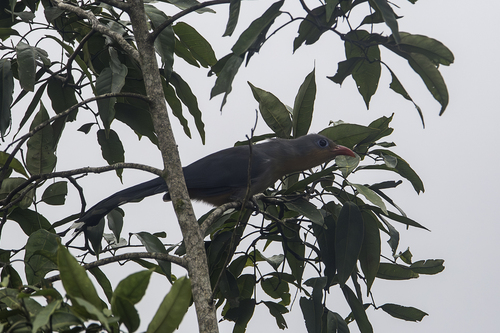 Red-billed Malkoha
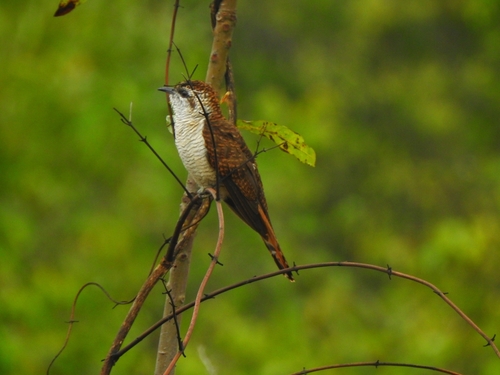 Banded Bay Cuckoo
In short
The most reliable field mark to separate Red-billed Malkoha from Banded Bay Cuckoo is the bill: malkoha has a prominent, thick, strongly decurved red bill, while the cuckoo’s bill is long, slender, and dark with a greenish-grey base. Banded Bay Cuckoo also stands out with a bold whitish supercilium (eyebrow) and fine, regular dark barring across its rufous upperparts and tail, features the malkoha lacks. Juvenile Banded Bay Cuckoos show white feather fringes on the upperparts and a paler lower mandible, but even then, the malkoha’s sickle-shaped bill and unbarred plumage are distinctive. Both species can occur in Southeast Asia, but malkoha is heavier and more robust, while the cuckoo is smaller and more slender.
Identification tips
- Bill shape and color: Red-billed Malkoha has a thick, strongly decurved, bright red bill; Banded Bay Cuckoo has a long, slender, slightly curved bill that is mostly dark with a greenish-grey base. This is the most consistent field mark at all ages.
- Supercilium (eyebrow): Banded Bay Cuckoo shows a bold whitish supercilium above a dark eye-line, giving a striking facial pattern. Red-billed Malkoha lacks any supercilium or strong facial markings.
- Upperpart barring: Adult and juvenile Banded Bay Cuckoo have broad, regular dark brown barring across the rufous upperparts and tail. Red-billed Malkoha’s upperparts are plain and unbarred.
- Tail pattern: Banded Bay Cuckoo’s tail is graduated, with a dark brown center, a subterminal black band, and white tips to the feathers. Red-billed Malkoha’s tail lacks these bars and white tips, appearing more uniform.
- Juvenile features: Juvenile Banded Bay Cuckoo has white fringes to upper body feathers and a pale lower mandible; Red-billed Malkoha juveniles do not show these features.
- Size and structure: Malkoha is much heavier and more robust (109 g), with a longer, bulkier body and a more powerful jizz. The cuckoo is smaller, lighter, and more slender, with a more delicate appearance.
- Iris color: Banded Bay Cuckoo has a yellow iris; iris color for malkoha is not specified in the notes, so use with caution.
- Perched behavior: Banded Bay Cuckoo often perches in the open, especially when singing. Malkoha tends to stay within dense foliage and is less likely to be seen in exposed positions.
- Flight style: While not detailed in the notes, malkoha’s heavier build suggests slower, more labored flight compared to the lighter cuckoo.
- Vocalization: If you hear a high-pitched, falling four-note whistle, it is Banded Bay Cuckoo. Malkoha is not noted for any distinctive call in these sources.
- Habitat context: In dense, dry forest interiors, malkoha is more likely; in hill forests or forest edges, especially if you hear song, cuckoo is more probable.
- Sex and season: Both species are sexually monomorphic (males and females look alike), so sex is not a separator. Seasonal differences are not detailed for malkoha; cuckoo may be more vocal and visible during the breeding season.
- Confusion with hepatic cuckoos: Hepatic forms of other Cacomantis cuckoos can resemble Banded Bay Cuckoo, but the strong supercilium, long beak, and barred tail are reliable for sonneratii vs malkoha.
- Host behavior: Banded Bay Cuckoo is brood-parasitic and may be seen near nests of small birds, but this is not a field mark for separation from malkoha.
- Geographic overlap: Both species occur in Southeast Asia, but Banded Bay Cuckoo’s range extends further west into the Indian subcontinent.
Size
Red-billed Malkoha is substantially heavier (109 g [wikidata]) and bulkier than Banded Bay Cuckoo, which is described as small and about 22 cm in length, similar to other Cacomantis cuckoos. The malkoha’s size is evident in the field, appearing larger and more elongated, while the cuckoo is noticeably lighter and more compact. This difference is most apparent when both are seen in the same area or habitat.
Plumage
- Juvenile/immature contrast: Juvenile Banded Bay Cuckoo shows white fringes to the feathers of the upper body and a pale lower mandible, which are never present on Red-billed Malkoha. Even in young birds, the malkoha’s plumage remains unbarred and lacks white feather edges.
- Adult contrast: Adult Banded Bay Cuckoo is bright rufous (bay) on the head and back, with broad, regular dark brown barring across upperparts and tail. It has a distinct whitish supercilium above a dark eye-line, and the tail is barred with a subterminal black band and white tips. In contrast, Red-billed Malkoha lacks barring and supercilium, and its plumage is plainer, with no strong facial markings or tail pattern. The malkoha’s bill is bright red and thick, while the cuckoo’s is dark with a greenish-grey base. Both sexes are similar in both species.
Behaviour
Red-billed Malkoha is typically seen moving deliberately through dense foliage, often in the mid to upper canopy, searching for insects. It is less likely to be seen in open or exposed perches. Banded Bay Cuckoo, on the other hand, often sings from exposed branches, especially during the breeding season, and may sally out for insects. The cuckoo’s behavior is more conspicuous when singing or foraging in the open, while the malkoha is more secretive and stays within cover.
Habitat
Red-billed Malkoha is found in subtropical or tropical dry forests across Brunei, Indonesia, Malaysia, Myanmar, and Thailand [wikipedia]. Banded Bay Cuckoo occurs in well-wooded areas, mainly in lower hills, across the Indian subcontinent and Southeast Asia. While both can occur in similar forested habitats in Southeast Asia, the cuckoo is more likely in hilly or edge habitats, and the malkoha is more tied to dense, dry forest interiors.
Voice
Banded Bay Cuckoo has a distinctive, high-pitched four-note whistle, often transcribed as "wee-ti wee-tee" or "smoke-yer-pepper," with each note falling in pitch. This call is diagnostic and often heard when the bird is perched in the open. There is no mention of a distinctive call for Red-billed Malkoha in the provided notes, so vocalization is a strong separator if the cuckoo is heard.