

Pearl-breasted Swallow vs White-throated Swallow
Hirundo dimidiata versus Hirundo albigularis
Play a quiz with Pearl-breasted Swallow and White-throated Swallow
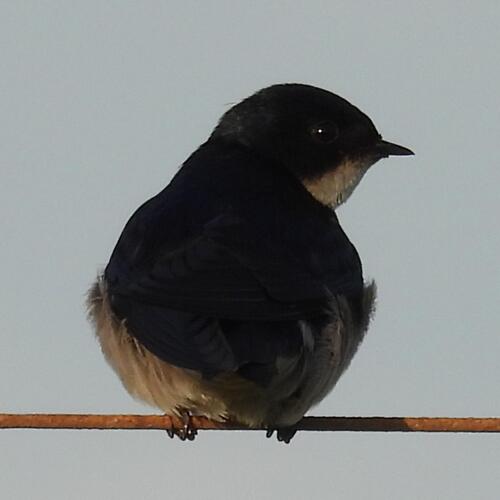 Pearl-breasted Swallow
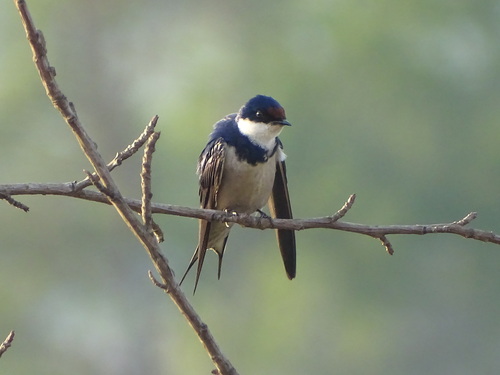 White-throated Swallow
In short
The most reliable field mark for separating Pearl-breasted Swallow from White-throated Swallow is the presence or absence of white in the tail: White-throated Swallow shows obvious white patches near the tips of the undertail feathers, while Pearl-breasted Swallow has a uniformly dark tail with no white. In addition, White-throated Swallow has a striking white throat sharply divided from the underparts by a dark breast band and a bright chestnut crown, whereas Pearl-breasted Swallow lacks both the breast band and the chestnut crown, and has more uniformly grey-white underparts. Juvenile birds of both species are duller and have shorter tails, but the tail and throat pattern differences remain useful. Both species are small, glossy blue swallows with similar flight style, but White-throated Swallow is slightly larger and more likely to be seen around bridges and dams.
Identification tips
- Check for white in the tail: White-throated Swallow always shows white patches near the tips of the undertail feathers, visible in flight and often when perched. Pearl-breasted Swallow's tail is uniformly dark with no white—this is the single most reliable mark for all ages and seasons.
- Look for a breast band: White-throated Swallow has a well-defined dark blue-black breast band separating the white throat from the greyish white underparts. Pearl-breasted Swallow lacks any breast band; its underparts are more uniformly grey-white.
- Note the throat color: White-throated Swallow has a bright white throat that stands out against the darker breast band and crown. Pearl-breasted Swallow's throat is not distinctly white and blends into the rest of the underparts.
- Crown color: Adult White-throated Swallow has a bright chestnut crown, contrasting with the blue back and white throat. Pearl-breasted Swallow lacks any chestnut on the crown; its head is glossy blue like the back.
- Juvenile marks: Juvenile White-throated Swallow is duller, with a browner crown and shorter tail, but still shows the white throat and breast band. Juvenile Pearl-breasted Swallow is duller and browner overall, with a plain face and no breast band or white throat.
- Underwing coverts: Both species have greyish or grey-white underwing coverts, but Pearl-breasted Swallow's are a darker shade than its underparts. This is subtle and not a primary field mark.
- Tail shape: Both species have forked tails, with males having longer outer feathers. Tail shape is not a strong separator, but the presence or absence of white is.
- Size: White-throated Swallow is slightly larger (14–17 cm vs 13–14 cm), but this is rarely diagnostic in the field unless seen side by side.
- Habitat context: If the bird is seen nesting or perching on a bridge or dam, White-throated Swallow is more likely, though not exclusive.
- Flight style: Both species have similar swift, agile flight; flight style is not a separator.
- Vocalizations: Only White-throated Swallow is described as giving warbles and twitters, but this is not a strong field mark without more information.
- Sex differences: In both species, males have slightly longer outer tail feathers, but this is not a practical field mark for separation.
- Seasonal variation: No strong seasonal plumage differences are described for either species; the main marks are consistent year-round.
- Plumage pitfalls: Beware of dull juveniles, which can obscure the crown and throat colors, but the presence or absence of the breast band and tail white remains reliable.
- When in doubt: Focus on the tail pattern and throat/breast band combination—these are the most consistent and visible differences at all ages.
Size
White-throated Swallow is slightly larger, measuring 14–17 cm in length, compared to Pearl-breasted Swallow's 13–14 cm. Both have similar slender swallow proportions, but the difference may be subtle in the field. The outer tail feathers are somewhat longer in males of both species, but this is not a strong separation point. Overall, size alone is not a reliable field mark, but White-throated Swallow may appear a bit longer and more robust, especially when perched.
Plumage
- Juveniles and immatures: Both species' juveniles are duller and browner than adults, with shorter outer tail feathers. However, even in young birds, White-throated Swallow shows a browner crown and a white throat separated from the underparts by a dark breast band, while Pearl-breasted Swallow juveniles lack both the chestnut crown and the breast band, and have a plainer, more uniform grey-white underside.
- Adults: Pearl-breasted Swallow has glossy blue upperparts, grey-white underparts, and a uniformly dark, blackish-blue forked tail with no white. The underwing coverts are a darker shade of grey-white. White-throated Swallow has glossy dark blue upperparts, a bright chestnut crown, a white throat sharply divided from the underparts by a dark blue-black breast band, and white patches near the tips of the undertail feathers. The underparts and underwing coverts are greyish white, but the throat is distinctly white and stands out due to the breast band. These differences are visible both in flight and when perched.
Behaviour
Both species are aerial insectivores with similar flight styles—swift, agile, and often low over water or open ground. There is no strong behavioral difference noted in the sources, though White-throated Swallow may be more likely to be seen perching on artificial structures such as bridges and dams due to its adaptation to human-altered landscapes.
Habitat
White-throated Swallow is common in southern Africa and has adapted well to nesting on bridges and dams, making it more likely to be seen in areas with human infrastructure. Pearl-breasted Swallow is also found in southern Africa but is less closely associated with artificial structures. Both can occur in open country, but the presence of bridges or dams favors White-throated Swallow.
Voice
White-throated Swallow gives a mix of warbles and twitters. No distinctive vocalization is described for Pearl-breasted Swallow in the provided notes, so voice is not a reliable separation point based on current information.
Pearl-breasted Swallow · White-throated Swallow · My Tricky Birds