

Nashville Warbler vs Pine Warbler
Leiothlypis ruficapilla versus Setophaga pinus
Play a quiz with Nashville Warbler and Pine Warbler
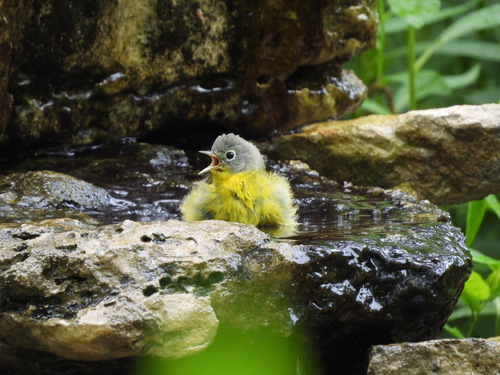 Nashville Warbler
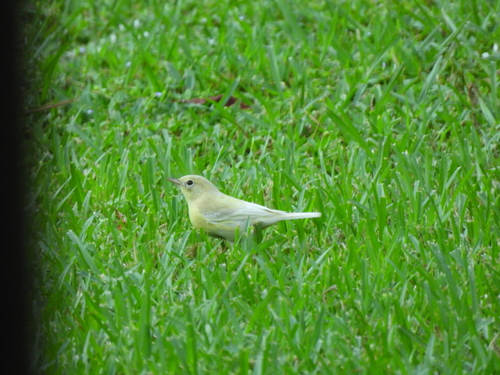 Pine Warbler
In short
The most reliable field mark between Nashville Warbler and Pine Warbler is the presence of two bold white wing bars on Pine Warbler of all ages, which are completely absent in Nashville Warbler. Nashville Warbler shows a clean gray head with a full white eye ring and no wing bars, while Pine Warbler has a yellowish spectacle but no full eye ring, and always shows wing bars. Both species have yellow throats and olive upperparts, but Nashville Warbler’s yellow is brighter and more sharply set off by its gray head, especially in adults. Structural differences are subtle, but Pine Warbler is slightly bulkier and heavier-billed. Immature and female birds are the most commonly confused; focus on the wing pattern and eye ring for a confident separation.
Identification tips
- Wing bars: Pine Warbler always shows two bold white wing bars on the upperwing, regardless of age or sex. Nashville Warbler never shows wing bars at any age. This is the most reliable field mark in all situations.
- Eye ring vs. spectacle: Nashville Warbler has a complete, bold white eye ring (all ages and sexes). Pine Warbler lacks a full eye ring but may show a yellowish spectacle (partial ring or arc) around the eye; never a full white ring.
- Head color: Nashville Warbler adults have a clean gray head that contrasts sharply with the olive-green back, especially in the eastern subspecies. Pine Warbler’s head is olive or olive-brown, blending into the back, with no sharp contrast.
- Throat and breast color: Both have yellow throats and breasts, but Nashville Warbler’s is brighter and more sharply defined, especially in males. Pine Warbler’s yellow is often duller or paler, especially in females and immatures.
- Crown patch: Male Nashville Warbler may show a hidden rusty crown patch when agitated, but this is rarely visible and not a reliable field mark.
- Bill shape: Pine Warbler has a slightly heavier, longer bill compared to the finer, more pointed bill of Nashville Warbler. This is subtle but can be noticed with good views.
- Leg color: Pine Warbler has dark legs; Nashville Warbler’s leg color is not distinctive for separation from Pine Warbler.
- Tail movement: Nashville Warbler often flicks its tail while foraging; Pine Warbler does not show this behavior as frequently.
- Foraging behavior: Pine Warbler often forages on pine cones and tree trunks, sometimes even on the ground for seeds. Nashville Warbler sticks to gleaning in shrubs and lower trees.
- Habitat context: In pine-dominated forests, especially in the southeast, Pine Warbler is much more likely. Nashville Warbler prefers shrubby habitats and is rarely found in pure pine stands.
- Seasonal context: Outside migration, Nashville Warbler is unlikely in the southeast US pine forests. Pine Warbler is resident or present year-round in much of its range.
- Sex and age pitfalls: Females and immatures of both species are duller, but the wing bar and eye ring differences remain reliable. Do not rely on overall brightness alone.
- In flight: Even in quick or distant flight views, the presence (Pine) or absence (Nashville) of wing bars is diagnostic.
- Mixed flocks: Nashville Warbler may join mixed-species flocks in winter; Pine Warbler is more likely to be seen singly or in small groups, often in pines.
- Confusion with other species: Pine Warbler can resemble Yellow-throated Vireo, but Nashville Warbler is not likely to be confused with vireo species due to its unique combination of gray head and white eye ring.
Size
Pine Warbler is slightly larger and heavier than Nashville Warbler (body mass: Pine Warbler 11.9 g vs. Nashville Warbler 8.8 g [wikidata]). In the field, this difference is subtle but Pine Warbler can appear a bit bulkier and more robust, with a slightly longer bill. Both are small warblers, but Pine Warbler may look a touch stockier, especially when foraging on trunks or branches.
Plumage
- Juvenile/Immature birds: Pine Warbler of all ages shows two clear white wing bars on otherwise olive-brown upperparts, and a yellowish spectacle around the eye (not a full eye ring). Nashville Warbler immatures lack wing bars entirely, have a duller olive-grey head, and retain a complete white eye ring. The yellow on the throat and breast is less bold in immature Nashville Warbler than adults, but still present.
- Adult males: Nashville Warbler males have a clean gray head with a subtle (often hidden) rusty crown patch, olive-green back, yellow throat and breast, and a complete white eye ring. Pine Warbler males have olive upperparts, bright yellow throat and breast, two white wing bars, and a yellowish spectacle but no full eye ring.
- Females: Both species’ females are duller, but the same contrasts hold: Pine Warbler females have wing bars and a yellowish spectacle, Nashville Warbler females have no wing bars and a full white eye ring. Pine Warbler females’ throats and breasts are paler yellow, while Nashville Warbler females are less boldly yellow than males but still show a yellow throat and breast.
- In flight: The lack of wing bars on Nashville Warbler is diagnostic at all ages and seasons. Pine Warbler always shows two white wing bars, visible even in quick views.
Behaviour
Nashville Warbler typically forages by gleaning insects in lower shrubs and trees, often flicking its tail. Pine Warbler tends to forage more slowly, often higher up, and is unique among warblers for regularly poking into pine cones and even foraging on the ground for seeds. Pine Warbler’s heavier, slower movements and tendency to forage on trunks or in pine cones can be a behavioral clue, while Nashville Warbler is more active and flicks its tail frequently.
Habitat
Nashville Warbler breeds in northern and western US and southern Canada, favoring shrubby or second-growth habitats, and winters in the southern US, Mexico, and northern Central America. Pine Warbler is more closely tied to pine-dominated forests, especially in the southeastern US, but also breeds in the northeast and southeastern Canada. If seen in extensive pine woodland, Pine Warbler is much more likely; Nashville Warbler is rarely found in pure pine stands.