
Lesser Whitethroat vs Goldcrest
Curruca curruca versus Regulus regulus
Play a quiz with Lesser Whitethroat and Goldcrest
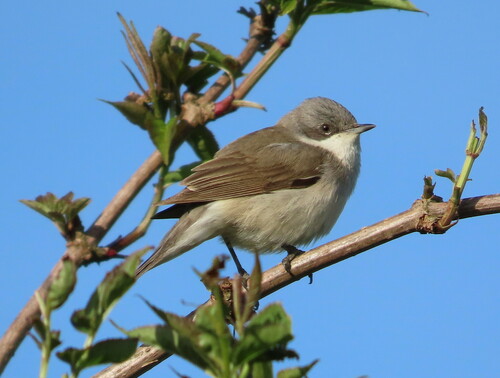 Lesser Whitethroat
 Goldcrest
In short
The most reliable field mark to separate Lesser Whitethroat from Goldcrest is the head and face: Lesser Whitethroat has a grey head with a dark 'bandit mask' through the eyes and a white throat, while Goldcrest shows a plain face with a striking yellow (or orange-yellow in males) crest on the crown, bordered by black. Juvenile Goldcrests lack the colored crest but still have a plain face and two bold white wingbars, unlike the Lesser Whitethroat. Goldcrest is also much smaller, with a rounder, more compact shape and a noticeably shorter, finer bill. In flight or perched, Goldcrest's wingbars and constant restlessness contrast with the more subdued, warbler-like Lesser Whitethroat. Both are small, active songbirds, but their structure, head pattern, and wing markings are distinct.
Identification tips
- Head pattern: Lesser Whitethroat has a grey head with a dark 'bandit mask' through the eye and a white throat; Goldcrest has a plain face with black irises and a bright yellow (or orange-yellow) crest bordered by black in adults. This is the single most reliable mark for all ages.
- Crest: Adult Goldcrests show a yellow crest (orange in males) bordered by black; Lesser Whitethroat never shows any colored crown or crest. Juvenile Goldcrests lack the colored crest but still have a plain face.
- Wingbars: Goldcrest (all ages) has two bold white wingbars; Lesser Whitethroat lacks wingbars entirely. This is especially useful in flight or when the wings are visible.
- Size and structure: Goldcrest is much smaller and more compact, with a very short tail and tiny, needle-like bill. Lesser Whitethroat is slightly larger, with a longer tail and a more typical warbler shape and bill.
- Bill shape: Goldcrest's bill is very short and fine, suited to picking insects from needles; Lesser Whitethroat has a longer, slightly heavier warbler bill.
- Upperparts color: Goldcrest is olive-green above; Lesser Whitethroat is grey-backed. In poor light, this can be subtle, but the difference is clear in good views.
- Underparts: Both have pale underparts, but Goldcrest's are buff-white, while Lesser Whitethroat's are more whitish, often with a sharp contrast to the grey head and white throat.
- Tail: Goldcrest's tail is very short and often appears almost stubby; Lesser Whitethroat has a longer, more pointed tail typical of warblers.
- Behavior: Goldcrest is constantly moving, often hovering or hanging from branches; Lesser Whitethroat moves more deliberately and rarely hovers.
- Habitat: Goldcrest favors conifers and dense evergreens; Lesser Whitethroat prefers open scrub, hedgerows, and woodland edges. Use habitat as a supporting clue, not a primary mark.
- Voice: Goldcrest's song is a high, thin series of notes; Lesser Whitethroat's is a fast, rattling 'tet' or 'che' sequence. If you hear the song, identification is straightforward.
- Sex and age: Both species are sexually similar, but only male Goldcrest has an orange center to the crest; females have all-yellow crests. Juvenile Goldcrests lack the colored crest but retain the plain face and wingbars, never showing a mask or throat contrast.
- Flight style: Goldcrest's flight is whirring and often includes abrupt changes of direction and hovering; Lesser Whitethroat flies more directly and rarely hovers.
- Common pitfalls: Juvenile Goldcrest can be mistaken for a drab warbler due to the lack of crest color, but the plain face and wingbars are always present. Lesser Whitethroat never shows wingbars or a crest, even in juveniles.
- When marks fail: In poor light or quick views, focus on the presence or absence of wingbars and the head pattern. If only a silhouette is seen, Goldcrest's tiny, round shape and short tail are distinctive compared to the more elongated Lesser Whitethroat.
Size
Goldcrest is the smallest European bird, measuring 8.5–9.5 cm in length with a 13.5–15.5 cm wingspan and weighing just 4.5–7.0 g [wikipedia]. Lesser Whitethroat is slightly larger than Goldcrest (though still a small warbler), with a more elongated body and longer tail, but is smaller than the Common Whitethroat. Goldcrest appears much more compact, almost round-bodied, with a very short tail and a tiny, needle-like bill. In the field, Goldcrest's diminutive size is often immediately apparent, especially when seen alongside other small birds.
Plumage
- Juvenile/first-winter Goldcrest: Duller olive upperparts, lacks the colored crest of adults, but still shows two bold white wingbars and a plain face. By first winter, young Goldcrests are nearly indistinguishable from adults except for slightly duller tones.
- Adult Goldcrest: Olive-green upperparts, buff-white underparts, two bright white wingbars, plain face with black irises, and a bright yellow crest (orange-centered in males, all yellow in females) bordered by black. The crest is often raised in display. No facial mask or throat contrast.
- Lesser Whitethroat (all ages/sexes): Grey back, whitish underparts, grey head with a distinct dark 'bandit mask' through the eye, and a white throat. Lacks wingbars and any colored crest. No chestnut wing patches. Sexes are almost identical. The head and throat contrast is a key feature, as is the absence of any wing pattern or crown color.
In summary, Goldcrest always shows wingbars and (in adults) a colored crest, while Lesser Whitethroat shows a masked face and white throat but no wingbars or crest.
Behaviour
Goldcrest is extremely active, constantly moving through foliage, often hovering, creeping along branches, and making short, whirring flights with abrupt changes of direction. It frequently feeds by dashing and fluttering, sometimes hanging upside down. Lesser Whitethroat is an active warbler but moves more deliberately, typically flitting through shrubs and low trees, rarely hovering. Goldcrest's restlessness and preference for conifers or dense foliage contrast with the more methodical, bush-level movements of Lesser Whitethroat.
Habitat
Lesser Whitethroat breeds in temperate Europe (except the southwest) and across the western and central Palearctic, favoring scrub, hedgerows, and open woodland edges. It is strongly migratory, wintering in Africa, Arabia, and India. Goldcrest is widespread across the Palearctic, often found in coniferous woodland, mixed forests, parks, and gardens. In Europe, Goldcrest is more likely in conifers or dense evergreens, while Lesser Whitethroat prefers open, shrubby habitats. Overlap can occur in migration, but habitat preference is often a useful clue.
Voice
Lesser Whitethroat's song is a fast, rattling sequence of 'tet' or 'che' calls, quite different from Goldcrest. Goldcrest sings a series of high, thin notes, higher-pitched and more delicate than most warblers. Their calls and songs are not easily confused: Goldcrest's song is a thin, high-pitched repetition, while Lesser Whitethroat's is harsher and rattling.