

Grey Crowned-Crane vs Wattled Crane
Balearica regulorum versus Grus carunculatus
Play a quiz with Grey Crowned-Crane and Wattled Crane
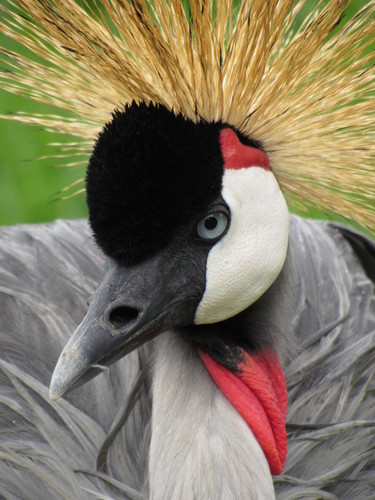 Grey Crowned-Crane
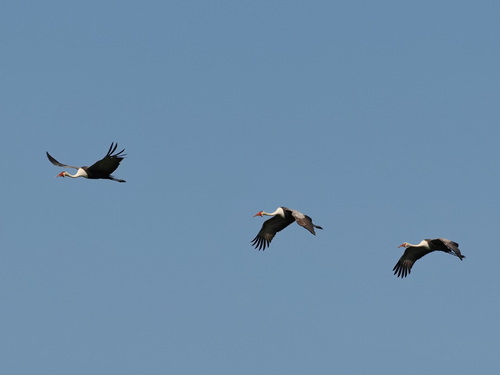 Wattled Crane
In short
The most reliable field mark to separate Grey Crowned-Crane from Wattled Crane is the striking golden crown of stiff feathers on the Grey Crowned-Crane's head, which is never present on Wattled Crane. In flight or at rest, Grey Crowned-Crane shows mostly grey body plumage with a white cheek patch and a bright red throat pouch, while Wattled Crane is much larger, with a mostly white neck and upper breast, a dark slate crown, and distinctive hanging wattles below the bill. Juvenile birds differ as well: young Grey Crowned-Cranes are greyer with a buff face, while juvenile Wattled Cranes are tawny and lack the bare red facial skin and prominent wattles. Size is a strong clue—Wattled Crane is substantially taller and heavier than Grey Crowned-Crane, but the golden crown remains the quickest field check.
Identification tips
- Golden crown of stiff feathers (adult Grey Crowned-Crane only): If you see a golden crown, it is Grey Crowned-Crane. Wattled Crane never shows this feature at any age.
- White cheek patch and red throat pouch (Grey Crowned-Crane): Look for a bright white cheek and a red, inflatable pouch below the bill. Wattled Crane has a white neck and upper breast but lacks the cheek patch and pouch.
- Long, hanging white wattles (adult Wattled Crane): Wattled Crane has long, feathered wattles hanging from the throat, plus a bare red patch in front of the eye. Grey Crowned-Crane lacks wattles and has feathered cheeks.
- Crown color: Grey Crowned-Crane has a golden crown; Wattled Crane's crown is dark slate gray, blending into the white neck.
- Juvenile color: Young Grey Crowned-Cranes are grey with a buff face; juvenile Wattled Cranes are tawny and lack bare red facial skin or wattles.
- Bill shape: Wattled Crane has a long, sharp bill; Grey Crowned-Crane's bill is shorter and grey.
- Body color: Grey Crowned-Crane is mostly grey with white and golden wing patches; Wattled Crane is ashy grey on the back and wings, with a white neck and upper breast and black lower breast and tail coverts.
- Legs: Both have long black legs, but Wattled Crane's are proportionally longer and more slender.
- Size: Wattled Crane is much taller and heavier (up to 175 cm and 9 kg) than Grey Crowned-Crane (about 1 m, 3.5 kg). Use this only when birds are side by side or with known scale.
- Roosting behavior: Grey Crowned-Crane may be seen roosting in trees; Wattled Crane always roosts on the ground.
- Habitat: Grey Crowned-Crane is found in savannah, fields, and marshes, sometimes far from water; Wattled Crane is restricted to wetlands and floodplains.
- Display: Elaborate dancing, bowing, and jumping is typical of Grey Crowned-Crane, not Wattled Crane.
- Voice: Booming and honking calls are diagnostic of Grey Crowned-Crane; Wattled Crane's voice is less distinctive and not described here.
- Flock size: Both can form flocks, but Wattled Crane flocks can be much larger (up to 89+ birds).
- Facial skin: Wattled Crane adults have a bare red patch in front of the eye; Grey Crowned-Crane has feathered white cheeks.
Size
Wattled Crane is the largest crane in Africa, standing 150–175 cm tall (up to 5 ft 9 in) with a wingspan of 230–260 cm and weighing 6.4–9 kg ([wikipedia]). Grey Crowned-Crane is much smaller at about 1 m tall (3 ft 3 in), a 2 m wingspan, and 3.5 kg weight. Even at a distance, Wattled Crane's greater height and bulk, especially the long neck and legs, are apparent. Both species have long legs, but Wattled Crane's are proportionally longer and more slender. If seen together, the size difference is unmistakable, but lone birds require caution—use plumage and head features for confirmation.
Plumage
- Juveniles: Young Grey Crowned-Cranes are overall greyer with a buff (light brownish) face and lack the full golden crown; their cheeks are feathered, not bare. Juvenile Wattled Cranes are tawny (warm brown), lack the bare red skin on the face, and have less prominent or absent wattles. Both lack the full adult head ornamentation, but the overall color tone (grey vs tawny) and face pattern remain useful.
- Adults: Grey Crowned-Crane adults have a golden crown of stiff feathers, white cheeks, a bright red inflatable throat pouch, and mostly grey body with white and golden patches on the wings. Wattled Crane adults have a white neck and upper breast, a dark slate crown, a long white wattle hanging from the throat, and a red, bare patch of skin in front of the eye. Their back and wings are ashy grey, and the lower breast, primaries, and tail coverts are black. The bill is long and sharp in Wattled Crane, shorter and grey in Grey Crowned-Crane. The golden crown is unique to Grey Crowned-Crane and never seen on Wattled Crane.
Behaviour
Grey Crowned-Crane is famous for its elaborate dancing displays, which involve bowing, jumping, and inflating the red throat pouch. Both sexes and even immatures participate, and these displays can occur year-round, not just in breeding season. Wattled Crane is less demonstrative, with no mention of such elaborate dances. Both species may gather in flocks outside the breeding season, but Wattled Crane flocks can be much larger (up to 89 birds or more). Grey Crowned-Crane is unique among cranes in regularly roosting in trees, thanks to a long hind toe, while Wattled Crane is strictly ground-roosting. Feeding behavior is similar (omnivorous, often associating with grazing mammals), but Grey Crowned-Crane is more likely to be seen walking through grasslands and cultivated fields, while Wattled Crane is more tied to wetlands.
Habitat
Grey Crowned-Crane is most often found in dry savannahs, grassy flatlands, cultivated lands, and marshes near rivers and lakes across Sub-Saharan Africa. It is adaptable and can be seen in a variety of open habitats, sometimes far from water. Wattled Crane, by contrast, is a specialist of wetlands and grasslands, especially in eastern and southern Africa. It is rarely found far from large, shallow wetlands or floodplains, and its presence is closely tied to water levels. If you see a crane in a dry field or perched in a tree, it is almost certainly a Grey Crowned-Crane. If it is in deep marsh or flooded grassland, especially in southern Africa, Wattled Crane becomes more likely.
Voice
Grey Crowned-Crane has a booming call, produced by inflating the red gular sac, and also gives a honking sound that is quite different from the trumpeting calls of other cranes. Wattled Crane's voice is not described in detail in the notes, but it lacks the distinctive booming and honking of the Grey Crowned-Crane. In the field, if you hear a deep, resonant boom followed by a honk, suspect Grey Crowned-Crane.