

Galah vs Sulphur-crested Cockatoo
Eolophus roseicapilla versus Cacatua galerita
Play a quiz with Galah and Sulphur-crested Cockatoo
 Galah
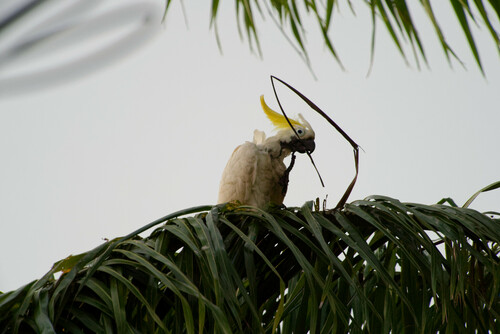 Sulphur-crested Cockatoo
In short
The most reliable way to separate Galah from Sulphur-crested Cockatoo in the field is by overall plumage color: Galah is distinctly pink and grey, while Sulphur-crested Cockatoo is entirely white with a yellow crest. This contrast holds for all ages and in flight or perched. Juvenile Galahs can appear duller and greyer, but never approach the all-white look of Sulphur-crested Cockatoo. Structurally, Sulphur-crested is larger and heavier, with a prominent yellow crest, while Galah has a shorter, lighter build and a pale pink crest. Both species may be seen together in open Australian habitats, but their coloration and size make confusion brief with binoculars.
Identification tips
- Overall color: Galah is always pink and grey; Sulphur-crested Cockatoo is always white with a yellow crest. This is the fastest and most reliable field mark for all ages and seasons.
- Crest color and shape: Galah has a light pink, shorter crest; Sulphur-crested has a long, expressive yellow crest that is often raised. If you see a yellow crest, it's never a Galah.
- Bill color: Galah's bill is pale bone-colored; Sulphur-crested's is black. This is visible at close range or with good optics.
- Size: Sulphur-crested is much larger and heavier than Galah. If the bird looks big and imposing, especially next to other cockatoos, it's likely Sulphur-crested.
- Flight profile: Sulphur-crested Cockatoo flies with slow, deep wingbeats and appears heavy; Galah is quicker and more agile in flight.
- Underwing color: Sulphur-crested shows yellowish underwings and undertail; Galah's underwing is grey, never yellow or white.
- Juvenile confusion: Young Galahs are duller but still show pink and grey; they never appear white. Juvenile Sulphur-crested is white from the start.
- Eye color: Both species have subtle sex differences in iris color (males darker, females browner or reddish), but this is rarely useful in the field.
- Leg color: Both have grey legs, not a useful separation.
- Voice: Sulphur-crested's call is a loud, harsh screech; Galah's is higher-pitched and more nasal. If you hear a piercing scream, think Sulphur-crested.
- Habitat overlap: Both can occur together in open country, parks, and suburbs, so do not rely on habitat alone.
- Perched posture: Sulphur-crested often appears larger-headed and more upright; Galah is more compact and rounded.
- Hybrid confusion: Galah can hybridize with Sulphur-crested, but hybrids are rare and show intermediate features; if you see a bird with pink and white/yellow, consider this possibility, but pure birds are easy to separate.
- Feeding behavior: Both forage on the ground, but Sulphur-crested is more likely to be seen manipulating objects or acting as a sentinel.
- Mistaken identity: Do not confuse Sulphur-crested with corellas (which are smaller, lack yellow crest, and have pale bills) or with Major Mitchell's Cockatoo (which is more pink and white, not grey). Galah is unique in its pink and grey combination.
Size
Sulphur-crested Cockatoo is significantly larger, measuring 44–55 cm in length and weighing more than Galah, which is about 35 cm long and 270–350 g in mass [wikipedia][avonet]. In the field, Sulphur-crested appears bulkier and longer-tailed, with a heavier bill and larger head. Galah is more compact and lighter overall, with a shorter tail and smaller head. These size differences are most obvious when both species are seen together, but even singly, the Sulphur-crested's size and presence are notable.
Plumage
- Juveniles: Young Galahs are duller than adults, with a greyer breast, crown, and crest, but still retain a pink face and underparts with a grey back and wings. They never appear all-white. Juvenile Sulphur-crested Cockatoos are white overall with yellowish underwings and crest, lacking any pink or grey tones at any age.
- Adults: Adult Galahs show a bright pink face, breast, and crest, with pale grey back, wings, and rump. The crest is light pink and mobile. Sulphur-crested Cockatoos are pure white with a bright yellow, expressive crest and yellowish wash to the underwing and undertail. Their bill is black, contrasting with the Galah's bone-colored bill. Eye color can differ by sex in both species but is subtle and not reliable in the field.
- In flight: The Galah's upperwing is grey, matching the back, with no white or yellow. Sulphur-crested shows white wings with yellow tinges below, and the yellow crest may be visible if raised. There are no complex wing patterns in either species that would cause confusion in flight.
Behaviour
Both species are social and often seen in flocks, sometimes together. Sulphur-crested Cockatoos are highly intelligent and can be seen manipulating objects, opening bins, or acting as sentinels while others feed. Galahs are also gregarious and adaptable but are less likely to display the same level of object manipulation. In flight, Sulphur-crested Cockatoos appear heavier and more powerful, with slower, deeper wingbeats, while Galahs are quicker and more agile. Both species perch conspicuously and forage on the ground or in trees.
Habitat
Both species are widespread in Australia and have adapted well to human-altered landscapes, often seen in urban parks, farmland, and open woodland. Sulphur-crested Cockatoo also occurs in New Guinea and parts of Indonesia, while Galah is endemic to mainland Australia. Galah is more abundant in open habitats with scattered trees, while Sulphur-crested prefers wooded areas but is also common in cities and suburbs. Both avoid dense, wet forests.
Voice
Sulphur-crested Cockatoo is famous for its loud, raucous screeches and squawks, which carry over long distances and are often heard before the bird is seen. Galah calls are also loud but are higher-pitched, more nasal, and less harsh than Sulphur-crested. Both can be noisy in flocks, but the Sulphur-crested's call is more piercing and grating, while Galah's is more chattering and conversational.