

Common Redpoll vs European Goldfinch
Acanthis flammea versus Carduelis carduelis
Play a quiz with Common Redpoll and European Goldfinch
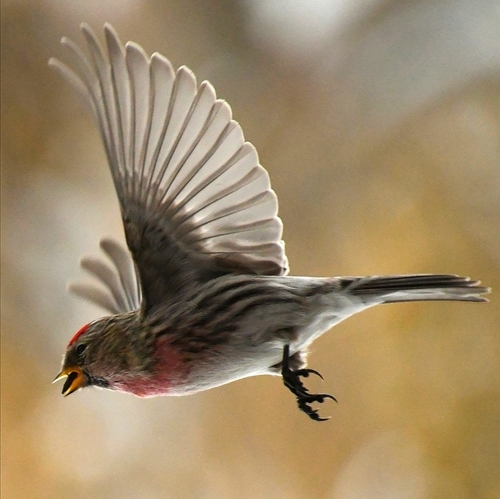 Common Redpoll
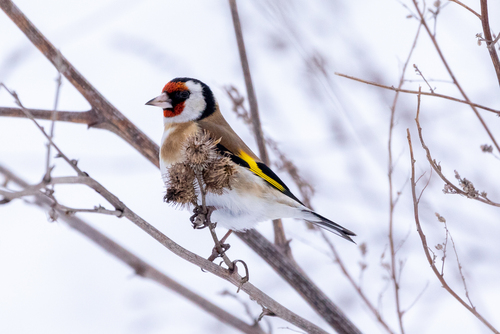 European Goldfinch
In short
The most reliable field mark to separate Common Redpoll from European Goldfinch in any plumage is the goldfinch’s bold yellow wing bar, visible in all ages and especially striking in flight, versus the redpoll’s two pale wing stripes and lack of yellow. Juvenile goldfinches are also distinctive by their plain, unmarked heads and yellow wing stripe, while juvenile redpolls already show a red forehead and streaked plumage. Adult goldfinches have a bright red face and black-and-white head, never shown by redpolls. Both species are small finches, but goldfinch is slightly bulkier and has a longer, paler, more conical bill. In perched or flight views, focus on face pattern and wing coloration for the quickest separation.
Identification tips
- Yellow wing bar (all ages): Only European Goldfinch shows a broad yellow wing bar, visible both perched and in flight. Redpoll never shows yellow in the wing—look for two pale wing stripes instead.
- Face pattern (adults): Goldfinch has a bright red face with black-and-white head; redpoll has a red forehead but a streaked brown face and black bib.
- Juvenile head: Juvenile goldfinch has a plain, unmarked head, while juvenile redpoll already shows a red forehead and streaking.
- Bill shape and color: Goldfinch has a long, pointed, ivory bill; redpoll’s bill is shorter, yellowish with a dark tip, and more triangular.
- Breast color: Male redpolls may have a pinkish wash on the breast, but never the goldfinch’s warm buff flanks and white underparts.
- Rump and tail: Goldfinch has a white rump and black tail; redpoll’s rump is streaked, and the tail is less distinctly marked.
- Wing stripes: Redpoll shows two pale wing stripes (not a single yellow bar), which can be seen in all ages.
- Body streaking: Redpoll is heavily streaked above and below; goldfinch is mostly unstreaked with warm brown upperparts and white underparts.
- Size and jizz: Goldfinch is slightly larger and bulkier, with a longer bill and more robust appearance; redpoll is daintier and more compact.
- Flight style: Goldfinch often shows a bounding, undulating flight with bursts of song; redpoll’s flight is more direct.
- Habitat context: Goldfinch is more likely in open, weedy fields, gardens, and parks; redpoll prefers birch or alder stands, especially in the north.
- Flock behavior: Both can form flocks, but goldfinch flocks are often larger and more likely at feeders in open areas.
- Sex differences: Male goldfinch has a larger red mask; male redpoll may have more red on the breast, but this is subtle and variable.
- Seasonal variation: Goldfinch’s bill is paler in breeding season, with a dark tip outside breeding; redpoll’s bill is always yellowish with a dark tip.
- Juvenile confusion: If you see a plain-headed, yellow-winged juvenile, it is goldfinch; any juvenile with a red forehead and streaks is redpoll.
Size
Both species are small finches, but the European Goldfinch is slightly larger and heavier: goldfinch averages 12–13 cm in length, 21–25 cm wingspan, and 14–19 g in weight; redpoll is 11.5–14 cm long, 19–22 cm wingspan, and 12–16 g. In the field, this difference is subtle, but goldfinch can appear a bit more robust and longer-winged. Bill structure is also different: goldfinch has a longer, more pointed, ivory-coloured bill, while redpoll’s bill is shorter, yellowish with a dark tip, and more triangular.
Plumage
- Juvenile/first-winter birds: Juvenile European Goldfinch is unique among these two for its plain, unmarked head and a bold yellow wing stripe; the rest of its plumage is greyish-brown with a paler belly. Juvenile Common Redpolls already show a red forehead patch, heavy streaking on the body, and two pale wing bars but no yellow in the wing. This makes juvenile goldfinch unmistakable if the head is visible.
- Adults: Adult goldfinch is instantly told by its red face, black-and-white head, warm brown upperparts, white underparts with buff flanks, and a broad yellow wing bar. Redpoll adults have a red forehead, black bib, brownish-grey streaked body, two pale wing stripes, and a streaked rump. Male redpolls may show a pinkish wash on the breast, but never the goldfinch’s face pattern or yellow in the wing.
- Flight views: Goldfinch always shows a broad yellow wing bar in flight, with white rump and black tail. Redpoll shows two pale wing stripes and a streaked rump, lacking any yellow. Both have white in the wing, but only goldfinch has the yellow bar.
- Sex differences: Male and female goldfinch are similar, but males have a slightly larger red mask. Redpoll males may have more red on the breast, but this is variable and not as striking as the goldfinch’s face.
Behaviour
Both species are active, social finches, often seen in flocks outside the breeding season. Goldfinches are especially drawn to seed heads of thistles and teasels, and are frequent visitors to garden feeders, often in large groups. They use their long, pointed bills to extract seeds from plants. Redpolls also form flocks, especially in winter, and forage mainly in trees for birch and alder seeds, but will also come to feeders. In flight, goldfinches often give a bounding, undulating flight with frequent bursts of song, while redpolls have a more direct, less undulating flight style.
Habitat
Goldfinch is widespread in open and semi-open areas across Europe, western Asia, and North Africa, often in gardens, parks, farmland, and weedy fields—especially where thistles or teasels grow. Redpoll is more northern, breeding in boreal forests and taiga, and wintering further south but still favoring areas with birch or alder. In New Zealand and other introduced ranges, both can occur together, but goldfinch is more likely in open, human-altered habitats, while redpoll prefers areas with more trees or shrubs.
Voice
Goldfinch has a pleasant, silvery, twittering song and a melodic call described as 'tickeLIT' or 'teLLIT-teLLIT-teLLIT.' Redpoll’s vocalizations are not described in the provided notes, so voice is not a reliable separator here based on these sources.