

Cinnamon Woodpecker vs Chestnut-coloured Woodpecker
Celeus loricatus versus Celeus castaneus
Play a quiz with Cinnamon Woodpecker and Chestnut-coloured Woodpecker
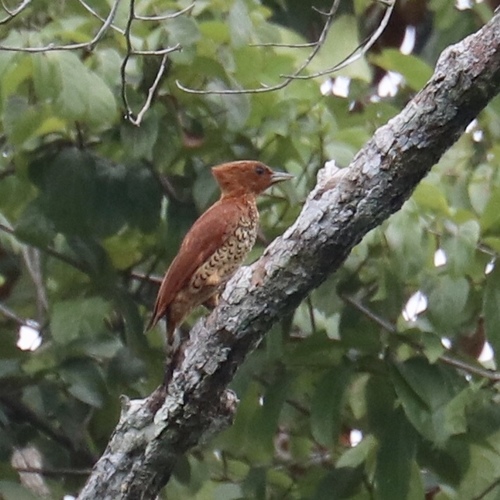 Cinnamon Woodpecker
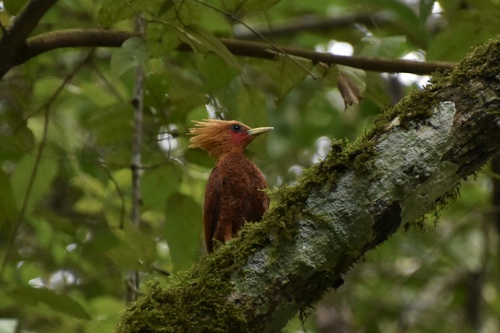 Chestnut-coloured Woodpecker
In short
The most reliable field mark to separate Cinnamon Woodpecker from Chestnut-coloured Woodpecker is the head and throat pattern: Cinnamon Woodpecker males have a rufous head with a red chin and throat, while Chestnut-coloured males show a much more extensive and brighter red from the lores to behind the eye and down the throat, with a pointed crest. Females of both species lack red on the face, but Cinnamon Woodpecker females have a uniform rufous head, whereas Chestnut-coloured females show a duller ochraceous or tawny head. Both species have rufous or chestnut upperparts with black barring, but Cinnamon Woodpecker is generally paler and more cinnamon-toned, especially in some subspecies. Juveniles of both are similar to adults but duller, and both show dusky mottling on the throat or malar, so age alone is not a strong separator. Size and structure are similar, but Chestnut-coloured Woodpecker is slightly larger and heavier on average. Focus on head pattern, throat color, and the tone of the upperparts for the most consistent field separation.
Identification tips
- Head and Crest Shape: Cinnamon Woodpecker has a bushy crest with black streaks on the crown, while Chestnut-coloured Woodpecker's crest is pointed and the head is dull ochraceous or tawny (not rufous).
- Male Face and Throat: Male Cinnamon Woodpecker shows a red chin and throat (with black streaks) on a rufous head; male Chestnut-coloured has a much more extensive bright red mask from the lores to behind the eye and down the throat, sometimes including the chin and upper throat. The red is much more obvious and extensive in Chestnut-coloured.
- Female Face: Female Cinnamon Woodpecker has a uniform rufous head with no red; female Chestnut-coloured has a dull ochraceous/tawny head, also with no red, but the overall tone is less rich than Cinnamon.
- Upperparts Tone: Cinnamon Woodpecker is generally paler and more cinnamon-toned above, especially in some subspecies (e.g., innotatus is very pale with weak barring). Chestnut-coloured Woodpecker is deeper rufous-chestnut above, with a cinnamon-buff rump and more distinct black barring on the back and uppertail coverts.
- Flight Feather Pattern: Cinnamon Woodpecker's flight feathers are blackish with wide rufous bars; Chestnut-coloured's are rufous-chestnut with dusky brown tips. In fast flight, Cinnamon may show more contrast between dark and rufous bars.
- Tail Pattern: Cinnamon Woodpecker has a black tail with wide buff to whitish bars; Chestnut-coloured has dull black tail feathers with chestnut bases. If you see pale bars in the tail, think Cinnamon.
- Underparts Markings: Cinnamon Woodpecker's underparts are paler buff with bold black arrowhead-shaped marks; Chestnut-coloured's underparts are chestnut with heavy black 'V' or 'U' marks. The background color is paler in Cinnamon, richer chestnut in Chestnut-coloured.
- Bill Color: Cinnamon Woodpecker's bill is grayish to yellowish; Chestnut-coloured's is ivory-yellow with a blue-green tinge at the base. This is subtle but can help at close range.
- Iris Color: Cinnamon Woodpecker has a red iris; Chestnut-coloured's iris is chestnut or garnet brown. Not always obvious in the field.
- Leg Color: Cinnamon Woodpecker has gray legs; Chestnut-coloured's legs are dark olive to grayish. Not a strong field mark.
- Juvenile Plumage: Both species' juveniles are duller and darker than adults, with dusky mottling on the throat (Cinnamon) or malar (Chestnut-coloured) and more irregular black marks below. Separation is difficult, but Cinnamon juveniles may show more throat mottling, Chestnut-coloured more overall darkness.
- Size and Structure: Chestnut-coloured Woodpecker is slightly larger and heavier, but this is rarely obvious unless you have direct comparison.
- Range: In Mexico, Belize, Guatemala, and Honduras, only Chestnut-coloured occurs. In Colombia and Ecuador, only Cinnamon. In Costa Rica, Nicaragua, and Panama, both are possible—use plumage.
- Subspecies Variation: Cinnamon Woodpecker subspecies vary in darkness and barring; some are paler and less barred above and below (e.g., innotatus), which can make them look quite different from the richer Chestnut-coloured.
- Plumage Pitfalls: Both species can show variation in the intensity of black markings and barring, so rely on head and throat pattern first, then overall tone and underpart pattern.
Size
Chestnut-coloured Woodpecker is slightly larger and heavier than Cinnamon Woodpecker. Cinnamon Woodpecker averages about 19–23 cm in length and 78 g in mass, while Chestnut-coloured Woodpecker is 21.5–25 cm and 80–105 g. This difference is subtle in the field, but Chestnut-coloured may appear a bit bulkier and longer, especially when seen side by side. Both species are medium-sized Celeus woodpeckers, so size alone is rarely diagnostic without direct comparison.
Plumage
-
Juveniles: Both species' juveniles resemble adults but are duller and darker overall, with dusky mottling on the throat (Cinnamon) or malar (Chestnut-coloured) and more irregular, less distinct black markings below. This makes juveniles tricky to separate, but Cinnamon Woodpecker juveniles tend to have more dusky mottling on the throat and irregular underpart markings, while Chestnut-coloured juveniles are overall darker and duller, with less extensive black marks below.
-
Adults: Cinnamon Woodpecker has a rufous head with a bushy crest and black streaks on the crown; males have a red chin and throat, females do not. Chestnut-coloured Woodpecker has a dull ochraceous or tawny head with a pointed crest; males show a bright red mask from the lores to behind the eye and down the throat, sometimes extending to the chin and upper throat, while females lack any red. Cinnamon Woodpecker's upperparts are dark rufous with narrow black bars, flight feathers are blackish with wide rufous bars, and the tail is black with wide buff/whitish bars. Chestnut-coloured Woodpecker's upperparts are rufous-chestnut with a cinnamon-buff rump and black bars, flight feathers are rufous-chestnut with dusky brown tips, and the tail is dull black with chestnut bases. Underparts in Cinnamon are paler buff with bold black arrowhead marks; in Chestnut-coloured, they are chestnut with heavy black 'V' or 'U' marks. Bill color is grayish/yellowish in Cinnamon, ivory-yellow with a blue-green tinge in Chestnut-coloured.
Behaviour
Both species share similar Celeus woodpecker behaviors: they forage by climbing trunks and branches, often in pairs or small groups, and excavate nest cavities in trees. No strong behavioral differences are noted in the sources that would reliably separate them in the field. Both may be seen at mid-levels to canopy and are active, alert birds.
Habitat
Both species overlap in range in Central America (Costa Rica, Nicaragua, Panama), but Chestnut-coloured Woodpecker extends further north into Mexico, Belize, Guatemala, and Honduras, while Cinnamon Woodpecker reaches further south into Colombia and Ecuador. Both inhabit humid forests and edges, so habitat alone is not diagnostic where their ranges overlap. If seen in Mexico or Belize, it is Chestnut-coloured; if in Colombia or Ecuador, it is Cinnamon. In Costa Rica, Nicaragua, and Panama, both are possible.
Cinnamon Woodpecker · Chestnut-coloured Woodpecker · My Tricky Birds