

Chestnut-rumped Thornbill vs Western Thornbill
Acanthiza uropygialis versus Acanthiza inornata
Play a quiz with Chestnut-rumped Thornbill and Western Thornbill
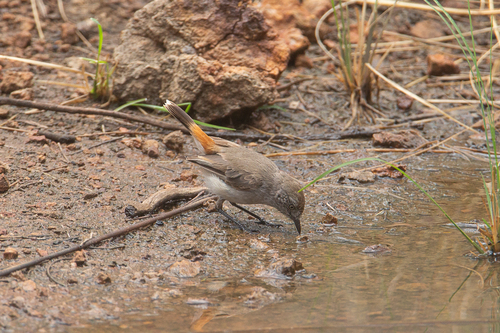 Chestnut-rumped Thornbill
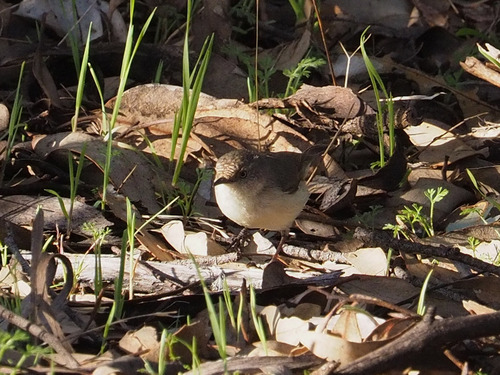 Western Thornbill
In short
The single most reliable field mark to separate Chestnut-rumped Thornbill from Western Thornbill is the presence of a rich chestnut rump patch on Chestnut-rumped Thornbill, which is always absent in Western Thornbill. Both species are small, plain thornbills with pale underparts and similar structure, but Chestnut-rumped Thornbill shows a distinctly colored rump and a mostly black tail with pale tips, while Western Thornbill is overall more uniformly brownish-gray without any rufous rump. Juvenile Chestnut-rumped Thornbills have a duller, plainer head and buff—not white—tail tips, but still show a chestnut rump, making this mark useful across all ages. In southwestern Australia, where both may occur, always check for the rump color when the bird flicks its tail or in flight, as structure and general coloration can be misleading.
Identification tips
- Rump color is key: Always look for a rich chestnut or rufous patch at the base of the back (rump) on Chestnut-rumped Thornbill. This is visible when the bird flicks its tail, in flight, or when perched with the tail slightly raised. Western Thornbill never shows a rufous rump—its back and rump are the same brownish-gray.
- Tail pattern: Chestnut-rumped Thornbill has a mostly black tail with pale tips (white in adults, buff in juveniles). Western Thornbill's tail is plain brownish and lacks strong contrast.
- Juvenile marks: Even young Chestnut-rumped Thornbills show a chestnut rump and buff tail tips. Western Thornbill juveniles remain plain and lack any rufous or chestnut tones.
- Overall coloration: Western Thornbill is more uniformly brownish-gray above and below, with a creamy pale underbelly. Chestnut-rumped Thornbill is paler above, with a whiter underbody and a contrasting rump.
- Head pattern: Chestnut-rumped Thornbill may show a rufous suffusion on the forehead and crown and pale mottled ear-coverts. Western Thornbill's head is plain grayish-brown without rufous or mottling.
- Iris color: Both species have pale irises; do not use this for separation.
- Size and structure: Both are similar in size and shape; do not rely on size in the field.
- Behavior: Both are active, restless, and may join mixed flocks. Chestnut-rumped Thornbill is more likely to be seen hopping on the ground, but this is not exclusive.
- Habitat context: In southwestern Australia, Western Thornbill is the default in wetter forests and coastal scrub, while Chestnut-rumped Thornbill prefers drier, more open habitats. However, overlap can occur.
- Flight views: In flight, the chestnut rump of Chestnut-rumped Thornbill is often conspicuous; Western Thornbill shows no such contrast.
- Season and sex: Both species are sexually monomorphic and show no seasonal plumage change; all field marks apply year-round and to both sexes.
- Vocalizations: Chestnut-rumped Thornbill may mimic other birds; if you hear mimicry, consider this species, but otherwise, calls are not diagnostic.
- Pitfalls: In poor light or at distance, the chestnut rump can appear dull or be hidden by folded wings. Always try to see the bird from behind or in flight for confirmation.
- Geographic range: If you are outside southwestern Australia, you are unlikely to encounter Western Thornbill. In the southwest, both may occur, so careful checking is needed.
- Mixed flocks: Both species may join mixed thornbill flocks; check every individual for rump color to avoid missing a Chestnut-rumped among Westerns.
Size
Both species are very similar in size and weight. Chestnut-rumped Thornbill averages about 9–11 cm in length with a wingspan of 14–16.5 cm and a weight of around 6 g [wikipedia]. Western Thornbill is slightly smaller on average (8–10 cm, 6–8 g), but this difference is subtle and not reliable in the field. Both are mid-sized for the genus and overlap extensively in measurements.
Plumage
- Juveniles and immatures: Chestnut-rumped Thornbill juveniles resemble adults but are plainer, with a duller head pattern and buff tail tips. Critically, even young birds retain the chestnut rump, though it may be slightly paler in inland birds. Western Thornbill juveniles are not described in detail, but no rufous rump is ever present at any age.
- Adults: Chestnut-rumped Thornbill shows a pale grey-brown upper body, a rich chestnut rump, mostly black tail with pale tips, pale mottled ear-coverts, and a whitish underbody. Western Thornbill is plainer overall, with a grayish-brown cap and back, creamy pale underbelly, and a more uniform brownish tint. The rump is always concolorous with the back—never chestnut or rufous.
- Tail: Chestnut-rumped Thornbill has a mostly black tail with pale tips (white in adults, buff in juveniles); Western Thornbill's tail is not specifically described but lacks the black-and-white contrast and is generally brownish.
- Iris: Both species have pale irises, so this is not a useful separator.
Behaviour
Both species are active and restless, foraging in shrubs and trees, often moving briskly through foliage and low branches. Chestnut-rumped Thornbill is noted for being gregarious, often in small flocks or mixed-species groups, and frequently hops on the ground searching among debris. Western Thornbill's behavior is not described in detail, but as a typical thornbill, it likely shares much of this jizz. Flight for both is in low, undulating dashes between cover. Behavioral differences are subtle and not reliable for separation.
Habitat
Chestnut-rumped Thornbill is widespread throughout inland Australia, west of the Great Dividing Range to the West Australian coast, but is absent from the far north and humid southwest. Western Thornbill is restricted to southwestern Australia, favoring open woodlands (karri and jarrah forests), gardens, and coastal scrub. In the southwest, Chestnut-rumped Thornbill is less common and more likely in drier, open habitats, while Western Thornbill is the default thornbill in wetter forests and coastal scrub. However, ranges can overlap in transitional zones, so habitat alone is not diagnostic.
Voice
Chestnut-rumped Thornbill has a penetrating, far-carrying song of repeated phrases and is known to mimic other birds. No specific vocal description is provided for Western Thornbill, but both species are likely to have typical thornbill calls—high-pitched and tinkling. Voice is not a reliable separator unless the mimicry of Chestnut-rumped Thornbill is recognized.
Chestnut-rumped Thornbill · Western Thornbill · My Tricky Birds