

Brown Thornbill vs Chestnut-rumped Thornbill
Acanthiza pusilla versus Acanthiza uropygialis
Play a quiz with Brown Thornbill and Chestnut-rumped Thornbill
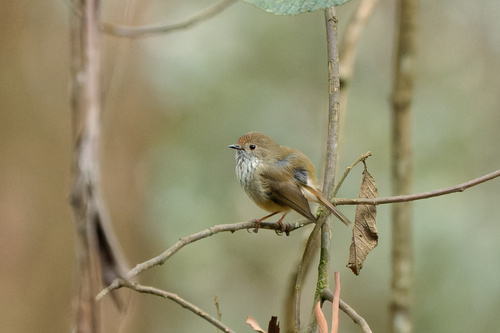 Brown Thornbill
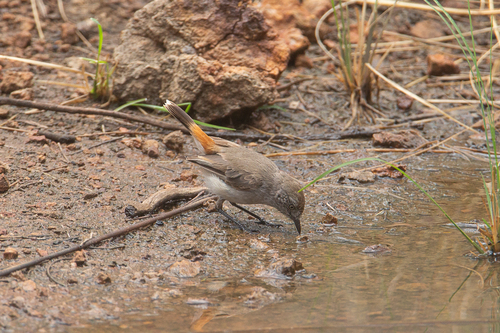 Chestnut-rumped Thornbill
In short
The most reliable field mark to separate Brown Thornbill from Chestnut-rumped Thornbill is the color of the rump and the iris: Chestnut-rumped Thornbill always shows a rich chestnut rump and pale eye, while Brown Thornbill has a tawny (not chestnut) rump and striking dark red eyes. Brown Thornbill is warmer brown above with heavy streaking on the throat and breast, whereas Chestnut-rumped Thornbill is paler, plainer, and lacks strong streaking below. Juveniles of both are duller, but the chestnut rump and pale eye of Chestnut-rumped are still useful. Both are small, active thornbills, but their preferred habitats rarely overlap: Brown Thornbill is an eastern forest bird, while Chestnut-rumped is an inland species of open woodlands and shrublands.
Identification tips
- Rump color (all ages): Chestnut-rumped Thornbill always shows a rich chestnut rump patch, visible both perched and in flight; Brown Thornbill's rump is tawny or brownish, never truly chestnut.
- Eye color (adults and most immatures): Brown Thornbill has striking dark red eyes; Chestnut-rumped Thornbill has a pale iris (cream or greyish white). This is often visible at close range or in good light.
- Throat and breast streaking (adults): Brown Thornbill shows strong blackish streaks on a grey throat and breast, giving a heavily marked look; Chestnut-rumped Thornbill is plain whitish below with little to no streaking.
- Forehead pattern (adults): Brown Thornbill has buff scallops on the forehead; Chestnut-rumped Thornbill has a rufous suffusion but lacks strong scalloping.
- Tail pattern (all ages): Both have mostly black tails with pale tips, but Chestnut-rumped Thornbill's tail tips are paler in juveniles (buff, not white). This is subtle and not always diagnostic.
- Underparts (all ages): Brown Thornbill's flanks are olive-buff to yellowish white; Chestnut-rumped is cleaner white below, especially in arid populations.
- Ear-coverts: Chestnut-rumped Thornbill has pale, mottled ear-coverts; Brown Thornbill's are less distinct.
- Bill and structure: Both are similar in structure, with no strong differences in bill shape or length. Do not rely on structure alone.
- Habitat and range: If you are in dense, wet forest in eastern Australia, Brown Thornbill is likely; in open inland woodland or shrubland, especially west of the Divide, Chestnut-rumped is far more probable.
- Behavior: Chestnut-rumped Thornbill is more likely to forage on the ground and in open groups; Brown Thornbill stays low in dense undergrowth.
- Juvenile marks: Juvenile Chestnut-rumped Thornbill is duller overall, with pale buff tail tips and a pale iris, but still shows the chestnut rump; Brown Thornbill juveniles are similar to adults but may be slightly duller, always with a dark eye.
- Voice: If you hear mimicry or a very repetitive, far-carrying song, Chestnut-rumped Thornbill is more likely, but this is not a safe field mark without experience.
- Season and sex: Both species are sexually monomorphic and show little seasonal variation, so do not rely on sex or time of year for separation.
- Pitfalls: Beware of confusing the chestnut rump of Chestnut-rumped Thornbill with the tawny rump of Brown Thornbill, especially in poor light. Always check the iris color and underpart streaking for confirmation.
- When in doubt: Use a combination of rump color, eye color, throat/breast streaking, and habitat context for the most reliable ID.
Size
Both species are very similar in size, with Brown Thornbill measuring 9–10 cm and weighing about 7 g, and Chestnut-rumped Thornbill at 9–11 cm and 6 g. Any difference in length or mass is negligible in the field, and both appear as typical small, round-bodied thornbills.
Plumage
- Juvenile/immature birds: Chestnut-rumped Thornbill juveniles are plainer than adults, with a duller head pattern and pale buff tail tips (not white), but still show a pale chestnut rump and pale iris. Brown Thornbill juveniles are similar to adults but may be slightly duller overall, retaining the warm brown tones and dark eye.
- Adults: Brown Thornbill is warm brown to olive-brown above, with a tawny rump (never rich chestnut), buff scalloping on the forehead, and heavy blackish streaks on a grey throat and breast. The tail is dark with a black subterminal band and pale tips. The eye is always dark red. Chestnut-rumped Thornbill is pale grey-brown above, with a rich chestnut rump, mostly black tail with pale tips, pale mottled ear-coverts, and a rufous wash on the forehead and crown. Underparts are plain whitish, lacking strong streaking. The iris is pale (cream or greyish white).
Behaviour
Both species are active, restless foragers, often in small groups or mixed flocks, and feed by hopping and flitting through low vegetation. Chestnut-rumped Thornbill is especially gregarious, often seen in twos or threes, and forages both in shrubs/trees and on the ground. Brown Thornbill tends to feed lower in the understory and is less likely to be seen on the ground. Flight in both is low and undulating, but not distinctive enough to separate them reliably.
Habitat
Brown Thornbill is found in eastern and southeastern Australia, including Tasmania, and prefers dense undergrowth in forests, rainforests, shrublands, and riparian thickets. It is common in wetter, coastal, and montane areas. Chestnut-rumped Thornbill is widespread in inland Australia, west of the Great Dividing Range, and favors open woodlands, shrublands, and arid or semi-arid habitats; it is absent from humid coastal and far northern regions. Overlap is limited to ecotones, so location is often a strong clue.
Voice
Both species have far-carrying, musical songs, but the notes do not provide enough detail for reliable separation in the field. Chestnut-rumped Thornbill is noted for mimicking other birds and having a penetrating, repetitive song. Brown Thornbill's voice is not described in detail here.
Brown Thornbill · Chestnut-rumped Thornbill · My Tricky Birds