

Black-tailed Trogon vs Green-backed Trogon
Trogon melanurus versus Trogon viridis
Play a quiz with Black-tailed Trogon and Green-backed Trogon
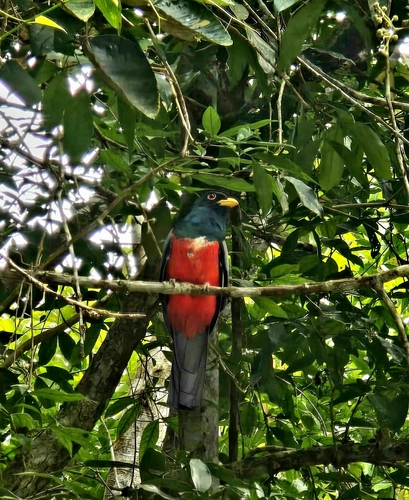 Black-tailed Trogon
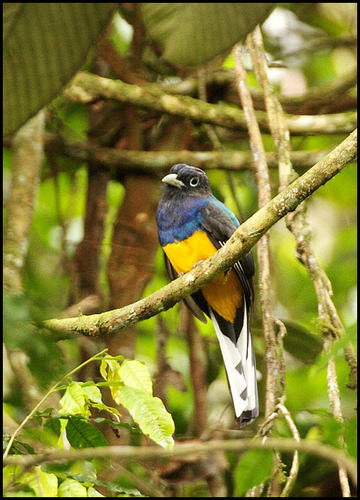 Green-backed Trogon
In short
The most reliable field mark to separate Black-tailed Trogon from Green-backed Trogon is the pattern of the undertail in both sexes: Black-tailed Trogon shows a uniformly dark (slaty gray) undertail, while Green-backed Trogon has a striking black-and-white pattern below the tail—broad white tips and edges on each feather in males, and black-and-white barring in females. Males also differ in eye-ring color (orange-red in Black-tailed, pale bluish in Green-backed) and bill color (yellow in Black-tailed, dark in Green-backed). Females of both are grayish above, but differ in facial pattern and tail. Both species are similar in size and shape, but careful attention to undertail and head details will resolve most field confusion, especially when perched birds are seen from below.
Identification tips
- Undertail pattern (all ages, both sexes): Black-tailed Trogon always shows a plain, slaty gray undertail; Green-backed Trogon always shows a bold black-and-white pattern—broad white tips and edges in males, black-and-white barring in females. This is the single most reliable field mark when viewing from below.
- Male head and breast color: Black-tailed Trogon males have a green crown, nape, upperparts, and breast; Green-backed Trogon males have a dark blue (often appearing blackish) head and upper breast, with a green back. This contrast is visible in good light but can be subtle in shade.
- Belly color (male): Black-tailed Trogon has a bright red belly, sharply separated from the green breast by a white band. Green-backed Trogon has orange-yellow lower underparts, with no sharp white band above.
- Eye-ring color (male): Black-tailed Trogon males have a distinctive orange-red eye-ring; Green-backed Trogon males have a pale bluish eye-ring. This is subtle but visible at close range or in photos.
- Bill color (male): Black-tailed Trogon males have a yellow bill; Green-backed Trogon males have a dark bill. Females of Black-tailed have a slaty maxilla.
- Female head and back: Both are gray above, but Black-tailed Trogon females are gray where the male is green, with the gray extending further into the upper belly. Green-backed Trogon females are also gray but have a paler bluish eye-ring and more extensive black-and-white barring on the tail.
- Female facial pattern: Black-tailed Trogon females show white arcs before and after the eye; Green-backed Trogon females have a complete pale bluish eye-ring.
- Female undertail: Black-tailed Trogon females have a plain slaty undertail; Green-backed Trogon females have black-and-white barring, mainly on the outer webs of each feather.
- Wing vermiculation (male): Both have vermiculated wings, but Black-tailed Trogon males (especially T. m. macroura) may show coarser vermiculation; Green-backed Trogon wings are black, vermiculated with white. This is subtle and rarely diagnostic at a distance.
- Perched jizz: Both perch upright and motionless, but undertail pattern is best seen from below or behind. Flight views rarely show diagnostic marks except possibly the undertail.
- Habitat and range: If in Amazonian rainforest or Atlantic Forest, Green-backed Trogon is more likely; if in Panama, northern Colombia, or foothill forests, Black-tailed Trogon is more likely. However, ranges can overlap in parts of northern South America.
- Voice: If heard, Green-backed Trogon's song is a series of 'cow' notes, higher-pitched than Black-tailed Trogon. Use with caution unless familiar with both.
- Size: Both are similar in size and shape; do not rely on size to separate them in the field.
- Sexual dimorphism: Both species are strongly sexually dimorphic, but the undertail pattern is reliable for both sexes.
- Pitfalls: Immature and female birds can be especially confusing; always check the undertail pattern and, if possible, eye-ring color and facial pattern for confirmation.
Size
Both species are large trogons, with similar lengths (28–30 cm) and body mass (Black-tailed Trogon: up to 122 g [wikidata]). No meaningful structural size difference is noted in the sources; both appear robust and broad-billed, typical of the genus.
Plumage
Juvenile and immature-specific upperwing or flight marks are not described for either species, so focus is on adult and general plumage. In adult males, Black-tailed Trogon has a green crown, nape, upperparts, and breast, separated from a bright red belly by a white band; the undertail is slaty gray and unmarked. Green-backed Trogon males have a dark blue (appearing blackish in poor light) head and upper breast, green back, and orange-yellow lower underparts; their undertail is boldly black and white, with each feather broadly tipped and edged white. In females, both species are gray-backed, but Black-tailed Trogon females have a more extensive gray wash and white arcs before and after the eye, while Green-backed Trogon females show black-and-white barring on the outer tail feathers and a pale bluish eye-ring. Both sexes of Black-tailed Trogon have a plain dark undertail, while both sexes of Green-backed Trogon show marked black-and-white patterning below the tail.
Behaviour
Both species perch upright and are generally reluctant to fly far, typical of trogons. Green-backed Trogon is noted as especially sedentary and less likely to join mixed-species flocks, while Black-tailed Trogon sometimes does. Both feed on fruit and insects, sometimes small vertebrates. No diagnostic difference in flight style or foraging behavior is described.
Habitat
Both species inhabit humid tropical forests, but their ranges only partially overlap. Black-tailed Trogon is found from Panama through northern South America, including various lowland and foothill forests, sometimes up to 2,200 m west of the Andes. Green-backed Trogon is widespread in the Amazon, Guiana Shield, Trinidad, and Atlantic Forest, and is often the commonest trogon in its range. Both prefer primary and secondary rainforest, but Green-backed Trogon is more strictly Amazonian and Atlantic Forest, while Black-tailed Trogon ranges further into foothills and some drier forest types.
Voice
Green-backed Trogon's song is a series of about 20 'cow' notes, starting slow and accelerating, and is described as slower than White-tailed Trogon and higher-pitched than Black-tailed Trogon. No detailed description of Black-tailed Trogon's song is provided for direct comparison, but pitch and tempo differences may be useful if familiar with both.