

Black-headed Trogon vs Graceful Black-throated Trogon
Trogon melanocephalus versus Trogon tenellus
Play a quiz with Black-headed Trogon and Graceful Black-throated Trogon
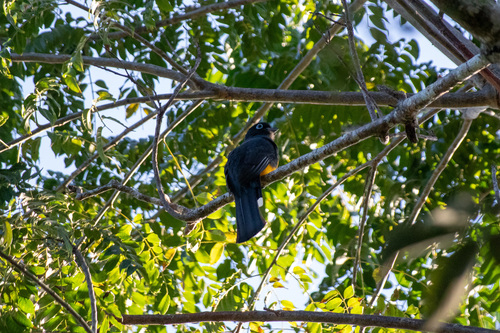 Black-headed Trogon
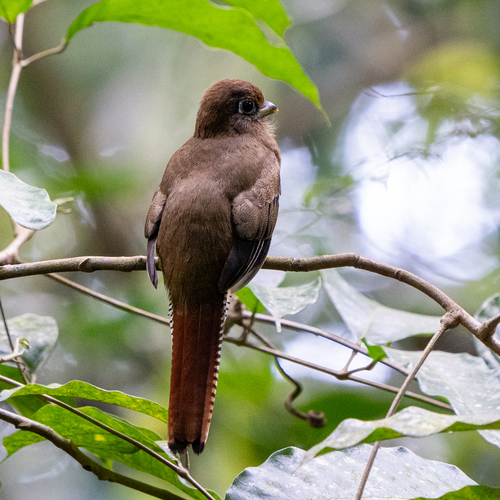 Graceful Black-throated Trogon
In short
The most reliable field mark to separate Black-headed Trogon from Graceful Black-throated Trogon is the color and extent of black on the head, chest, and upperparts: Black-headed Trogon of all ages and sexes shows a solid black (or slate-black) head, neck, and chest, while Graceful Black-throated Trogon males have a black face and throat but metallic green upper breast and crown, and females are brown-headed. Immature Black-headed Trogons have more white in the wings and less white in the tail than adults, but never show the complex barred and rufous tail patterns of Graceful Black-throated Trogon. Size is also a strong clue: Black-headed Trogon is distinctly larger and heavier. Tail and wing patterns, especially in flight or for immatures, are key—look for the metallic inner tail feathers and simple black-and-white outer tail of Black-headed versus the intricate black, white, and rufous barring of Graceful Black-throated. Both species have yellow underparts and a pale blue eye-ring, but differ in upperpart and tail color and pattern.
Identification tips
- Head and Chest Color (All Ages): Black-headed Trogon always shows a solid black or slate-black head, neck, and chest, sharply set off from the yellow belly by a thin white line. Graceful Black-throated Trogon males have a black face and throat only, with metallic green crown, back, and upper breast; females are brown-headed and brown-faced.
- Upperparts (Sex/Age): Male Black-headed Trogon has bright metallic bluish green to golden green upperparts, with a metallic blue to bluish violet rump; females are dark slate above. Graceful Black-throated males are metallic green above with bluish uppertail coverts; females are brown above with a darker crown and lighter rump.
- Tail Pattern (All Ages): Black-headed Trogon has metallic bronze-green to bluish green central tail feathers with black tips, the next pair all black, and outer three pairs black with broad white tips. Immatures have less white in the tail. Graceful Black-throated Trogon has a more complex tail: central feathers bluish with black tips, next pairs with black inner webs, and outer three pairs with black bases, white tips, and black-and-white bars between; the underside is barred black and white with a wide white tip. Female Graceful Black-throated shows rufous-brown to chestnut central tail feathers with narrow black tips and cinnamon-buff bands.
- Wing Pattern (Immatures): Immature Black-headed Trogons have more white in the wings than adults, but never show the intricate black-and-white barring of Graceful Black-throated Trogon. Graceful Black-throated males have black and white patterned flight feathers and coverts; females have fuscous-black primaries with narrow white edges, coppery secondaries, and black lesser coverts with brown tips.
- Bill Color: Black-headed Trogon has a dark bill. Graceful Black-throated males have a mostly bright yellow to yellow-green bill; females' bills are variable, from black with some yellow to dusky yellow with some black.
- Eye-ring: Both have a pale blue eye-ring, but Black-headed's is described as sky-blue and Graceful Black-throated's as pale blue or whitish to pale blue. This is subtle and not always reliable in the field.
- Underparts: Both species have yellow underparts, but Black-headed's is cadmium to chrome yellow, lighter at the vent. Graceful Black-throated has yellow lower breast and belly, sometimes with a thin white band below the upper breast (always present in females).
- White Chest Band: Both species can show a white band separating the upper and lower breast, but in Black-headed Trogon this is a thin line below the black chest, while in Graceful Black-throated it is below the metallic green (male) or pale brown (female) upper breast.
- Size and Structure: Black-headed Trogon is distinctly larger and heavier, with a bulkier appearance. Graceful Black-throated is smaller and lighter, with a more delicate build.
- Sex Differences: Female Black-headed Trogon is dark slate above and black-headed; female Graceful Black-throated is brown above and brown-headed, with rufous or chestnut tones in the tail.
- Tail in Flight (All Ages): Black-headed Trogon's tail is simpler, lacking the black-and-white barring and rufous tones of Graceful Black-throated. In flight, look for the metallic inner tail feathers and broad white tips on the outer tail feathers in Black-headed; in Graceful Black-throated, look for barred and rufous outer tail feathers, especially in females.
- Range (if known): If seen in Mexico, Belize, Guatemala, or El Salvador, it is Black-headed Trogon. In Colombia, it is Graceful Black-throated. In Honduras or Nicaragua, both are possible—use plumage and size.
- Habitat: Both use forested habitats, but local abundance may differ. If following monkey troops, Graceful Black-throated is more likely, but this is not diagnostic.
- Behavior: Both perch upright and remain still for long periods; behavior is not a strong separator.
- Pitfalls: Immature Black-headed Trogons may appear paler-winged and less white-tailed than adults but never show the barred or rufous tail patterns of Graceful Black-throated. Bill color is variable in female Graceful Black-throated and not always reliable.
Size
Black-headed Trogon is noticeably larger and heavier: 27–28 cm in length and 74–95 g in weight. Graceful Black-throated Trogon is smaller and lighter, at 23–26 cm and 50–59 g. This size difference is apparent in the field, especially if seen side by side or with experience. The larger, bulkier jizz of Black-headed is a useful supporting clue, but not diagnostic on its own.
Plumage
Immature and adult Black-headed Trogons of both sexes have a solid black (or slate-black) head, neck, and chest, with a thin white band separating the black chest from the bright yellow underparts. Their upperparts are metallic green (male) or dark slate (female), and the tail is mostly metallic bronze-green to bluish green on the inner feathers with black and white on the outer feathers. Immature Black-headed Trogons have more white in the wings and less white in the tail than adults, but the tail never shows the intricate barring or rufous tones of Graceful Black-throated. By contrast, adult male Graceful Black-throated Trogons have a black face and throat, but the crown, back, and upper breast are metallic green, not black. Their tail is complex: the central feathers are bluish with black tips, the next pairs have black inner webs, and the outer tail feathers are black-based with white tips and black-and-white bars between; the underside of the tail is barred black and white with a wide white tip. Adult females are mostly brown above, with a brown face and crown, and the tail shows rufous-brown to chestnut with black tips and cinnamon-buff bands. Both sexes of Graceful Black-throated have a white band below the upper breast, but the upper breast is metallic green (male) or pale brown (female), not black. Bill color is also variable: Black-headed has a dark bill, while male Graceful Black-throated has a bright yellow to yellow-green bill, and females' bills are variable. Both have a pale blue or bluish eye-ring, but Black-headed's is described as sky-blue and Graceful Black-throated's as pale blue or whitish to pale blue.
Behaviour
Both species perch upright and remain motionless for long periods, typical of trogons. Graceful Black-throated Trogon is noted for feeding in the forest understory to mid-story, often sallying or hovering to catch insects or pluck fruit, and sometimes follows monkey troops to catch disturbed prey. There is no specific behavioral difference noted for Black-headed Trogon in the sources, so behavior is not a strong separator.
Habitat
Black-headed Trogon ranges from Mexico to Costa Rica, including Belize, El Salvador, Guatemala, Honduras, and Nicaragua. Graceful Black-throated Trogon is found from southeastern Honduras south to northwestern Colombia. Their ranges overlap in Honduras and Nicaragua, but Black-headed is more northern overall, while Graceful Black-throated extends farther south. Both inhabit forested areas, but local abundance and precise habitat preferences are not detailed in the notes.
Black-headed Trogon · Graceful Black-throated Trogon · My Tricky Birds