

Ashy Tailorbird vs Yellow-bellied Prinia
Orthotomus ruficeps versus Prinia flaviventris
Play a quiz with Ashy Tailorbird and Yellow-bellied Prinia
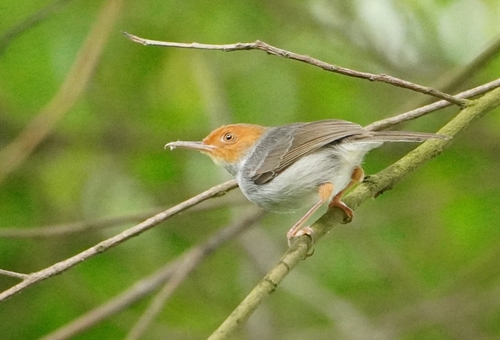 Ashy Tailorbird
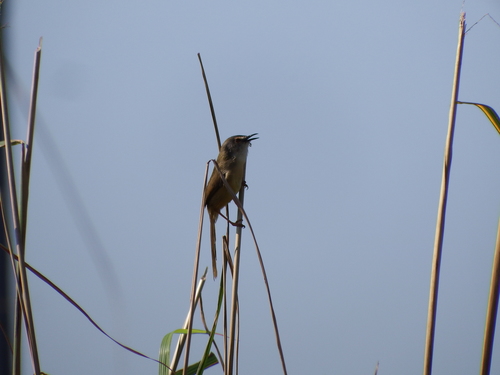 Yellow-bellied Prinia
In short
The most reliable field mark to separate Ashy Tailorbird from Yellow-bellied Prinia is the Ashy Tailorbird's distinctive rufous-chestnut face and forecrown in adult males, which is never shown by Yellow-bellied Prinia. Female and juvenile Ashy Tailorbirds lack this rufous but still show a contrasting ashy-grey back and paler underparts, while Yellow-bellied Prinia always shows a yellow belly and lacks any rufous on the head. Both species are small, active insectivores in Southeast Asia, but their plumage, especially on the head and underparts, is the key field separation. Bill shape and tail pattern can also help, especially in perched views.
Identification tips
- Rufous-chestnut face and forecrown (Ashy Tailorbird adult male): Only Ashy Tailorbird males show this rich rufous on the face, chin, and forecrown. If you see this, it's diagnostic. Yellow-bellied Prinia never shows any rufous or chestnut on the head.
- Yellow belly (Yellow-bellied Prinia): Any bird with a bright yellow belly is a Yellow-bellied Prinia. Ashy Tailorbird never shows yellow on the belly at any age or sex.
- Ashy-grey back and tail (Ashy Tailorbird): Ashy Tailorbird adults have a distinctly ashy-grey back and tail, contrasting with the rufous head (male) or white throat (female). Yellow-bellied Prinia is more olive or brownish above and lacks this sharp contrast.
- White chin and throat (Ashy Tailorbird female): Females have a white chin and throat, sometimes with a pale grey breast, but never yellow underparts. This helps separate from Yellow-bellied Prinia, which has yellow underparts and a less contrasting throat.
- Juvenile confusion: Juvenile Ashy Tailorbirds lack rufous on the head and have olive-green upperparts, which can look similar to Yellow-bellied Prinia. However, check for yellow on the belly (present only in Yellow-bellied Prinia) and the plain face (Ashy Tailorbird juvenile). If the face is plain and the belly is not yellow, lean toward Ashy Tailorbird.
- Bill shape: Ashy Tailorbird has a long, slightly decurved bill, bark brown above and horn below. While not always obvious at a distance, this can help in close views. Yellow-bellied Prinia's bill is shorter and more typical of prinias.
- Tail color and contrast: Ashy Tailorbird has a lighter grey tail, which can contrast with the ashy back. Yellow-bellied Prinia's tail is more in line with the olive/brown upperparts.
- Foraging height: Ashy Tailorbird often forages and nests low (below 1 m) in vegetation, while Yellow-bellied Prinia is not specifically noted for this behavior.
- Sex differences: Only Ashy Tailorbird shows strong sexual dimorphism (rufous in male, white throat in female). Yellow-bellied Prinia sexes are similar.
- No upperwing or flight pattern difference: Neither species shows a distinctive upperwing or flight pattern in the available sources, so do not rely on wing panels or trailing edges.
- Habitat overlap: Both can occur in disturbed habitats and edge, so do not use habitat as a primary separator unless in palm oil plantations, where Ashy Tailorbird may be more common.
- No song or call difference in notes: If you hear a distinctive song, consult a local field guide, as the sources do not provide vocal differences.
- Subspecies variation (Ashy Tailorbird): There is some variation in the redness of the head and shade of grey on the back among Ashy Tailorbird subspecies, but the basic pattern holds: rufous head (male), ashy back, no yellow belly.
- Plumage sequence: Remember that Ashy Tailorbird juveniles can be confusingly plain, but the absence of yellow on the belly and any rufous on the head is key. Yellow-bellied Prinia always shows some yellow below, even in young birds.
- Overall impression: In mixed flocks or edge habitats, look for the sharp head/underpart contrast in Ashy Tailorbird versus the more uniform, yellow-bellied look of Yellow-bellied Prinia.
Size
Both species are very similar in size and mass, with Ashy Tailorbird averaging about 7.0 g and Yellow-bellied Prinia about 7.6 g [wikidata]. Both are tiny, active birds, and size alone is not a reliable separator in the field. Length is also similar (Ashy Tailorbird around 7 cm), so observers should focus on plumage and structure.
Plumage
-
Juvenile/immature birds: Juvenile Ashy Tailorbirds lack the adult's rufous head and instead show olive-green upperparts, which can overlap with the general tones of Yellow-bellied Prinia, but Ashy Tailorbird juveniles still lack yellow on the belly and have a plainer face. Juvenile Yellow-bellied Prinia, by contrast, always shows some yellow on the belly and never shows any rufous or chestnut on the head.
-
Adult males: Ashy Tailorbird males have a striking rufous-chestnut face, chin, and forecrown, sharply set off from an ashy-grey back and lighter grey tail, with the underparts grading from grey throat to whitish belly. Yellow-bellied Prinia never shows rufous on the head and is named for its bright yellow belly, with upperparts more olive or brownish and a less contrasting face.
-
Adult females: Female Ashy Tailorbirds are similar to males but with a white chin and throat, paler upperparts, and a pale grey wash across the breast. They still lack yellow on the belly and any rufous on the head. Female Yellow-bellied Prinia resembles the male but is overall duller, still with yellow underparts and no rufous on the face.
-
Upperwing pattern: No distinctive upperwing or flight pattern is described for either species in the sources, so separation relies on head and underpart color, not wing panels or edges.
Behaviour
Ashy Tailorbird is often seen foraging in pairs or small family groups, moving actively through both forest canopy and undergrowth, as well as forest edge. It is highly adaptable and can be common even in disturbed habitats like palm oil plantations. Yellow-bellied Prinia is also an active insectivore, but the sources do not detail its foraging style or social behavior in this context. Both are likely to be seen flitting through low vegetation, but Ashy Tailorbird's habit of staying low (often nesting below 1 m) may be a subtle behavioral clue.
Habitat
Both species occur in Southeast Asia and can overlap in range. Ashy Tailorbird is especially noted for its adaptability to disturbed habitats, including palm oil plantations, where it can be common. Yellow-bellied Prinia has a wider range, extending from Pakistan and the Himalayan foothills to Southeast Asia, but habitat preference is not detailed in the notes. In areas of overlap, both may be found in edge and secondary growth, so habitat is not a strong separator.