

Motmot

Acre Tody-Tyrant vs Yellow-backed Tanager

Hemitriccus cohnhafti versus Hemithraupis flavicollis

Play a quiz with Acre Tody-Tyrant and Yellow-backed Tanager

Acre Tody-Tyrant (Hemitriccus cohnhafti) Acre Tody-Tyrant
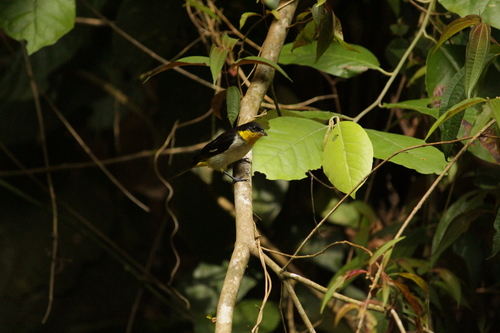
Yellow-backed Tanager (Hemithraupis flavicollis) Yellow-backed Tanager

Media

Loading…

In short

The most reliable field mark between Acre Tody-Tyrant and Yellow-backed Tanager is the combination of overall color and wing pattern: Acre Tody-Tyrant (all ages and sexes) shows a greenish-olive body with bold yellowish-tawny wing bars and yellow-edged flight feathers, while Yellow-backed Tanager males are strikingly black and yellow, and females are olive-green above with yellow underparts and only faint yellowish-green wing edges. The Tody-Tyrant is smaller, with a flat, broad-based bill and a compact, stubby-tailed jizz; the tanager is longer, slimmer, and has a more typical pointed bill. In the field, confusion is most likely with female or immature tanagers, which can appear greenish, but the Tody-Tyrant always shows strong streaking on the throat and breast and a distinctive face pattern. Habitat overlap is possible, but the Tody-Tyrant is much more localized and scarce. Vocalizations differ: the Tody-Tyrant gives short, low trills and single 'tick' notes, while the tanager's song is not described here.

Identification tips

  1. Wing bars and edges: Acre Tody-Tyrant of all ages shows two bold yellowish-tawny wing bars and yellow outer edges to the flight feathers; Yellow-backed Tanager (female/immature) has only faint yellowish-green edges and no strong wing bars.
  2. Throat and breast streaking: Tody-Tyrant has creamy yellowish streaks on the olive-green throat and breast (all ages/sexes); tanager is unstreaked below, with yellow or off-white underparts.
  3. Face pattern: Tody-Tyrant shows tawny lores and a tawny wash on the face, contrasting with the greenish-olive head; female tanager has a plain olive-green face with no strong lores.
  4. Back and rump: Tody-Tyrant is greenish-olive throughout; male tanager has a black upper back and bright yellow lower back/rump, female tanager is olive-green above but lacks the Tody-Tyrant's streaked crown.
  5. Bill shape: Tody-Tyrant has a flat, broad-based bill with large oval nostrils; tanager's bill is slender and pointed, more typical of a small songbird.
  6. Tail: Tody-Tyrant's tail is short and blackish with dark green inner vanes; tanager's tail is longer and uniformly dark.
  7. Underparts: Tody-Tyrant has olive-green upper belly and flanks, with a sulphur-yellow lower belly and undertail; female tanager is yellow below, brightest on throat/breast, with olive-tinged flanks.
  8. Sexual dimorphism: Tody-Tyrant sexes are alike; tanager males are strikingly black and yellow, females are greenish and yellow, so only female/immature tanagers are likely to cause confusion.
  9. Size and jizz: Tody-Tyrant is smaller, more compact, and short-tailed; tanager is longer, slimmer, and more active.
  10. Behavior: Tody-Tyrant perches upright, often low in dense forest; tanager is more active, foraging higher and more openly, often in groups.
  11. Vocalizations: Tody-Tyrant gives short, low trills and single 'tick' notes; tanager's song is not described here but is not similar.
  12. Habitat: Tody-Tyrant is local and scarce in dense Amazonian forest; tanager is widespread and common in a range of wooded habitats.
  13. Iris and leg color: Tody-Tyrant has a cream to brownish hazel iris and gray legs; tanager has a dark brown iris and dark gray legs.
  14. Mandible color: Tody-Tyrant has a creamy base to the mandible; tanager's mandible is pinkish to yellow.
  15. Pitfalls: Female/immature tanagers may look greenish above and yellow below, but always lack the Tody-Tyrant's bold wing bars, streaked throat, and compact jizz. If you see a greenish bird with strong wing bars and a streaked throat, it's the Tody-Tyrant.

Size

Acre Tody-Tyrant is smaller and lighter, about 11 cm long and weighing around 9 g (based on a single male), with a compact, short-tailed appearance. Yellow-backed Tanager is larger and heavier, about 13 cm long and averaging 12.8 g (range 11–15 g), with a more elongated body and proportionately longer tail. The size difference is subtle but noticeable with good views or in mixed flocks.

Plumage

No age-specific upperwing patterns are described for either species, but adults and immatures are separable by overall color and wing markings. Acre Tody-Tyrant of all ages and sexes is greenish-olive above with darker streaks on the crown, tawny lores, and a tawny wash on the face. The wings are blackish with yellow outer edges and two distinct yellowish-tawny wing bars. Underparts are olive-green with creamy yellowish streaks on the throat and breast, and the belly is sulphur-yellow. In contrast, Yellow-backed Tanager males are mostly black above with a bright yellow lower back, rump, and throat, and a thin white patch on the outer primaries. Females are olive-green above with yellowish-green edged wings (no strong wing bars), and mostly yellow underparts, brightest on the throat and breast. Both sexes of the tanager have a dark tail and a contrasting yellow undertail. The Tody-Tyrant's streaked throat and breast and bold wing bars are never matched by the tanager, whose females may look greenish but lack streaking and have more uniform yellow below.

Behaviour

Acre Tody-Tyrant typically shows a compact, upright posture, often perching low or mid-level in dense forest, and may sally for insects. Its movements are quick and somewhat furtive. Yellow-backed Tanager is more active and social, often seen in pairs or small groups, foraging higher in the canopy or at forest edges, and moving more openly. The tanager's flight is more direct and less fluttery than the Tody-Tyrant's, which may appear more hesitant and bouncy.

Habitat

Both species occur in lowland tropical forests of South America, but Acre Tody-Tyrant is much more local, found in a limited area of Bolivia, Brazil, and Peru, usually in dense, humid forest. Yellow-backed Tanager is widespread from Panama south through most of South America (except the far south), and is common in a variety of wooded habitats, including forest edges and second growth. If seen outside the core Acre region, the odds strongly favor the tanager.

Voice

Acre Tody-Tyrant gives a short, low-pitched trill of 'tick' notes, usually without introductory notes, and also single 'skep' or 'keek' calls and lower 'kup' calls. The Yellow-backed Tanager's vocalizations are not described in these notes, but are not similar to the Tody-Tyrant's trills. If you hear a short, mechanical trill, suspect the Tody-Tyrant.

Submit a better description

Use the same sections as the comparison. Your text is published immediately.

The most reliable field mark between Acre Tody-Tyrant and Yellow-backed Tanager is the combination of overall color and wing pattern: Acre Tody-Tyrant (all ages and sexes) shows a greenish-olive body with bold yellowish-tawny wing bars and yellow-edged flight feathers, while Yellow-backed Tanager males are strikingly black and yellow, and females are olive-green above with yellow underparts and only faint yellowish-green wing edges. The Tody-Tyrant is smaller, with a flat, broad-based bill and a compact, stubby-tailed jizz; the tanager is longer, slimmer, and has a more typical pointed bill. In the field, confusion is most likely with female or immature tanagers, which can appear greenish, but the Tody-Tyrant always shows strong streaking on the throat and breast and a distinctive face pattern. Habitat overlap is possible, but the Tody-Tyrant is much more localized and scarce. Vocalizations differ: the Tody-Tyrant gives short, low trills and single 'tick' notes, while the tanager's song is not described here.

  1. Wing bars and edges: Acre Tody-Tyrant of all ages shows two bold yellowish-tawny wing bars and yellow outer edges to the flight feathers; Yellow-backed Tanager (female/immature) has only faint yellowish-green edges and no strong wing bars.
  2. Throat and breast streaking: Tody-Tyrant has creamy yellowish streaks on the olive-green throat and breast (all ages/sexes); tanager is unstreaked below, with yellow or off-white underparts.
  3. Face pattern: Tody-Tyrant shows tawny lores and a tawny wash on the face, contrasting with the greenish-olive head; female tanager has a plain olive-green face with no strong lores.
  4. Back and rump: Tody-Tyrant is greenish-olive throughout; male tanager has a black upper back and bright yellow lower back/rump, female tanager is olive-green above but lacks the Tody-Tyrant's streaked crown.
  5. Bill shape: Tody-Tyrant has a flat, broad-based bill with large oval nostrils; tanager's bill is slender and pointed, more typical of a small songbird.
  6. Tail: Tody-Tyrant's tail is short and blackish with dark green inner vanes; tanager's tail is longer and uniformly dark.
  7. Underparts: Tody-Tyrant has olive-green upper belly and flanks, with a sulphur-yellow lower belly and undertail; female tanager is yellow below, brightest on throat/breast, with olive-tinged flanks.
  8. Sexual dimorphism: Tody-Tyrant sexes are alike; tanager males are strikingly black and yellow, females are greenish and yellow, so only female/immature tanagers are likely to cause confusion.
  9. Size and jizz: Tody-Tyrant is smaller, more compact, and short-tailed; tanager is longer, slimmer, and more active.
  10. Behavior: Tody-Tyrant perches upright, often low in dense forest; tanager is more active, foraging higher and more openly, often in groups.
  11. Vocalizations: Tody-Tyrant gives short, low trills and single 'tick' notes; tanager's song is not described here but is not similar.
  12. Habitat: Tody-Tyrant is local and scarce in dense Amazonian forest; tanager is widespread and common in a range of wooded habitats.
  13. Iris and leg color: Tody-Tyrant has a cream to brownish hazel iris and gray legs; tanager has a dark brown iris and dark gray legs.
  14. Mandible color: Tody-Tyrant has a creamy base to the mandible; tanager's mandible is pinkish to yellow.
  15. Pitfalls: Female/immature tanagers may look greenish above and yellow below, but always lack the Tody-Tyrant's bold wing bars, streaked throat, and compact jizz. If you see a greenish bird with strong wing bars and a streaked throat, it's the Tody-Tyrant.

Acre Tody-Tyrant is smaller and lighter, about 11 cm long and weighing around 9 g (based on a single male), with a compact, short-tailed appearance. Yellow-backed Tanager is larger and heavier, about 13 cm long and averaging 12.8 g (range 11–15 g), with a more elongated body and proportionately longer tail. The size difference is subtle but noticeable with good views or in mixed flocks.

No age-specific upperwing patterns are described for either species, but adults and immatures are separable by overall color and wing markings. Acre Tody-Tyrant of all ages and sexes is greenish-olive above with darker streaks on the crown, tawny lores, and a tawny wash on the face. The wings are blackish with yellow outer edges and two distinct yellowish-tawny wing bars. Underparts are olive-green with creamy yellowish streaks on the throat and breast, and the belly is sulphur-yellow. In contrast, Yellow-backed Tanager males are mostly black above with a bright yellow lower back, rump, and throat, and a thin white patch on the outer primaries. Females are olive-green above with yellowish-green edged wings (no strong wing bars), and mostly yellow underparts, brightest on the throat and breast. Both sexes of the tanager have a dark tail and a contrasting yellow undertail. The Tody-Tyrant's streaked throat and breast and bold wing bars are never matched by the tanager, whose females may look greenish but lack streaking and have more uniform yellow below.

Acre Tody-Tyrant typically shows a compact, upright posture, often perching low or mid-level in dense forest, and may sally for insects. Its movements are quick and somewhat furtive. Yellow-backed Tanager is more active and social, often seen in pairs or small groups, foraging higher in the canopy or at forest edges, and moving more openly. The tanager's flight is more direct and less fluttery than the Tody-Tyrant's, which may appear more hesitant and bouncy.

Both species occur in lowland tropical forests of South America, but Acre Tody-Tyrant is much more local, found in a limited area of Bolivia, Brazil, and Peru, usually in dense, humid forest. Yellow-backed Tanager is widespread from Panama south through most of South America (except the far south), and is common in a variety of wooded habitats, including forest edges and second growth. If seen outside the core Acre region, the odds strongly favor the tanager.

Acre Tody-Tyrant gives a short, low-pitched trill of 'tick' notes, usually without introductory notes, and also single 'skep' or 'keek' calls and lower 'kup' calls. The Yellow-backed Tanager's vocalizations are not described in these notes, but are not similar to the Tody-Tyrant's trills. If you hear a short, mechanical trill, suspect the Tody-Tyrant.

Discard your changes?

You have unsaved edits. If you leave now, those changes will be lost.

Acre Tody-Tyrant · Yellow-backed Tanager · My Tricky Birds