

Abbott's Babbler vs Streaked Wren-Babbler
Malacocincla abbotti versus Gypsophila brevicaudata
Play a quiz with Abbott's Babbler and Streaked Wren-Babbler
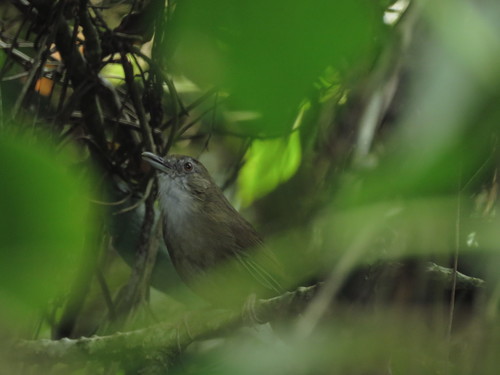 Abbott's Babbler
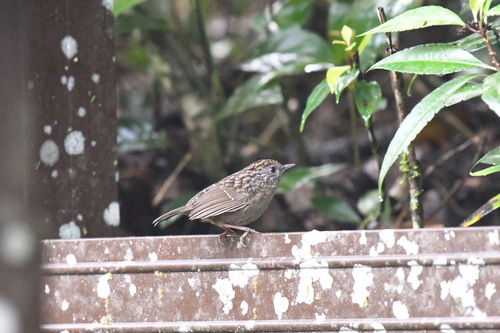 Streaked Wren-Babbler
In short
The most reliable field mark to separate Abbott's Babbler from Streaked Wren-Babbler is the presence of bold streaking on the underparts of the Streaked Wren-Babbler, which is entirely absent in Abbott's Babbler. Abbott's Babbler is a drab olive-brown bird with a white throat and belly center, rusty undertail, and no streaking, while Streaked Wren-Babbler is densely streaked below and above, giving it a much more patterned appearance. Abbott's Babbler is slightly larger, with a stouter structure and a heavier bill, and is typically seen in pairs low in dense undergrowth. Both species can overlap in range and habitat, but their plumage and structure are the best field clues.
Identification tips
- Streaked underparts: Streaked Wren-Babbler always shows bold streaking on the underparts and often above as well, at all ages. Abbott's Babbler is completely unstreaked below—this is the single most reliable field mark in any view.
- Plainness vs pattern: Abbott's Babbler is a plain, drab olive-brown bird with a white throat and belly center, olive flanks, and rusty undertail coverts. Streaked Wren-Babbler is much more patterned and contrasting, with heavy streaking and no rusty vent.
- Tail and structure: Abbott's Babbler is short-tailed but appears bulkier and more robust, with a heavy bill. Streaked Wren-Babbler is smaller, more compact, and has a proportionally shorter tail and finer bill.
- Juvenile confusion: Even juvenile Abbott's Babbler, with its darker rufescent-brown crown and upperparts, lacks streaking below. Any streaked juvenile is Streaked Wren-Babbler.
- Supercilium and lores: Abbott's Babbler may show a pale gray supercilium and lores, but these are subtle and not a strong separator. Streaked Wren-Babbler's face is more patterned due to streaking.
- Undertail color: Abbott's Babbler has bright rusty undertail coverts and vent, which are lacking in Streaked Wren-Babbler.
- Habitat context: If seen in secondary growth, forest edge, or disturbed habitats, Abbott's Babbler is more likely. In dense, undisturbed forest interior, both are possible, but Streaked Wren-Babbler is more typical.
- Behavior: Abbott's Babbler is often in pairs, foraging low and sometimes in the open, while Streaked Wren-Babbler is more secretive, often solitary or in small groups, and keeps to dense cover.
- Flight and movement: Abbott's Babbler flies with labored wingbeats and quickly disappears into cover, sometimes hopping away. Streaked Wren-Babbler is more likely to scuttle or creep through dense vegetation.
- Voice: Abbott's Babbler's song is a short series of rich, fluty, slurred notes, and its duet is distinctive. If you hear this, it is diagnostic for Abbott's Babbler. Streaked Wren-Babbler's voice is not described here, so absence of this song is not conclusive.
- Sex and season: Both species are similar between sexes and do not show strong seasonal plumage changes, so these are not useful separators.
- Local abundance: Both species can be common in their preferred habitats, but Abbott's Babbler is more adaptable to disturbed areas.
- Bill shape: Abbott's Babbler has a heavier, more robust bill, useful if seen well.
- Pitfall: Do not rely on subtle face pattern or supercilium alone, as these can be variable and misleading. Focus on streaking and overall pattern.
- When in doubt: If you see a plain, unstreaked, olive-brown babbler with a white throat and rusty vent, it is Abbott's. If the bird is streaked below or above, it is Streaked Wren-Babbler.
Size
Abbott's Babbler is slightly larger, measuring about 12–13 cm in length, and has a noticeably stouter build with a heavy bill and short tail [wikipedia]. Streaked Wren-Babbler is generally smaller and more compact, with a proportionally shorter tail and finer bill, though precise measurements are not given in the sources. In the field, Abbott's Babbler often appears bulkier and more robust, while Streaked Wren-Babbler is more delicate and rounded.
Plumage
- Juvenile/immature plumage: Juvenile Abbott's Babbler shows dark rufescent-brown crowns and upperparts, but still lacks any streaking below. Streaked Wren-Babbler, by contrast, is streaked both above and below at all ages, making this the most immediate visual difference in any plumage.
- Adult plumage: Abbott's Babbler is plain olive-brown above with a grayish-white throat and breast, white belly center, olive flanks, and rusty undertail coverts. There is no streaking anywhere. Streaked Wren-Babbler is heavily streaked on the underparts and upperparts, giving a much more patterned and contrasting look. Abbott's has a variable pale gray supercilium and lores, but these are subtle compared to the bold streaking of Streaked Wren-Babbler. The undertail of Abbott's is rusty, which is not a feature of Streaked Wren-Babbler. Sexes are alike in Abbott's Babbler; no sex differences are noted for Streaked Wren-Babbler.
Behaviour
Abbott's Babbler is usually seen in pairs, foraging close to the ground in dense undergrowth, often near streams or tangled vegetation. When disturbed, it flies with labored wingbeats and quickly disappears into cover, sometimes hopping out of sight. Streaked Wren-Babbler also prefers dense forest undergrowth but is more likely to be found singly or in small groups, moving quickly and often more secretively. Both species are skulking, but Abbott's Babbler is more likely to be seen in open tangles or at forest edge, while Streaked Wren-Babbler is more strictly tied to dense, moist forest interiors.
Habitat
Both species overlap in subtropical or tropical moist lowland and montane forests across South and Southeast Asia. Abbott's Babbler is more tolerant of secondary growth, scrub, and disturbed forest, and may be found at forest edge or in regenerating areas. Streaked Wren-Babbler is more closely associated with dense, moist forest interiors and is less likely to be found in disturbed or secondary habitats. If you are in open, edge, or secondary growth, Abbott's Babbler is more likely; in dense, undisturbed forest, both are possible but Streaked Wren-Babbler is more typical.
Voice
Abbott's Babbler has a distinctive, variable song of three or four rich, fluty, slurred notes, sometimes halting, sometimes rapid. Its calls include soft mewing notes and a pulsing, purring trill when agitated. The antiphonal duet is also distinctive, with the male's 'poor'ol bear' followed by the female's 'dear dear.' Streaked Wren-Babbler's vocalizations are not described in the provided notes, so voice is only a reliable separator if Abbott's Babbler's distinctive song or duet is heard.