

Perruche turquoisine vs Perruche splendide
Neophema pulchella contre Neophema splendida
Faire un quiz avec Perruche turquoisine et Perruche splendide
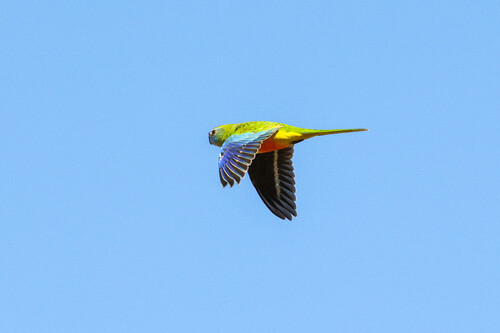 Perruche turquoisine
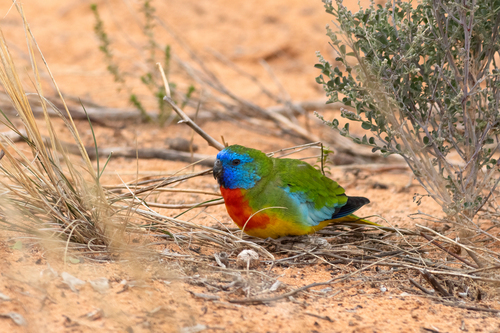 Perruche splendide
En bref
The most reliable field mark between Turquoise Parrot and Scarlet-chested Parrot is the presence of a scarlet (red) chest in adult male Scarlet-chested Parrot, which is never shown by Turquoise Parrot. For females and immatures, focus on the face and wing pattern: female Turquoise Parrot has a paler blue face and a broad white bar on the underwing in flight, while female Scarlet-chested Parrot has blue lores and a paler blue wing patch but lacks the white underwing bar. Both species are small, slender parrots with green upperparts and yellow underparts, but their ranges do not overlap in the wild—Turquoise Parrot is found in eastern Australia, Scarlet-chested Parrot in arid inland areas further west. Immature males of Scarlet-chested Parrot gradually acquire the red chest, so young birds can be confusing; look for the combination of face color, wing markings, and underwing pattern to separate them.
Conseils d’identification
- Adult male Scarlet-chested Parrot always shows a vivid scarlet chest—if you see a red chest, it is not Turquoise Parrot. Turquoise Parrot males never have a red chest, though some may have an orange belly wash.
- Male Turquoise Parrot shows a bright turquoise-blue face (darker on the crown) and a red shoulder patch on the wing. Scarlet-chested Parrot male has a cobalt blue face but lacks the red shoulder patch.
- Female Turquoise Parrot has a paler, more uniform blue face and a broad white bar on the underwing (visible in flight). This underwing bar is absent in Scarlet-chested Parrot females.
- Female Scarlet-chested Parrot has blue lores and a paler blue wing patch. The blue on the face is less extensive than in males and is a key contrast with Turquoise Parrot females, which have a more uniform blue face.
- Juvenile and immature Turquoise Parrots of both sexes show a white underwing stripe in flight, which disappears in adult males. Scarlet-chested Parrot immatures do not show this underwing bar.
- Immature male Scarlet-chested Parrot gradually acquires the red chest from 2–3 months, completed by 15–18 months. During this period, young males may lack obvious red and resemble females or Turquoise Parrots; check the face and underwing pattern.
- Turquoise Parrot females and immatures have cream bare skin around the eye, which is more contrasting than in Scarlet-chested Parrot.
- Bill color is not reliably diagnostic in the field: both species have dark upper mandibles, but Turquoise Parrot females may have a paler brown-grey bill with a darker tip.
- In flight, look for the white underwing bar (Turquoise Parrot female/immature) versus no bar (Scarlet-chested Parrot).
- Habitat and range are strong clues: Turquoise Parrot is only in eastern Australia woodlands; Scarlet-chested Parrot is only in arid inland regions. If you are outside the known range, reconsider the ID.
- Both species are similar in size and structure: do not rely on size or shape for separation.
- Both sexes of Scarlet-chested Parrot have a green tail and bright green upperparts, similar to Turquoise Parrot, so focus on face, chest, and wing pattern for separation.
- Vocalizations are not highly distinctive in the field: Scarlet-chested Parrot is quieter, but this is subtle and not a primary field mark.
- If you see a parrot with a red patch on the wing (not the chest), consider immature male Turquoise Parrot.
- If uncertain, prioritize underwing pattern (white bar in Turquoise Parrot female/immature) and face/chest color for the most reliable separation, especially in flight or with distant views.
Taille
Both species are very similar in size and structure: Turquoise Parrot measures about 20–22 cm in length and weighs around 40 g, while Scarlet-chested Parrot is 19–21 cm long. Both are lightly built, slender parrots with similar proportions. Size alone is not reliable for separation in the field.
Plumage
-
Adult males: Scarlet-chested Parrot males have a vivid scarlet chest and a cobalt blue face, with yellow lower underparts and green upperparts. Turquoise Parrot males lack any red on the chest; instead, they show a bright turquoise-blue face (darker on the crown), grass-green upperparts, yellow underparts, and a red shoulder patch on the wing. Some Turquoise Parrot males may show an orange wash on the belly, but never a solid red chest.
-
Adult females: Both species' females are duller, with green upperparts and yellow underparts. Female Turquoise Parrot has a paler, more uniform blue face and a broad white bar on the underwing (visible in flight), plus cream bare skin around the eye. Female Scarlet-chested Parrot has blue lores and a paler blue wing patch, but lacks the red chest and the white underwing bar.
-
Immatures/juveniles: Both species' immatures are duller versions of adults. Juvenile Turquoise Parrots of both sexes have less blue on the face (not extending past the eye) and a white underwing stripe; immature males show a red patch on the wing and sometimes an orange wash on the belly. Scarlet-chested Parrot immatures are duller overall; young males start to develop the red chest from 2–3 months but do not complete it until 15–18 months. Female Scarlet-chested Parrot closely resembles female Turquoise Parrot but can be separated by blue lores and paler blue wing patch, and lacks the underwing bar.
Comportement
Both species are generally unobtrusive and can be overlooked when feeding quietly on the ground. Scarlet-chested Parrot is described as nomadic, moving in response to conditions in arid regions, while Turquoise Parrot is more sedentary within its eastern range. Both feed mainly on grass seeds. Flight is swift and direct in both, but the white underwing bar of female and juvenile Turquoise Parrot is a useful mark in flight.
Habitat
Turquoise Parrot is native to eastern Australia, found in open woodland and savanna, especially with eucalypts or cypress. Scarlet-chested Parrot is restricted to central South Australia and inland southern Western Australia, favoring arid and semi-arid regions, often with spinifex. Their ranges do not overlap in the wild, so location is a strong clue. Turquoise Parrot is never found in the arid interior, and Scarlet-chested Parrot does not occur in the eastern woodlands.
Voix
Scarlet-chested Parrot has a soft, twittering call, said to be quieter than other Neophema parrots. No distinctive vocal differences are noted for Turquoise Parrot in the provided notes.
Perruche turquoisine · Perruche splendide · Mes oiseaux difficiles