

Yellow-olive Flatbill vs Yellow-bellied Tyrannulet
Tolmomyias sulphurescens versus Ornithion semiflavum
Play a quiz with Yellow-olive Flatbill and Yellow-bellied Tyrannulet
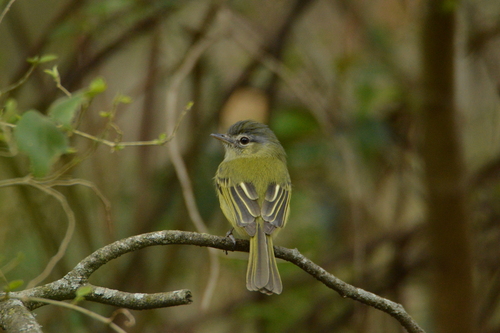 Yellow-olive Flatbill
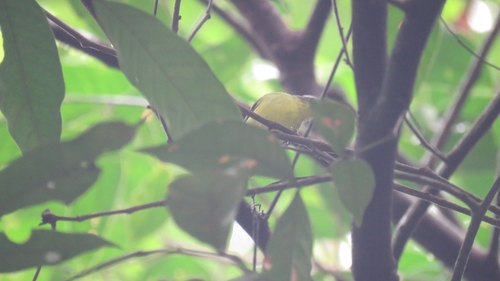 Yellow-bellied Tyrannulet
In short
The most reliable field mark is size and structure: Yellow-olive Flatbill is much larger and heavier-bodied with a broad, flat bill, while Yellow-bellied Tyrannulet is tiny and delicate with a short, pointed bill. Both species have olive-green upperparts and yellow underparts, but the Flatbill shows a darker olive crown and two yellowish wingbars, while the Tyrannulet has a slate-grey crown with a crisp white supercilium and forehead. Juveniles of both are paler below, but the Tyrannulet’s small size and sharp bill are always distinctive. If you see a small flycatcher with a strong white eyebrow and tiny proportions, it's the Tyrannulet; a bigger, thick-billed bird with a more subdued face pattern is the Flatbill.
Identification tips
- Size is the fastest separator: If the bird is tiny (barely larger than a kinglet), it's the Yellow-bellied Tyrannulet. If it’s noticeably larger, approaching the size of a small vireo or large warbler, it’s the Yellow-olive Flatbill. This holds for all ages and seasons.
- Bill shape and size: Flatbill has a broad, flat, paddle-shaped bill (especially obvious in profile or head-on views). Tyrannulet’s bill is short, thin, and pointed, never flat or wide. Bill color is black in both, but Flatbill’s mandible can be pale gray to pinkish.
- Facial pattern: Tyrannulet shows a strong white supercilium and forehead (almost a 'white brow'), contrasting with a slate-grey crown. Flatbill’s face is plainer, with only a thin white band above the lores and a thin white eye-ring; crown is olive or grayish-olive, not sharply set off from the face.
- Wingbars: Flatbill has two yellowish-olive wingbars formed by edging on the wing coverts, visible when perched. Tyrannulet lacks distinct wingbars; its wings are plain dusky olive with little contrast.
- Crown color: Flatbill’s crown is dark olive (sometimes grayish in some subspecies), blending into the nape. Tyrannulet’s crown is slate-grey, sharply contrasting with the white forehead and supercilium.
- Underparts: Both have bright yellow bellies, but Flatbill’s breast and flanks are grayish greenish olive, while Tyrannulet’s yellow is more extensive and uniform, with only faint olive streaks on the breast/flanks.
- Iris color: Flatbill’s iris is variable (pale brown to pale gray or even grayish in some subspecies), while Tyrannulet’s is consistently brown. This is subtle and rarely diagnostic in the field.
- Juvenile differences: Flatbill juveniles have a broken eye-ring and dark iris; Tyrannulet juveniles have a brownish crown and upperparts, and paler yellow below. Both are paler than adults, but Tyrannulet’s tiny size and facial contrast remain.
- Tail: Flatbill’s tail is brownish to dusky with buffy edges; Tyrannulet’s tail is dusky olive, matching the wings. Tail shape is not a strong separator.
- Leg color: Both have gray to dark gray legs and feet; not useful for separation.
- Behavior: Tyrannulet is much more active, flitting and hovering among foliage; Flatbill is bulkier and perches more deliberately.
- Habitat: Overlap is extensive in Central America; do not rely on habitat alone.
- Geographic range: If seen in South America (outside Panama/Colombia), it is almost certainly Flatbill. In Mexico and Central America, both occur.
- Sex and season: Both sexes look alike year-round in both species; no seasonal plumage change.
- Pitfalls: Do not confuse Flatbill’s thin white eye-ring and band above the lores for a true supercilium; only Tyrannulet has a bold white brow. Wingbars are only present on Flatbill. Always check bill shape and size first if in doubt.
Size
Yellow-olive Flatbill is significantly larger: 12.5–14 cm long and 14.5–15.2 g in weight. Yellow-bellied Tyrannulet is much smaller, at only 8–9 cm and 7–8 g. The Flatbill appears robust and heavy-bodied, while the Tyrannulet is noticeably petite and dainty. In direct comparison, the Flatbill is almost twice the mass and a third longer in length. This size difference is obvious in the field if both are seen together or with familiar reference species.
Plumage
- Juveniles: Both species have paler underparts as juveniles. Flatbill juveniles have a broken eye-ring and dark iris, while Tyrannulet juveniles show a brown tinge to the crown and upperparts, and even paler yellow below.
- Adults: Flatbill adults have a dark olive (sometimes grayish, depending on subspecies) crown and nape, thin white eye-ring, and two yellowish-olive wingbars. The face is relatively plain except for a thin white band above the lores. Underparts are grayish olive on the breast, bright yellow on the belly. Tyrannulet adults have a slate-grey crown with a striking white forehead, lores, and supercilium, giving a strong 'eyebrow' effect. Their upperparts are bright olive, wings and tail dusky olive, and underparts bright yellow with faint olive streaks on the breast and flanks. The Tyrannulet lacks the Flatbill’s wingbars and has a much more contrasting facial pattern.
- Wing pattern in flight: No distinctive juvenile or immature upperwing patterns (like triangles or W-marks) are described for either species; both have fairly plain wings with subtle edging, but Flatbill’s wingbars are more apparent when perched.
Behaviour
Both are active canopy or edge flycatchers, but the Tyrannulet’s small size and quick, darting movements make it appear more restless and energetic. Flatbill is bulkier and tends to perch more deliberately, often sallying out from a prominent perch. The Tyrannulet’s behavior is often described as flitting and hovering among foliage, while Flatbill is more likely to sit still for longer intervals. In flight, the Tyrannulet’s tiny, compact shape is distinctive compared to the Flatbill’s broader wings and heavier jizz.
Habitat
Both species overlap widely in Central America and edge habitats, but Yellow-olive Flatbill has a much broader range, found from Mexico through all of Central America, Trinidad, and nearly all of South America except Chile. Yellow-bellied Tyrannulet is restricted to Central America and southern Mexico. Both prefer forest edges, second growth, and open woodland, so habitat alone is not diagnostic within the overlap zone.
Yellow-olive Flatbill · Yellow-bellied Tyrannulet · My Tricky Birds