

Yellow-bellied Flycatcher vs Hammond's Flycatcher
Empidonax flaviventris versus Empidonax hammondii
Play a quiz with Yellow-bellied Flycatcher and Hammond's Flycatcher
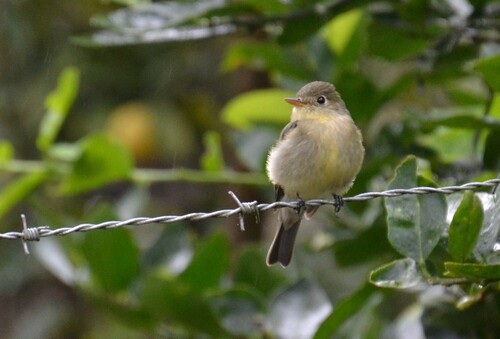 Yellow-bellied Flycatcher
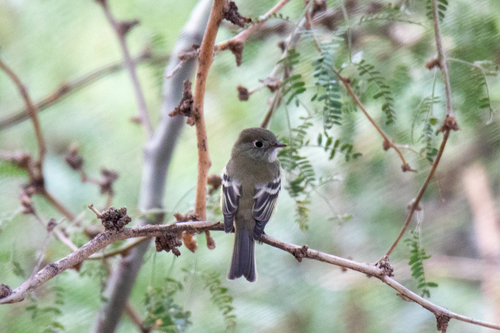 Hammond's Flycatcher
In short
The most reliable field mark between Yellow-bellied and Hammond's Flycatchers is the overall color of the underparts: Yellow-bellied shows distinctly yellowish underparts (especially on the throat and belly), while Hammond's is much whiter below with only a faint yellow wash on the belly sides. Both species have strong eye rings and wing bars, but Yellow-bellied's are often more yellowish and contrast more with the black wings. Bill color and structure also help: Yellow-bellied has a broader, flatter bill with a dark upper mandible and orange-pink lower, while Hammond's has a smaller, narrower bill. Juvenile/immature birds of both species can show broader, buffier wing bars, but the overall underpart color and bill shape remain useful. Structural and behavioral clues, as well as subtle differences in voice, can further aid separation.
Identification tips
- Underpart Color (All Ages): Yellow-bellied Flycatcher has distinctly yellowish underparts, especially on the throat and belly, while Hammond's Flycatcher is whitish below with only a faint yellow wash on the belly sides and a grayish wash on the breast. This is the most consistent field mark.
- Upperparts Tone: Yellow-bellied is greenish above, contrasting with its yellow underparts. Hammond's is grayish-olive above, giving a duller, colder overall impression.
- Wing Bars (All Ages): Both species show two pale wing bars, but Yellow-bellied's are often more yellowish and strongly contrast with black wings, while Hammond's are white and less contrasting. Immatures of both species can have broader, buffier wing bars, but the underpart color remains a better clue.
- Eye Ring: Both have a strong eye ring, but Yellow-bellied's may be more yellowish, while Hammond's is usually bright white. The eye ring shape is not a strong separator between these two.
- Bill Structure and Color: Yellow-bellied has a broad, flat bill with a dark upper mandible and orange-pink lower mandible. Hammond's has a smaller, narrower bill, generally darker overall. Bill color is especially useful in good light.
- Tail Length and Shape: Both have relatively short tails, but Yellow-bellied's is especially short for an Empidonax. This is a subtle distinction and not always reliable in the field.
- Perch Height and Behavior: Yellow-bellied tends to perch lower or mid-level in trees, while Hammond's prefers higher, more open perches in the upper canopy. Use this in combination with other marks.
- Vocalizations: If singing, Yellow-bellied gives a rough, descending "tse-berk"; Hammond's gives a more complex, multi-versed song. Calls are less distinctive but can help with experience.
- Habitat Context: In the east or boreal forests, Yellow-bellied is more likely; in mature western coniferous forests, especially fir/aspen, Hammond's is expected. Range and habitat are supporting clues, not primary field marks.
- Sex Differences: Female Hammond's may have a shorter, wider bill than males, but this is subtle and not a reliable field mark for separation from Yellow-bellied.
- Juvenile/Immature Birds: Both can show buffy or yellowish wing bars when immature, but Yellow-bellied's yellow underparts are still distinctive. Hammond's immatures are more buff overall but remain whitish below.
- Flight Impression: Both species sally for insects and hover-glean, but Hammond's may appear slightly more slender and longer-winged due to its marginally greater wingspan.
- Pitfalls: Do not rely solely on wing bar color or eye ring shape; always check underpart color and bill structure. Immature birds can be especially confusing, but the yellow wash of Yellow-bellied is usually visible.
- When Marks Fail: In poor light or worn plumage, underpart color may be muted. Use bill color/shape and behavior as backup. Voice is essential if seen poorly.
- Summary: Always combine underpart color, bill structure, and habitat/behavior for the most reliable identification, especially in mixed flocks or migration.
Size
Both species are very similar in size, with Yellow-bellied Flycatcher averaging a body mass of 11.3 g [wikidata] and Hammond's Flycatcher ranging from 8–12 g [wikipedia]. In length, Yellow-bellied is 13–15 cm (5.1–5.9 in) and Hammond's is 12–14 cm (4.7–5.5 in), so there is extensive overlap and size alone is not a reliable field mark. Wingspan is slightly larger in Hammond's (22 cm vs. 18–20 cm), but this is subtle and not easily judged in the field.
Plumage
-
Juvenile/Immature birds: Both species' immatures have broader, buffier wing bars than adults. Hammond's immatures are especially noted for buffy wing bars and a generally more buff appearance, but Yellow-bellied can also show yellowish or buffy wing bars. The key difference remains the underparts: Yellow-bellied immatures are yellowish throughout the underparts (especially throat and belly), while Hammond's immatures are whitish below with only a faint yellow wash on the belly sides and a grayish wash on the breast.
-
Adults: Yellow-bellied Flycatcher has greenish upperparts and yellowish underparts, with a yellowish or white eye ring and yellowish or white wing bars that contrast strongly with the black wings. Hammond's Flycatcher is grayish-olive above, with whitish underparts, a conspicuous white eye ring, and white wing bars; the breast is washed gray and only the sides of the belly show a yellow tinge. Bill color is also a clue: Yellow-bellied's lower mandible is orange-pink, while Hammond's is generally darker and smaller.
Behaviour
Both species use similar feeding strategies, sallying from perches to catch insects in flight and sometimes hovering to glean from foliage. Yellow-bellied Flycatcher typically perches low or mid-level in trees, while Hammond's often chooses higher, more open perches in the upper parts of trees. This difference in preferred perch height can be a subtle behavioral clue in the right habitat.
Habitat
Yellow-bellied Flycatcher is most often found in moist, mixed or coniferous forests, especially in the boreal zone, and prefers lower or mid-level perches. Hammond's Flycatcher is characteristic of mature coniferous and mixed forests of western North America, especially dense fir, aspen, and dogwood forests, and is more likely to be found in the upper canopy. While both can overlap in some coniferous habitats, Hammond's is more strictly associated with mature western forests.
Voice
Yellow-bellied Flycatcher's song is a rough, descending "tse-berk," which can be confused with the Least Flycatcher but is less snappy and more descending. Hammond's Flycatcher gives a multi-versed, hoarse "ssilit, greeep, silit, pweet" and a sharp "peek" call. Hammond's does not sing on migration or wintering grounds. In the field, vocalizations are subtle and can be difficult to separate unless heard well, but Yellow-bellied's song is typically simpler and more descending, while Hammond's is more complex and variable.
Yellow-bellied Flycatcher · Hammond's Flycatcher · My Tricky Birds