
Willow Warbler vs Iberian Chiffchaff
Phylloscopus trochilus versus Phylloscopus ibericus
Play a quiz with Willow Warbler and Iberian Chiffchaff
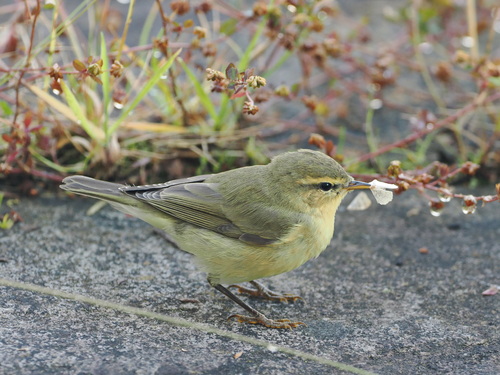 Willow Warbler
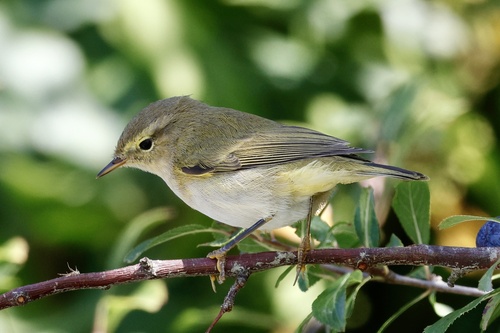 Iberian Chiffchaff
In short
Willow Warbler and Iberian Chiffchaff are notoriously similar leaf warblers, but careful observation of structure and subtle plumage details can separate them. The most reliable field mark is the Willow Warbler’s longer primary projection (wingtip extension beyond the tertials), which is noticeably greater than in Iberian Chiffchaff of all ages. Willow Warbler also tends to look more elegant and slender, with a longer, paler bill and paler pinkish-yellow legs, while Iberian Chiffchaff is slightly stockier with a cleaner green upperpart and a distinct dark eyestripe. Both species lack wingbars and have yellowish underparts, but Iberian Chiffchaff’s breast is more strongly yellow and the belly whiter, creating a sharper contrast. Vocalizations are helpful but variable; Willow Warbler’s song is a sweet descending whistle, while Iberian Chiffchaff’s is more complex and rattling.
Identification tips
- Primary projection (all ages): Willow Warbler shows a distinctly longer primary projection (the wingtip extends well beyond the tertials when perched), giving a more pointed wing. Iberian Chiffchaff’s projection is shorter, making the wing look rounder and the bird more compact.
- Overall shape and jizz: Willow Warbler appears more slender and elegant, with a longer body and tail, while Iberian Chiffchaff is slightly stockier and shorter-winged.
- Bill color and length: Willow Warbler has a longer, paler bill (often pinkish at the base), while Iberian Chiffchaff’s bill is slightly shorter and may be darker, though not as dark as common chiffchaff.
- Leg color: Willow Warbler’s legs are pale pinkish-yellow. Iberian Chiffchaff’s leg color is not described in detail, but if legs appear dark, consider Iberian Chiffchaff less likely (though this is not as reliable as for common chiffchaff).
- Upperpart color: Willow Warbler is greenish-brown above, sometimes with a browner or greyer cast depending on subspecies. Iberian Chiffchaff is cleaner, more olive-green above, lacking any brown hue.
- Underpart pattern: Willow Warbler is off-white to yellowish below, with juveniles especially yellow. Iberian Chiffchaff has a strongly yellow breast and a white belly, creating a sharper division between breast and belly.
- Facial pattern: Iberian Chiffchaff has a more distinct dark eyestripe, making the face look more contrasting. Willow Warbler’s face is plainer.
- Wingbars: Both species lack wingbars; do not use this feature.
- Juvenile plumage: Willow Warbler juveniles are yellower below than adults, which can be a clue in late summer and autumn. Iberian Chiffchaff juveniles are not specifically described but likely resemble adults.
- Song: Willow Warbler’s song is a sweet, descending whistle, very different from the complex, rattling, and repetitive song of Iberian Chiffchaff. Use song if heard well.
- Call: Willow Warbler’s call is a disyllabic 'hoo-eet', while Iberian Chiffchaff’s is faster and more monotonous, but calls are less reliable for separation.
- Habitat and range: Willow Warbler is widespread in northern and temperate Europe; Iberian Chiffchaff is restricted to southwestern Europe and northwestern Africa. Out of range, consider the commonness of each species.
- Season: Both are migratory and may overlap on passage, so do not rely solely on date except at the extremes of their ranges.
- Sex: No sexual dimorphism; all marks apply to both sexes.
- Pitfalls: Both are easily confused with common chiffchaff, but the above marks are most useful when directly comparing Willow Warbler and Iberian Chiffchaff. Always check multiple features, as individual variation and light can mislead.
Size
Both species are very similar in size, with Willow Warbler measuring 11–12.5 cm in length and weighing 7–15 g [wikipedia]. Iberian Chiffchaff is described as slightly larger, but this difference is minimal and not reliable in the field. Structure is more useful: Willow Warbler appears more elongated due to its longer wings and primary projection, while Iberian Chiffchaff is a touch more compact.
Plumage
- Juvenile/immature birds: Both species lack wingbars and have plain upperwings, so flight pattern is not helpful. However, Willow Warbler juveniles are noticeably yellower below than adults, while Iberian Chiffchaff juveniles are not specifically described but likely show a similar pattern to adults: yellow breast and white belly with a pronounced dark eyestripe.
- Adults: Willow Warbler is greenish-brown above with off-white to yellowish underparts, and the wings are plain greenish-brown. Iberian Chiffchaff has cleaner, more olive-green upperparts with no brown hue, a yellow breast, and a white belly, creating a sharper division between breast and belly. Both species lack wingbars. Willow Warbler’s legs are paler pinkish-yellow, while Iberian Chiffchaff’s are not described in detail but are darker in common chiffchaff, so may be intermediate. The eyestripe is more pronounced in Iberian Chiffchaff, enhancing the facial contrast.
Behaviour
Both species are active, restless foragers in trees and shrubs, often flicking wings and tails. Willow Warbler may appear slightly more graceful and elongated in movement, reflecting its longer wings and overall shape. No major behavioral differences are noted that would reliably separate them in the field.
Habitat
Willow Warbler breeds across a vast range in northern and temperate Europe and the Palearctic, favoring open woodlands with birch, alder, and willow. Iberian Chiffchaff is restricted as a breeder to southwestern Europe and northwestern Africa, often in oak woods, scrub, and riverine forests. Overlap is minimal except on migration, but habitat alone is not diagnostic where both may occur.
Voice
Willow Warbler’s song is a simple, sweet, repetitive descending whistle, and its contact call is a disyllabic 'hoo-eet'. Iberian Chiffchaff’s song is more complex, with repeated 'chiff-chiff-chiff-chiff-dr-dr-dr-dr-swit-swit-swit' phrases, including rattles and drawn-out whistles. The call is faster and more monotonous than the common chiffchaff, but both species’ calls can be confusing without experience. Willow Warbler’s song is the easiest to separate; calls are less reliable.