

Willow Warbler
Phylloscopus trochilus
Leaf Warblers (Phylloscopidae) · Passeriformes · Leaf Warblers
Play a quiz with Willow Warbler and similar species
View all photos, video and sound
Reviewed
How to identify Willow Warbler
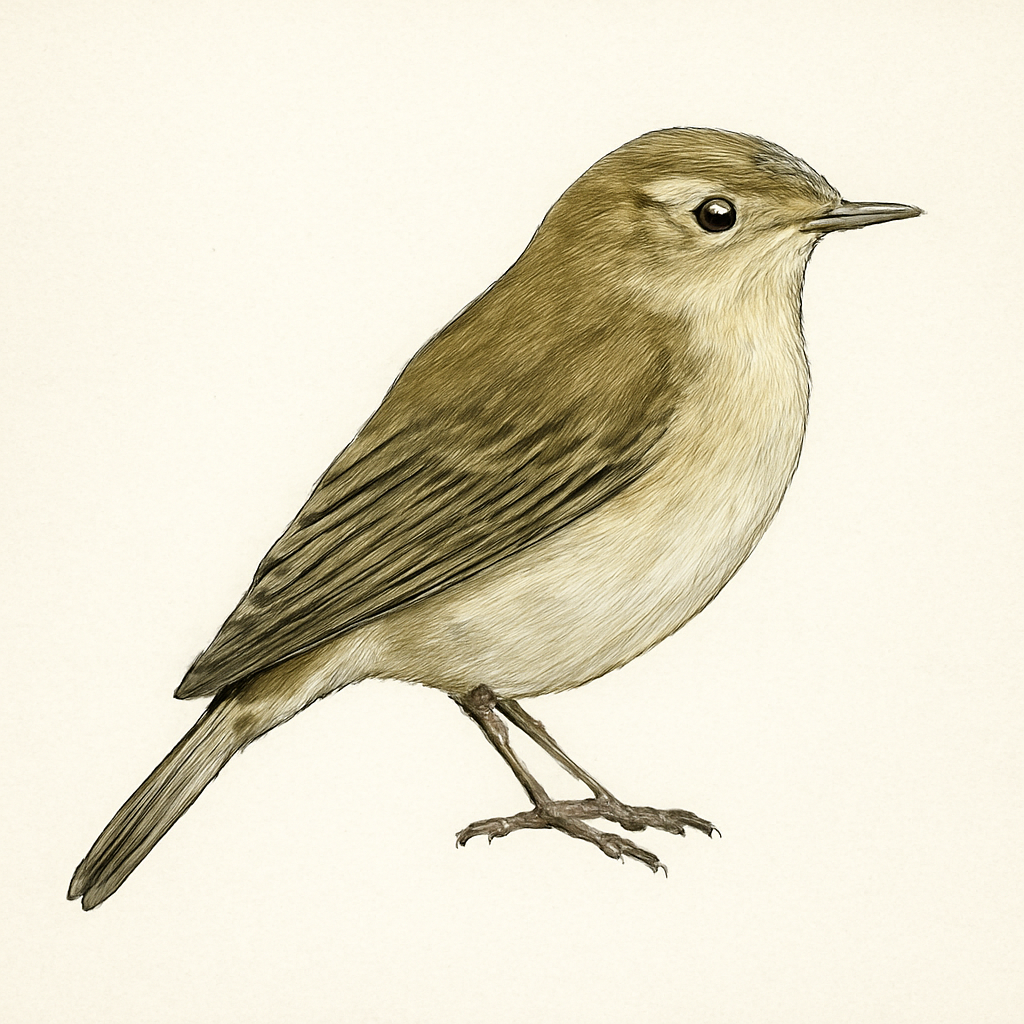
Willow Warbler is a slim, greenish-brown leaf warbler with pale legs, a long pale bill, and a long primary projection—never shows wingbars.
The Willow Warbler is a slim, elegant leaf warbler with greenish-brown upperparts and off-white to yellowish underparts. It never shows wingbars. Its legs are distinctly pale pinkish-yellow, and the bill is longer and paler than most similar warblers. The primary projection (the length of the wingtip feathers beyond the secondaries) is long, giving the wing a pointed look at rest. Juveniles are brighter yellow below than adults, but the overall structure and plain wings remain consistent.
Compared to other leaf warblers, Willow Warbler stands out for its delicate build and longer wings. The face is rather plain, with a faint pale supercilium. In the field, it often flicks its wings and moves actively through open woodland, especially among birch, alder, and willow trees.
The song is a simple, sweet, descending series of whistles, and its contact call is a disyllabic 'hoo-eet', which helps distinguish it from similar species.
Similar species
- Common Chiffchaff: Shorter primary projection, darker legs (dark brown to blackish), shorter and darker bill, and a more compact, less elegant shape. Song and call differ: chiffchaff's call is a monosyllabic 'hweet'. → How to tell them apart
- Wood Warbler: Brighter yellow throat and breast, white belly, bold supercilium, and much shorter primary projection. Wood Warbler is bulkier and more contrastingly marked. → How to tell them apart
- Iberian Chiffchaff: Similar to chiffchaff but with slightly paler legs and longer primary projection; voice is the most reliable difference. → How to tell them apart
- Plain Leaf Warbler: Duller overall, lacks yellow tones, and has a shorter primary projection and bill. → How to tell them apart
- Greenish Warbler: Shows a faint wingbar and is greyer above, with a more distinct supercilium. → How to tell them apart
- Dusky Warbler: Darker brown above, buffy supercilium, and lacks yellow tones below. → How to tell them apart
Often mixed up with
In quizzes, players most often confuse Willow Warbler with these birds—either this species was picked by mistake, or the other way around.
| Species | Mix-ups |
|---|---|
| Common Chiffchaff Phylloscopus collybita | 1013 |
| Wood Warbler Phylloscopus sibilatrix | 266 |
| Iberian Chiffchaff Phylloscopus ibericus | 234 |
| Cetti's Warbler Cettia cetti | 152 |
| Western Bonelli's Warbler Phylloscopus bonelli | 108 |
Family
Leaf warblers are small insectivorous passerine birds belonging to the genus Phylloscopus. Leaf warblers were formerly included in the Old World warbler family but are now considered to belong to the family Phylloscopidae, introduced in 2006. The family originally included the genus Seicercus, but all species have been moved to Phylloscopus in the most recent classification.
Order
A passerine () is any bird of the order Passeriformes (; from Latin passer 'sparrow' and formis '-shaped'), which includes more than half of all bird species. Sometimes known as perching birds, passerines generally have an anisodactyl arrangement of their toes (three pointing forward and one back), which facilitates perching. With more than 140 families and some 6,500 identified species, Passeriformes is the largest order of birds and one of the most diverse clades of terrestrial vertebrates, representing 60% of …