

White-tipped Dove vs Zenaida Dove
Leptotila verreauxi versus Zenaida aurita
Play a quiz with White-tipped Dove and Zenaida Dove
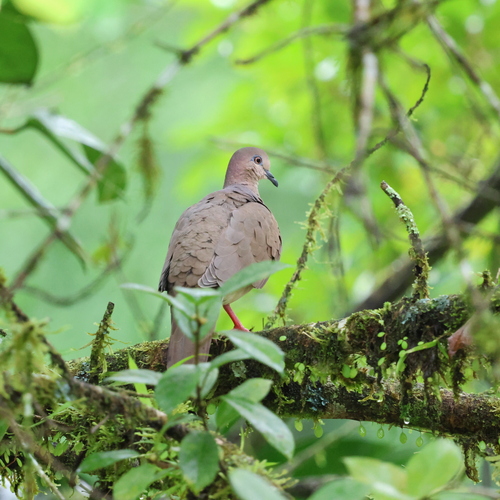 White-tipped Dove
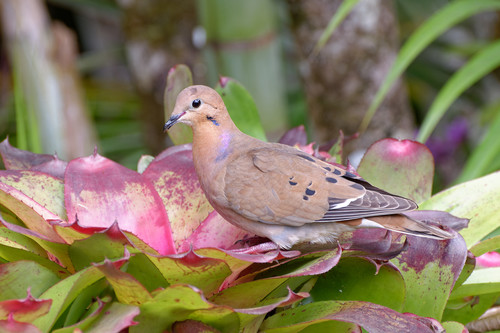 Zenaida Dove
In short
The most reliable field mark between White-tipped Dove and Zenaida Dove is the white on the trailing edge of the wing in flight, which is present in Zenaida Dove but absent in White-tipped Dove. Both species are similar in size and overall shape, but differ subtly in plumage and structure. White-tipped Dove shows a broad white tip to the tail (best seen from below), while Zenaida Dove has a shorter, more rounded tail and is overall darker. Eye-ring color and subtle head coloration can help, but are variable and unreliable in some regions. Both species are ground-foraging doves, but their preferred habitats and vocalizations differ.
Identification tips
- White trailing edge to wing in flight: Zenaida Dove shows a clear white trailing edge on the wing in flight (all ages), which is never present in White-tipped Dove. Look for this flash of white when the bird takes off or flies past.
- Broad white tip to tail: White-tipped Dove has a broad white tip to the tail, best seen from below in flight or when the tail is spread. Zenaida Dove's tail is shorter, more rounded, and lacks this broad white tip.
- Tail shape: Zenaida Dove's tail is distinctly shorter and more rounded compared to the longer, more squared tail of White-tipped Dove. This can be judged when birds are perched or in flight.
- Head and forehead color: White-tipped Dove has a pale grey or whitish forehead and throat, with a grey crown and nape that blend smoothly into the rest of the head. Zenaida Dove's head is darker and less contrasting, appearing more uniformly brownish.
- Overall darkness: Zenaida Dove is generally darker and more uniformly brown above and below, while White-tipped Dove is paler below and has more contrast between the head and body.
- Eye-ring color: White-tipped Dove usually has a red eye-ring, but in much of Amazonia and northern South America it is blue. This mark is unreliable in Brazil, Argentina, Bolivia, Paraguay, and Uruguay, where both species can have red eye-rings. Do not rely solely on this feature.
- Iris color: White-tipped Dove has a yellow iris, which can be visible at close range. Zenaida Dove's iris color is not specified as diagnostic.
- Underwing color: White-tipped Dove has rufous underwing coverts, but this is rarely visible except in strong light or close views. Zenaida Dove does not show this feature.
- Leg color: Both species have reddish legs; this is not a useful distinction.
- Flight style: Both species have fast, direct flight with regular wingbeats, but Zenaida Dove may appear more compact and agile due to its shorter tail.
- Vocalization: Listen for a deep, hollow two-note call from White-tipped Dove ("ooo-wooooo") versus a faster, rolling, multi-note call from Zenaida Dove ("cooOOoo-coo-coo-coo").
- Habitat: In open or urban areas, especially near beaches or coastal scrub, Zenaida Dove is more likely. In denser woodland or forest edge, White-tipped Dove is more typical.
- Behavior: White-tipped Dove is more likely to be seen alone or in pairs and is notably wary. Zenaida Dove may be more tolerant of people and found in small groups, especially near water or in urban parks.
- Pitfall – Mourning Dove confusion: Zenaida Dove is often confused with Mourning Dove, but White-tipped Dove is not. If you see a dove with a white trailing edge to the wing in the Caribbean or Yucatan, it's Zenaida, not White-tipped.
- Pitfall – eye-ring color: Do not rely on eye-ring color alone in southern South America, as both species can show red eye-rings there.
Size
Both species are very similar in size, with White-tipped Dove around 28 cm in length and Zenaida Dove 28–30 cm. Adult body mass is essentially identical (White-tipped Dove: ~155 g [wikipedia]; Zenaida Dove: 159 g [wikidata]). There is no consistent size difference in the field. Zenaida Dove may appear slightly more compact due to its shorter, more rounded tail, but this is subtle.
Plumage
- In flight (all ages): Zenaida Dove shows a distinct white trailing edge to the wing, visible as a flash in flight, which is absent in White-tipped Dove. White-tipped Dove instead shows a broad white tip to the tail, especially from below, but not on the wing.
- Adults: White-tipped Dove has a pale grey or whitish forehead and throat, with a greyer crown and nape that contrast less with the hindcrown than in Zenaida Dove. Its underparts are whitish shading to pinkish or buff on the chest. The upperparts are grey-brown. Zenaida Dove is darker overall, with a more uniform brownish coloration and less contrast on the head. Both species have reddish legs, but White-tipped Dove has a yellow iris and, depending on region, a red or blue eye-ring (blue in much of Amazonia and northern South America; red elsewhere). Zenaida Dove's eye-ring color is not diagnostic here.
- Tail: White-tipped Dove's tail is longer and broadly tipped with white, while Zenaida Dove's is shorter, more rounded, and lacks the broad white tip.
- Underwing: White-tipped Dove has rufous underwing coverts, but this is rarely visible except in strong light or at close range.
Behaviour
Both species forage mainly on the ground, feeding on seeds and some insects. White-tipped Dove is usually seen alone or in pairs and is notably wary, often keeping to cover. Zenaida Dove is also ground-foraging but may be more tolerant of human presence, especially in urban or semi-urban settings. Both species have fast, direct flight with regular wingbeats typical of pigeons, but Zenaida Dove may appear more compact and agile due to its shorter tail.
Habitat
White-tipped Dove is found in a variety of woodland habitats, often in denser cover and less open areas. Zenaida Dove prefers open and semi-open habitats, especially lowlands, coastal plains, bushy scrublands, beaches, and even highly urbanized areas. In Jamaica, Zenaida Dove can be found at higher elevations, but generally it is more associated with open or edge habitats than White-tipped Dove.
Voice
White-tipped Dove gives a deep, hollow two-note call: an introductory hoot followed by a longer, more audible, hollow note ("ooo-wooooo"). Zenaida Dove's call is a faster-paced, mournful "cooOOoo-coo-coo-coo," similar to Mourning Dove but more rapid. Both calls are low-pitched and can carry, but the rhythm and number of notes differ. White-tipped Dove's call is more spaced and hollow; Zenaida Dove's is more rapid and rolling.