

White-throated Swallow vs Wire-tailed Swallow
Hirundo albigularis versus Hirundo smithii
Play a quiz with White-throated Swallow and Wire-tailed Swallow
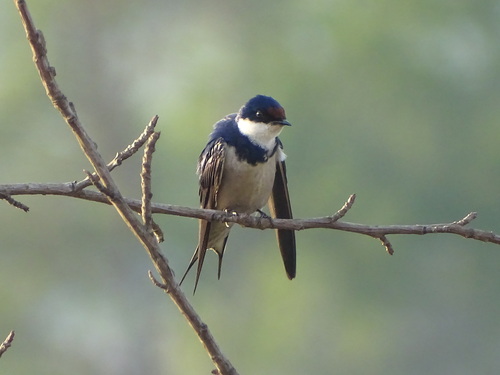 White-throated Swallow
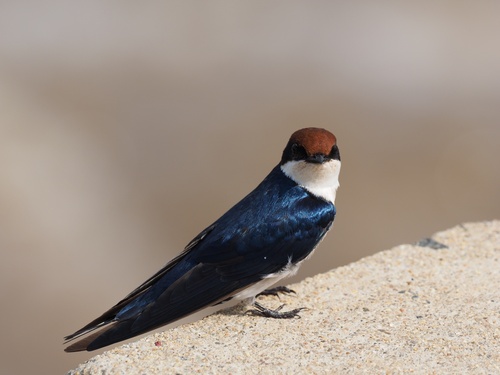 Wire-tailed Swallow
In short
The single most reliable field mark is the tail: adult Wire-tailed Swallow shows extremely long, filamentous outer tail feathers ('wires'), while White-throated Swallow has a deeply forked but broader tail without wires. Juveniles of both species lack the full tail features, so look to the head and underparts: White-throated Swallow has a white throat sharply divided from the underparts by a dark breast band, while Wire-tailed Swallow has a clean white underside without a breast band. Both species have a chestnut crown as adults, but juveniles are duller and browner. In flight, look for the undertail: White-throated Swallow shows white spots near the feather tips, absent in Wire-tailed Swallow. Both are common near water in southern Africa, but White-throated Swallow is especially associated with bridges and dams.
Identification tips
- Tail shape (adults): Look for the extremely long, filamentous outer tail feathers ('wires') in Wire-tailed Swallow. White-throated Swallow has a deeply forked but broader tail without wires. This is the most reliable mark for adults.
- Tail in juveniles: Juvenile Wire-tailed Swallow lacks tail wires and has a shorter, less forked tail, similar to juvenile White-throated Swallow. Do not rely on tail shape alone in young birds.
- Breast band: White-throated Swallow of all ages has a dark blue-black breast band sharply dividing the white throat from the underparts. Wire-tailed Swallow never shows a breast band; its white underparts are clean and unmarked.
- Throat and underparts: White-throated Swallow has a white throat, greyish white underparts, and a sharp contrast at the breast band. Wire-tailed Swallow has a white throat that blends into the rest of the white underparts without a dividing band.
- Crown color: Both species have a chestnut crown as adults, but juveniles are duller and browner. In poor light or with distant birds, this mark can be subtle.
- Upperparts: Both are glossy blue above, but White-throated Swallow is described as 'glossy dark blue,' while Wire-tailed Swallow is 'bright blue.' This difference is slight and unreliable in the field.
- Undertail pattern: White-throated Swallow shows white patches near the tips of the undertail feathers, visible in flight or when the tail is spread. Wire-tailed Swallow lacks these white undertail spots.
- Perched posture: When perched, the tail wires of Wire-tailed Swallow often trail well beyond the rest of the tail, especially in males. White-throated Swallow's tail is forked but lacks wires.
- Juvenile confusion: Both species' juveniles are duller, with browner crowns and shorter tails. In this case, rely on the presence (White-throated) or absence (Wire-tailed) of the breast band, and undertail pattern if visible.
- Sex differences: Male Wire-tailed Swallow has longer wires than the female, but both sexes have wires as adults. White-throated Swallow shows only a slight difference in tail fork length between sexes.
- Habitat clues: If seen nesting under a bridge or dam, White-throated Swallow is more likely, but both species can be found near water and human habitation.
- Flight style: Both species are agile and fast, but Wire-tailed Swallow may appear more delicate and 'draggy' in flight due to the long wires.
- Voice: Only White-throated Swallow's call is described (warbles and twitters); do not rely on voice for separation.
- Size: Wire-tailed Swallow is slightly heavier and longer (with wires), but this is not a reliable field mark except in direct comparison.
- Pitfalls: Beware of juvenile birds, which lack the full adult tail features and are generally duller. In these cases, the breast band (present only in White-throated Swallow) and undertail pattern are the best separators.
Size
Wire-tailed Swallow is slightly heavier (12.7 g) and longer (up to 18 cm, including wires) than White-throated Swallow (14–17 cm), but the difference is mainly due to the tail wires. In the hand or perched, both are small swallows with similar proportions, so size alone is rarely diagnostic.
Plumage
- Juveniles: Both species are duller than adults, but juvenile White-throated Swallow has a browner crown and shorter tail forks, while juvenile Wire-tailed Swallow has a brown crown, back, and tail, and lacks the tail wires. The breast band is present in White-throated Swallow of all ages, absent in Wire-tailed Swallow.
- Adults: White-throated Swallow has glossy dark blue upperparts, a bright chestnut crown, a white throat sharply separated from the greyish white underparts by a dark blue-black breast band, and white patches near the tips of the undertail feathers. Wire-tailed Swallow has bright blue upperparts, a bright white underside, a chestnut cap, and extremely long filamentous outer tail feathers (wires) in adults. The underparts are clean white without a breast band, and the undertail lacks white spots.
- Sexes: Both species are similar in appearance; male Wire-tailed Swallow has longer wires than the female.
Behaviour
Both species are fast-flying insectivores, often seen low over water. Wire-tailed Swallow is more closely associated with water than most swallows and is often seen skimming very close to the surface. White-throated Swallow also frequents water but is especially common around bridges and dams. Both perch conspicuously, but Wire-tailed Swallow's tail wires are often obvious when perched.
Habitat
Both species are found in open country near water in southern Africa. White-throated Swallow is especially common around man-made structures like bridges and dams, while Wire-tailed Swallow is more generally associated with water bodies and open areas, often near human habitation. Their ranges overlap widely, so habitat alone is not diagnostic.
Voice
White-throated Swallow gives a mix of warbles and twitters. No distinctive vocalization is described for Wire-tailed Swallow in the sources, so voice is not a reliable separator.
White-throated Swallow · Wire-tailed Swallow · My Tricky Birds