

White-tailed Tropicbird vs Sooty Shearwater
Phaethon lepturus versus Ardenna grisea
Play a quiz with White-tailed Tropicbird and Sooty Shearwater
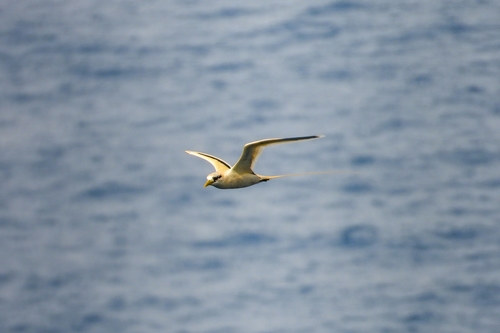 White-tailed Tropicbird
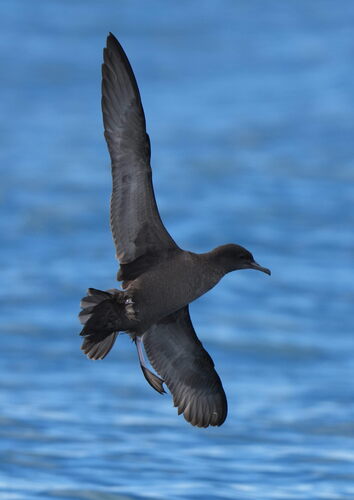 Sooty Shearwater
In short
The most reliable field mark to separate White-tailed Tropicbird from Sooty Shearwater is overall coloration: the tropicbird is a strikingly white seabird with long, ribbon-like tail streamers and a contrasting black inner wing bar, while the sooty shearwater is uniformly dark brown to sooty-black, showing only a silvery underwing panel in good light. Juvenile tropicbirds lack the long tail streamers and have a finely barred back, but still appear much paler than any shearwater. In flight, the tropicbird is buoyant and tern-like, whereas the shearwater powers along with stiff, straight wings and a distinctive "shearing" flight low over the water. Bill color is also diagnostic at close range: yellow to orange in tropicbird (green-yellow in juveniles), dark in shearwater. These two species are extremely unlikely to be confused in good viewing conditions, but distant or backlit views can cause confusion, especially with immature tropicbirds.
Identification tips
- Overall color: White-tailed Tropicbird is predominantly white with black markings; Sooty Shearwater is uniformly dark brown to sooty-black. This is the fastest way to separate them at any distance.
- Tail shape: Adult tropicbirds have extremely long, thin, white tail streamers that double their apparent length. Juveniles lack streamers but still have a square white tail. Sooty Shearwater has a short, wedge-shaped, dark tail with no streamers at any age.
- Bill color: Tropicbird has a bright orange-yellow to orange-red bill (green-yellow in juveniles); shearwater's bill is dark and slender. Bill color is visible only at close range.
- Wing pattern: Tropicbird shows a bold black bar on the inner wing (all ages), contrasting with the white wing. Shearwater is dark above, with a silvery underwing panel in good light but no sharp black bar.
- Facial pattern: Tropicbird has a black eye-mask; shearwater's face is uniformly dark.
- Flight style: Tropicbird is buoyant, gliding and soaring with frequent changes of direction, often high above the water. Shearwater flies low with stiff, straight wings, rarely flapping, and often shears side to side just above the waves.
- Back pattern (juveniles): Juvenile tropicbirds have fine barring on the back but remain much paler than any shearwater. Shearwater juveniles are as dark as adults.
- Underwing: Shearwater shows a silvery central underwing panel in good light; tropicbird's underwing is mostly white with a black bar.
- Perched/at rest: Tropicbird is rarely seen sitting on the water; if seen, appears white and upright. Shearwater often rests on water, appearing dark and flat.
- Group size: Tropicbird usually seen singly or in pairs; shearwater often in large flocks.
- Habitat: Tropicbird is strictly tropical and oceanic, often near islands; shearwater is widespread, including temperate and subarctic waters, and may be seen far from land.
- Voice: Tropicbird's call is a high scream, rarely heard at sea; shearwater is silent at sea, vocal at breeding colonies only.
- Size impression: Shearwater is bulkier with broader wings; tropicbird is slender and delicate, but tail streamers can make it appear longer.
- Pitfalls: Distant or backlit views can make tropicbird appear darker or shearwater paler, but the presence or absence of tail streamers and overall body color remain reliable. Juvenile tropicbirds without streamers may confuse, but still show white plumage and black wing bar.
- Season: Shearwater is present in temperate waters during migration; tropicbird is present year-round in tropics, but may wander.
Size
White-tailed Tropicbird is overall smaller in body than Sooty Shearwater, but its extremely long central tail feathers can make it appear longer (total length 71–80 cm including streamers, wingspan 89–96 cm) [wikipedia]. Sooty Shearwater is more robust, with a body length of 40–51 cm and a broader wingspan of 94–110 cm [wikipedia]. Without the tail streamers, the tropicbird is noticeably more slender and delicate than the shearwater, which has a heavier, more barrel-chested look. In flight, the shearwater's wings are longer and more pointed relative to body size.
Plumage
Juvenile and adult White-tailed Tropicbirds are predominantly white, with a black eye-mask and a bold black bar on the inner wing. Adults have long white tail streamers; juveniles lack these streamers, have a green-yellow bill, and show fine barring on the back. In all ages, the back and underparts remain white. Sooty Shearwater is dark chocolate-brown to sooty-black overall in all plumages, with a slightly paler silvery strip along the center of the underwing visible in good light. There is no white on the body or tail at any age. The underwing silvery panel of the shearwater is the only pale area, and is never as extensive or as crisp as the white of the tropicbird. At distance or in poor light, the shearwater can appear all-black, while the tropicbird remains pale. The tropicbird's black wing bar is a sharp, well-defined mark, not present in the shearwater.
Behaviour
White-tailed Tropicbird has a buoyant, tern-like flight, often soaring or gliding with long tail streamers trailing behind, and is rarely seen sitting on the water. It feeds by plunging from height and is a poor swimmer. Sooty Shearwater, by contrast, is almost always seen flying low over the water with stiff, straight wings, often dipping from side to side in a characteristic 'shearing' motion, and frequently lands on the sea to rest or feed. Its flight is more direct and powerful, resembling a small albatross. The tropicbird is more likely to be seen singly or in pairs, while the shearwater often occurs in large flocks.
Habitat
White-tailed Tropicbird is a tropical species, found around islands and warm oceanic waters in the tropical Atlantic, Indian, and western Pacific Oceans, sometimes wandering far from breeding sites. It breeds on tropical islands, often nesting on cliffs or ground. Sooty Shearwater breeds on southern hemisphere islands but migrates widely, occurring in both hemispheres and often seen far offshore in temperate and subarctic waters. In the Atlantic, the shearwater is the only large, all-dark shearwater, while the tropicbird is the only large, white seabird with tail streamers in its range.
Voice
White-tailed Tropicbird gives a high, screamed 'keee-keee-krrrt-krrt-krrt' [wikipedia], usually heard near breeding sites. Sooty Shearwater is mostly silent at sea, but on breeding grounds gives loud coos and croaks at night. At sea, the shearwater may call when competing for food, but is generally quiet. Voice is unlikely to be useful for separation at sea.
White-tailed Tropicbird · Sooty Shearwater · My Tricky Birds