

White-tailed Hawk vs White Hawk
Geranoaetus albicaudatus versus Pseudastur albicollis
Play a quiz with White-tailed Hawk and White Hawk
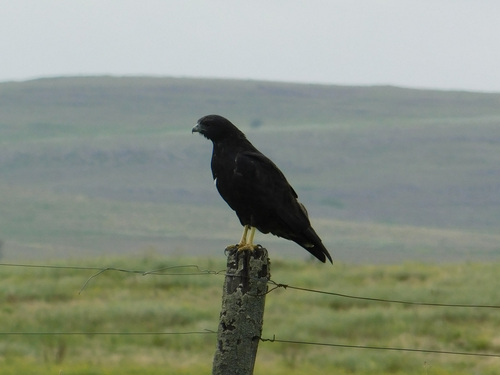 White-tailed Hawk
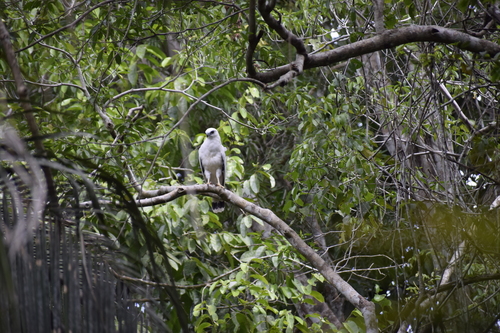 White Hawk
In short
The most reliable field mark is the tail pattern in flight: adult White-tailed Hawk shows a white tail with a narrow black band near the tip, while adult White Hawk has a black tail with a broad white band. Immature White-tailed Hawks are much darker overall, with blackish upperparts and conspicuous black-and-white spotted wing linings, whereas immature White Hawks are mostly white below but have extensive black spotting above and dark-streaked underparts. Structurally, White-tailed Hawk is larger and stockier, with longer wings and a rusty shoulder patch in adults, while White Hawk is shorter-tailed, broader-winged, and lacks any rufous. Both can soar, but White Hawk is more strictly a forest bird and appears strikingly white from below.
Identification tips
- Tail pattern in flight (adults): White-tailed Hawk has a white tail with a narrow black band near the tip; White Hawk has a black tail with a broad white band. This is usually visible in soaring birds and is the most reliable mark for adults.
- Tail pattern (immatures): Immature White-tailed Hawk has a brown tail with several dark bars, becoming greyer with a hazy dark band as it matures. Immature White Hawk already shows the black tail with a broad white band.
- Overall darkness (immatures): Immature White-tailed Hawks can appear nearly black above and below in poor light, especially if the white underparts are limited. Immature White Hawks are mostly white below, with black spotting above and streaked underparts, never appearing overall blackish.
- Wing lining (immatures): Immature White-tailed Hawks have conspicuous black-and-white spotted wing linings, visible in flight. Immature White Hawks do not show this pattern; their underwings are mostly white.
- Rusty shoulder patch: Adult White-tailed Hawk shows a rusty-red shoulder patch when perched with wings closed, absent in all ages of White Hawk.
- Upperwing color (adults): White-tailed Hawk's upperwings are dark with grey near the base of the blackish primaries; White Hawk's upperwings are mostly black, with some white depending on subspecies.
- Underwing pattern: Both species are white below, but White-tailed Hawk has indistinct brownish barring on the underwing coverts, while White Hawk's underwings are clean white.
- Head and body color: Adult White Hawk is entirely white on head and body; White-tailed Hawk is white below but grey above.
- Bill and legs: Both have black bills and yellow legs, so this is not diagnostic.
- Eye color: White-tailed Hawk has a hazel iris; White Hawk's eye color varies by subspecies (yellow or brown), but this is rarely visible in the field.
- Structure and jizz: White-tailed Hawk is bulkier and longer-winged, with a longer tail; White Hawk is more compact, with very broad wings and a notably short tail. In flight, White Hawk appears more 'chunky' and strikingly white from below.
- Habitat: White-tailed Hawk is found in open country; White Hawk is a forest specialist. Context can be a strong clue if the plumage is ambiguous.
- Behavior: White-tailed Hawk often hovers and glides over open areas; White Hawk perches in forest and soars above the canopy, sometimes associating with monkeys or coatis.
- Vocalization: If you hear a plaintive 'kerwee', it's White Hawk. White-tailed Hawk is not noted for a distinctive call in these sources.
- Subspecies variation (White Hawk): Some White Hawk subspecies have more black on the wings and tail, but all are mainly white from below. If you see a mostly white bird with a black tail band in forest, check for these details.
Size
White-tailed Hawk is the larger and heavier species, with a length of 44–60 cm and a wingspan of 118–143 cm, and body mass ranging from 865–1,240 g depending on subspecies [wikipedia]. White Hawk is slightly smaller, at 46–56 cm in length, but is notably lighter: males average 650 g and females 840 g [wikipedia]. White-tailed Hawk is stockier and bulkier, while White Hawk is more compact with very broad wings and a shorter tail. In the field, White-tailed Hawk will look more robust and longer-winged, especially when soaring.
Plumage
-
Immature/juvenile birds: Immature White-tailed Hawks are much darker overall, sometimes appearing nearly black in poor light, especially if the underparts are not visible. Their wing linings are conspicuously spotted black-and-white, and they lack the rusty shoulder patch of adults. The tail is brown with several dark bars, gradually becoming greyer with a hazy dark band as the bird matures. In contrast, immature White Hawks are mostly white below but have extensive black spotting on the upperparts and dark-streaked whitish underparts. Their tail is already black with a broad white band, similar to adults.
-
Adults: Adult White-tailed Hawk is grey above, white below, and has a short, white tail with a narrow black band near the tip. The upperwings are dark with grey near the base of the blackish primaries, and the underwing is whitish with indistinct brownish barring. The rusty-red shoulder patch is a key mark when perched. Adult White Hawk is almost entirely white below and on the head, with black upperwings and a very short black tail with a broad white band. The underwings are white, and the upperwings are black (with some variation by subspecies in the amount of black and white). No rufous is present.
-
Subspecies variation (White Hawk): Some subspecies have more black on the wings and tail, but all look mainly white from below. Eye color varies from yellow to brown depending on subspecies.
Behaviour
White-tailed Hawk typically hunts by hovering and scanning open areas, then gliding to another perch if nothing is found. It is often seen soaring over open country. White Hawk, on the other hand, is more often seen soaring above or within forest canopies and is known for its spectacular aerial courtship displays. It hunts mainly by sallying from a perch within or at the edge of forest, sometimes associating with monkey or coati groups to catch prey they flush. Both species can soar, but White Hawk is more strictly tied to forested habitats and often appears as a striking white shape against the canopy.
Habitat
White-tailed Hawk is a bird of open tropical and subtropical environments, including grasslands, savannas, and open cerrado, and is rarely found in dense forest. White Hawk is a specialist of lowland forest and woodland, ranging from southern Mexico through the Amazon basin and into the Atlantic Forest, and is rarely seen far from forested areas. If you see a large white hawk soaring over open country, White-tailed Hawk is more likely; in or over forest, especially deep forest, White Hawk is the default.
Voice
White Hawk gives a plaintive 'kerwee' call. No distinctive vocalization is described for White-tailed Hawk in the provided notes, so voice is only useful if you hear the White Hawk's call.