

White-eared Hummingbird vs Xantus's Hummingbird
Basilinna leucotis versus Basilinna xantusii
Play a quiz with White-eared Hummingbird and Xantus's Hummingbird
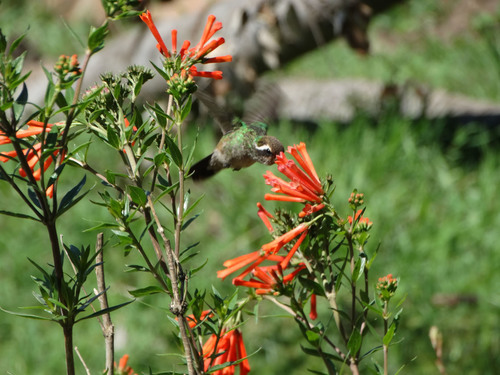 White-eared Hummingbird
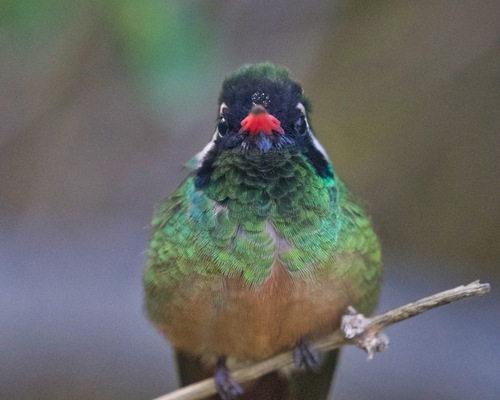 Xantus's Hummingbird
In short
The most reliable field mark between White-eared Hummingbird and Xantus's Hummingbird is the color and pattern of the underparts and tail: White-eared shows mostly grayish to greenish underparts with bronze or green spots, while Xantus's has rich cinnamon underparts and a rufous tail. Both species have a bold white post-ocular stripe and similar bill shape, but the crown, throat, and tail coloration are key. Immature and female birds can be especially tricky, but careful attention to underpart color and tail pattern usually resolves confusion. Range is also a strong clue: Xantus's is restricted to Baja California, while White-eared is found from the southwestern US to Nicaragua.
Identification tips
- Underpart color is the single most useful field mark: Xantus's Hummingbird always shows pale to medium cinnamon underparts (including throat and undertail coverts) in both sexes and all ages. White-eared Hummingbird has grayish to grayish-white underparts with bronze or green spotting, never cinnamon.
- Tail color and pattern: Xantus's has a rufous-chestnut tail with green edges on the central feathers and thin white tips on the outer feathers (females). White-eared's tail is bronze-green to bronzy-black with green tips, lacking any rufous or chestnut tones.
- Crown and forehead: White-eared males have a metallic violet or bluish-violet forehead and dull black crown; females have a dusky brown crown. Xantus's males have a golden green to emerald green crown and nape; females have a dull brownish forehead but still show golden green upperparts.
- Throat color (males): White-eared males have a violet-blue chin and upper throat, with metallic emerald green lower throat. Xantus's males have a black chin and iridescent emerald green throat, but the black chin is more extensive and contrasts with the cinnamon underparts.
- Facial pattern: Both species have a bold white stripe behind the eye, but Xantus's face is black (male) or blackish brown (female) with a pale buffy stripe, while White-eared's face is mostly black with a wide white stripe. This is similar, so not always reliable.
- Bill color: Males of both species have a red bill with a black tip, but White-eared females have a mostly blackish bill with some red/orange at the base, while Xantus's females have a black maxilla with a pinkish base and a pinkish red mandible with a black tip. This is subtle and not always visible in the field.
- Flank color: Xantus's shows green mottling on the flanks over cinnamon, while White-eared has bronze-green flanks over grayish underparts.
- Uppertail coverts: Both species have rufous edging on the uppertail coverts, but Xantus's is more pronounced.
- Undertail coverts: Xantus's undertail coverts are pale cinnamon; White-eared's are grayish brown with faint bronze gloss (male) or grayish with whitish margins (female).
- Central tail feathers: Xantus's females have golden green central tail feathers with a rufous shaft; White-eared's central tail feathers are bright bronze green with no rufous shaft.
- Range: If seen outside Baja California, rule out Xantus's. If in Baja, White-eared is not expected.
- Sex/age pitfalls: Females and immatures of both species are duller but still show the underpart and tail differences; beware of lighting that can obscure cinnamon tones on Xantus's.
- No distinctive flight or wing pattern differences: Both species lack unique juvenile or immature wing markings.
- Size and structure: Both are similar in size and shape; do not rely on this for separation.
- Habitat context: In gardens or forest edge in Baja, expect Xantus's; in montane forests of mainland Mexico or further north/south, expect White-eared.
Size
Both species are very similar in size and mass, with White-eared Hummingbird at 9–10 cm and Xantus's Hummingbird at 8.5–9.5 cm in length. Males and females of both average about 3.2–3.6 g. There is no meaningful size difference in the field, though Xantus's may appear slightly shorter and stockier due to its richer underpart color and tail shape. Bill length and straightness are also closely matched.
Plumage
-
Juvenile/Immature/First-year: No age-specific upperwing or flight pattern differences are described for either species; both lack distinctive juvenile wing panels or trailing edge contrasts. Focus instead on body and tail coloration at all ages.
-
Adult males: White-eared males have a metallic violet or bluish-violet forehead, black face, and a wide white stripe behind the eye. Their chin and upper throat are violet-blue, with metallic emerald green lower throat, and the breast/flanks are bronze to bronze-green with a grayish-white center. The tail is mostly bronze-green to bronzy-black with green tips. Xantus's males have a golden to emerald green crown and upperparts, black forehead and chin, a similarly bold white post-ocular stripe, and an iridescent emerald green throat. Their underparts are cinnamon with green mottling on the flanks, and the tail is rufous-chestnut with green edges on the central feathers.
-
Adult females: White-eared females are duller, with a dusky brown crown, mostly grayish underparts with metallic green spots, and a tail with brownish-gray tips. Xantus's females have a dull brownish forehead, golden green upperparts, and pale to medium cinnamon underparts and undertail coverts. Their tail is golden green centrally with rufous shafts and outer feathers that are dark rufous with black/bronzy green bands and thin white tips.
-
Key contrast: White-eared never shows the extensive cinnamon underparts and rufous tail of Xantus's; Xantus's never shows the mostly grayish or green-spotted underparts and bronzy-green tail of White-eared.
Behaviour
Both species forage for nectar at a variety of flowers and shrubs, usually in the low to mid-levels of vegetation. White-eared Hummingbird is notably territorial, defending feeding areas even against larger hummingbirds. Xantus's Hummingbird's movements are less well documented, but it may move locally in response to flowering plants. In the field, their behavior is similar and not reliably diagnostic.
Habitat
White-eared Hummingbird is found from the southwestern US south through Mexico to Nicaragua, favoring montane forests, edges, and shrubby clearings. Xantus's Hummingbird is endemic to the Baja California Peninsula, breeding in montane forests but also descending to lower elevations after nesting. If observed outside Baja California, the bird is almost certainly not Xantus's. Both species may visit gardens and edges, but their ranges do not overlap.
White-eared Hummingbird · Xantus's Hummingbird · My Tricky Birds