

White-chinned Petrel vs Blue-winged Warbler
Procellaria aequinoctialis versus Vermivora cyanoptera
Play a quiz with White-chinned Petrel and Blue-winged Warbler
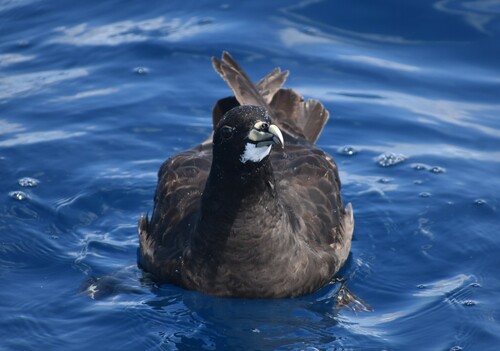 White-chinned Petrel
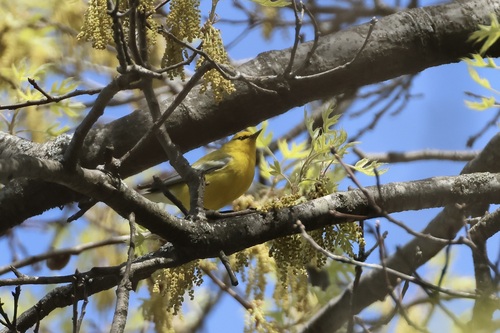 Blue-winged Warbler
In short
The most reliable separation between White-chinned Petrel and Blue-winged Warbler is overall size and structure: the petrel is a massive, dark seabird with a heavy bill and broad wings, while the warbler is a tiny, bright yellow songbird with blue-gray wings and a pointed bill. In flight, the petrel’s wings are long and sooty with possible silvery undersides, whereas the warbler shows compact, rounded wings with two white wing-bars. Juvenile and immature warblers can be duller and lack strong wing-bars, but are still minuscule compared to any petrel. Habitat is also a decisive clue: petrels are oceanic, warblers are found in brushy or wooded areas. Confusion is only likely in a photo quiz or extreme vagrancy scenario.
Identification tips
- Size is decisive: If you see a bird larger than a crow, it's not a Blue-winged Warbler. If it's sparrow-sized, it's not a White-chinned Petrel. This works for all ages and sexes.
- Bill shape and color: Petrel has a thick, pale, hooked bill with black between the nostrils; warbler has a thin, pointed, dark or pinkish bill (immature). This is visible even at a distance with good optics.
- Wing pattern in flight: Warbler (adult) shows two white wing-bars on blue-gray wings; juvenile may have faint or absent bars but still shows a small, compact wing shape. Petrel has uniformly dark wings with possible silvery undersides, never any wing-bars.
- Overall color: Petrel is sooty-black with possible white on chin/throat; warbler is bright yellow below and on head (male), olive above, with blue-gray wings. Even dull female or immature warblers are never all-black.
- Leg color: Petrel has black legs and feet; warbler's legs are not diagnostic but never strikingly black in the same way.
- Facial pattern: Warbler (male) has a sharp black eye-line; female's is paler. Petrel lacks any eye-line, just dark plumage and pale bill.
- Habitat: Petrel is only at sea or remote islands; warbler is always in terrestrial, brushy or wooded habitats.
- Behavior: Petrel soars and glides for long periods; warbler flits, hovers, and perches frequently.
- Vocalizations: Warbler sings a buzzy song and chips; petrel is silent except for rare groans at colonies.
- Underparts: Petrel is dark below; warbler is yellow below (male/female) or yellowish/olive (immature).
- Wing shape: Petrel has long, broad wings; warbler has short, rounded wings.
- Tail: Petrel's tail is short and square; warbler's is also short but not diagnostic between these two.
- Sex/age confusion: Female and immature warblers are duller but still show yellow and are tiny; petrel does not vary much by age or sex.
- White chin/throat: Only petrel may show a white chin patch, but this is not always visible and is never as extensive as the warbler's yellow.
- Context: If seen from a boat at sea, expect petrel; if in a field or forest, expect warbler.
Size
White-chinned Petrel is a giant among seabirds (body mass ~1335 g, length 51–58 cm, wingspan 134–147 cm), easily dwarfing the Blue-winged Warbler, which is a tiny passerine (length 11.4–12.7 cm, wingspan 17–19.5 cm, mass ~8.5 g). Even the smallest petrel is over four times the length and vastly heavier than the warbler. With binoculars, the petrel appears goose-sized or larger, while the warbler is sparrow-sized or smaller.
Plumage
- Juvenile/immature Blue-winged Warbler: Olive above with blue-gray wings and faint or nearly invisible white wing-bars; pinkish bill; underparts yellowish but duller than adults. Still, the small size and short, pointed bill are obvious.
- Adult male Blue-winged Warbler: Bright yellow below and on head, blue-gray wings with two crisp white wing-bars, black eye-line. Females are duller yellow with less distinct eye-line and paler wing-bars.
- White-chinned Petrel (all ages): Uniformly sooty-black overall with a variable white patch on chin/throat (sometimes absent or faint), black legs and feet, and a heavy, pale bill with black between the nostrils. Underwing may show a silvery cast on the primaries, but no wing-bars or contrasting panels. No seasonal or age-related plumage variation noted.
In summary, the petrel is always dark and lacks any wing-bar or yellow tones, while the warbler is always much brighter and patterned, even in dull plumages.
Behaviour
White-chinned Petrel is a powerful, gliding seabird, often seen mixing slow wingbeats with long glides over open ocean. It rarely perches except at breeding colonies. Blue-winged Warbler is an active, flitting songbird, often seen foraging among low shrubs or trees, hovering briefly or making short flights. Their flight is quick and undulating, never the soaring style of a petrel.
Habitat
White-chinned Petrel is strictly pelagic, found far offshore in the Southern Ocean and only coming to land to breed on remote islands. Blue-winged Warbler breeds in brushy fields, woodland edges, and young forests in eastern North America, and winters in shrubby habitats in Central America. You will never see a Blue-winged Warbler at sea, nor a White-chinned Petrel in a thicket or forest.
Voice
White-chinned Petrel is mostly silent at sea, but at colonies may give rattling or groaning calls. Blue-winged Warbler has a distinctive buzzy song and a sharp 'chip' call, typical of New World warblers. Any song or chip heard in a brushy habitat points to the warbler, not the petrel.
White-chinned Petrel · Blue-winged Warbler · My Tricky Birds