

White-cheeked Antbird vs Rufous-throated Antbird
Gymnopithys leucaspis versus Gymnopithys rufigula
Play a quiz with White-cheeked Antbird and Rufous-throated Antbird
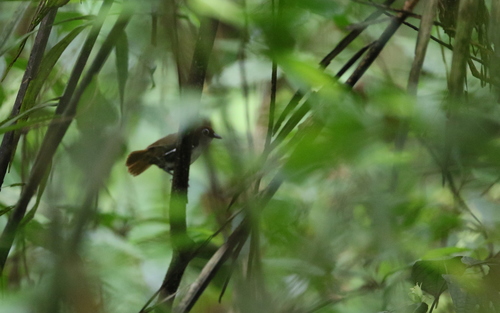 White-cheeked Antbird
 Rufous-throated Antbird
In short
The most reliable field mark to separate White-cheeked Antbird from Rufous-throated Antbird is the color of the throat and cheek: White-cheeked Antbird shows a bold white cheek and throat, while Rufous-throated Antbird has a rich rufous-chestnut cheek and upper throat. Both species have bare blue skin around the eye and similar overall structure, but their underpart and facial coloration are strikingly different in adults. Juveniles are trickier, as White-cheeked Antbird starts with brownish underparts before the white emerges, but even then, the lack of rufous tones helps. Both occur in northern South America, but their ranges only overlap in Brazil. Focus on face and throat color for the quickest field separation.
Identification tips
- Face and throat color (all ages): White-cheeked Antbird always shows a crisp white cheek and throat in adults; Rufous-throated Antbird always shows rufous-chestnut on the cheek and upper throat. This is the single most reliable mark.
- Juvenile underparts: Immature White-cheeked Antbirds have brownish underparts before the white emerges, but never show rufous tones on the face or throat. If you see a brownish juvenile with a hint of white coming in on the cheek/throat, favor White-cheeked.
- Crown and nape color: White-cheeked Antbird has a chestnut-brown crown and nape, while Rufous-throated Antbird's crown/nape is olive-brown. This is subtle and best used in good light.
- Mask and facial pattern: White-cheeked Antbird has a blackish mask running from lores through the eye and down the neck; Rufous-throated Antbird has a brownish-black forehead/lores but lacks the strong black mask.
- Underpart color: White-cheeked Antbird has a white breast and dark brown lower belly; Rufous-throated Antbird has cinnamon lower throat/upper breast and olive-brown belly.
- Scapular patch (female): Female White-cheeked Antbird shows a cinnamon patch between the scapulars; female Rufous-throated Antbird has a cinnamon intrascapular patch but is otherwise duller and never shows white on the face.
- Upperparts: White-cheeked Antbird is chestnut-brown above with some rufous edging; Rufous-throated Antbird is olive-brown above with dark yellow-brown wings and tail. This is a supporting mark.
- Bare blue skin around eye: Both species have this, so it does not help for separation.
- Size and structure: White-cheeked Antbird is slightly longer but lighter; Rufous-throated Antbird is shorter but can be heavier. This is not a reliable field mark.
- Range: If outside Brazil, check the country: White-cheeked is west and south (Colombia, Ecuador, Peru), Rufous-throated is northeast (French Guiana, Guyana, Suriname, Venezuela). In Brazil, both occur—use plumage.
- Army ant swarms: Both follow ants and can occur together at swarms in Brazil; do not use behavior alone.
- No distinctive flight pattern: Neither species has a unique upperwing or flight mark for separation; focus on face and underpart color even in brief flight views.
- Subspecies variation: Some White-cheeked Antbird subspecies are darker or have paler undertail coverts, but all retain the white cheek/throat. Rufous-throated Antbird subspecies vary in throat/belly shade but never show white on the face.
- Plumage pitfalls: Beware of immature White-cheeked Antbirds that have not yet fully developed the white cheek/throat—look for the absence of rufous tones and the emergence of white.
- Sex differences: Both species' females are duller and have cinnamon scapular/intrascapular patches, but only White-cheeked females ever show a white cheek/throat.
Size
White-cheeked Antbird is slightly larger in length (13.5–15 cm) and averages about 25 g, while Rufous-throated Antbird is a bit shorter (11.5–14 cm) but can be heavier (26–32 g). In the field, this size difference is subtle and not a reliable separation point. Both are small, compact antbirds with similar proportions.
Plumage
- Juveniles: White-cheeked Antbird juveniles have brownish underparts before the white cheek and throat feathers emerge, while Rufous-throated Antbird juveniles are not described in detail, but adults lack any white in the face or throat at all ages.
- Adult males: White-cheeked Antbird males have a chestnut-brown crown/nape, white cheeks and throat, a blackish mask, and chestnut-brown upperparts. Rufous-throated Antbird males have a brownish-black forehead/lores, olive-brown crown/nape, rufous-chestnut cheeks and upper throat, cinnamon lower throat/upper breast, and olive-brown underparts.
- Adult females: Both species' females are similar to males but duller. White-cheeked Antbird females add a cinnamon patch between the scapulars; Rufous-throated Antbird females have a cinnamon intrascapular patch and are overall duller than males. Neither sex of Rufous-throated Antbird ever shows a white cheek or throat.
- Upperwing in flight: No distinctive age-specific upperwing or flight pattern is described for either species; separation relies on face and underpart color, even in flight.
Behaviour
Both species are typical antbirds, foraging in the understory and often following army ant swarms. Their foraging style and general behavior are very similar and not useful for field separation.
Habitat
White-cheeked Antbird is found in Brazil, Colombia, Ecuador, and Peru, while Rufous-throated Antbird occurs in Brazil, French Guiana, Guyana, Suriname, and Venezuela. Their ranges only overlap in Brazil. Both inhabit humid lowland forests and are associated with army ant swarms, so habitat alone is not diagnostic except at the country level.
White-cheeked Antbird · Rufous-throated Antbird · My Tricky Birds