

White Bellbird vs Bare-throated Bellbird
Procnias albus versus Procnias nudicollis
Play a quiz with White Bellbird and Bare-throated Bellbird
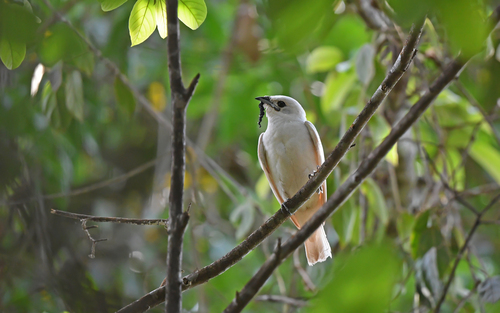 White Bellbird
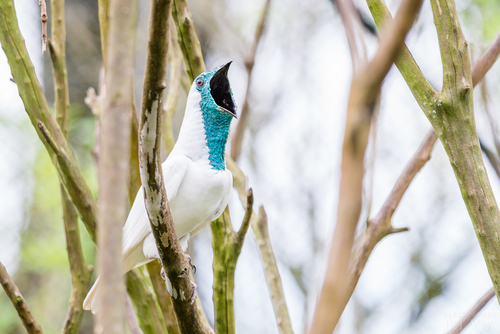 Bare-throated Bellbird
In short
The most reliable field mark between White Bellbird and Bare-throated Bellbird is the presence of a single black wattle hanging from the male White Bellbird’s bill, absent in Bare-throated. Both adult males are strikingly white, but the Bare-throated Bellbird male shows a conspicuous bluish-black bare patch of skin around the eye, beak, and throat, while the White Bellbird male’s face is entirely feathered except for the wattle. Females and immatures of both species are olive above and yellowish below, but the White Bellbird female is more greenish-olive, while the Bare-throated is olive-brown with a blackish crown. Both species are about the same size and have similar structure, but their ranges only overlap in parts of Brazil. Calls are extremely loud in both, but the White Bellbird’s is the world’s loudest and has a distinctive two-note pattern.
Identification tips
- Adult Male: Wattle vs. Bare Skin – The single black wattle hanging from the bill base is unique to male White Bellbird; Bare-throated Bellbird males never show a wattle but have a bare bluish-black patch of skin around the eye, bill, and throat.
- Adult Male: Facial Pattern – White Bellbird males have a fully feathered white face (except for the wattle), while Bare-throated Bellbird males have obvious bare skin patches that contrast with the white plumage.
- Adult Male: Bill and Wattle Movement – When calling, White Bellbird males may inflate and swing the wattle; Bare-throated Bellbird males do not have a wattle to move.
- Adult Female: Upperparts Color – White Bellbird females are olive-green above; Bare-throated Bellbird females are olive-brown with a blackish crown. This difference is subtle but can be useful in good light.
- Adult Female: Underparts Streaking – Both have yellowish underparts with olive streaking, but the White Bellbird female’s streaks are more olive, while the Bare-throated’s are olive green and may appear more diffuse.
- Immature Birds – Both species’ immatures resemble their respective females and lack any white plumage, wattle, or bare facial skin. Separation is difficult; look for subtle differences in upperpart color (greenish vs. brownish) and crown (blackish in Bare-throated only).
- No Diagnostic Wing Pattern – Neither species has a distinctive upperwing or flight mark at any age; flight views are not helpful for separation.
- Size and Structure – Both are similar in size and shape, with short, wide-gaped bills; do not rely on structure for separation.
- Vocalization – Both are extremely loud, but the White Bellbird’s call is a sharp, two-note 'kong-kay' or a droning musical phrase, while the Bare-throated Bellbird’s is a metallic, anvil-like note. If you hear the call, use it as a strong clue.
- Habitat and Range – If in northern Amazonian forests (Guyana, Suriname, French Guiana, Venezuela, northern Brazil), White Bellbird is expected. In the Atlantic Forest of southeast Brazil, Paraguay, or Argentina, Bare-throated Bellbird is the likely species.
- Urban Sightings – Bare-throated Bellbird has been recorded in urban parks in southeast Brazil, but White Bellbird is not known from such settings.
- Seasonal Movements – Both species show some local or elevational movements, but this is not usually helpful for field ID.
- Subspecies Variation – The subspecies P. a. wallacei (White Bellbird) has a longer, thinner bill and a slight grayish throat, but these are subtle and rarely diagnostic in the field.
- Sexual Dimorphism – Both species are strongly sexually dimorphic; always consider sex when identifying, as only adult males show the most distinctive marks.
- Pitfalls – Immature and female bellbirds of both species are easily confused with each other and with female Bearded Bellbird; use location, subtle plumage tones, and (if possible) association with calling males to help.
Size
Both species are very similar in size, with adults around 27–29 cm (11 in) in length. Male White Bellbirds weigh slightly more (210–222 g) than Bare-throated Bellbirds, but this difference is not likely to be noticeable in the field. Both have a short, wide-gaped bill typical of bellbirds. Structure and overall proportions are not useful for separation.
Plumage
- Juvenile/Immature: Both species’ immatures resemble their respective females, lacking any white plumage or facial wattles/bare skin. Immature White Bellbirds are olive-green above and yellow below with olive streaks, while immature Bare-throated Bellbirds are olive-brown above with a blackish crown and yellowish underparts streaked with olive green. No distinctive upperwing pattern or flight mark is described for either species at any age.
- Adult Male: White Bellbird males are entirely white with a single black wattle at the base of the bill; no bare skin on the face or throat. Bare-throated Bellbird males are also white but have a striking bluish-black bare patch of skin around the eye, beak, and throat, with no wattle.
- Adult Female: White Bellbird females are olive-green above, duskier on the wings, and yellow below with olive streaks; no facial bare skin or wattle. Bare-throated Bellbird females are olive-brown above (not green), have a blackish crown, and yellowish underparts streaked with olive green. Both lack facial wattles or bare skin.
- Subspecies: The subspecies P. a. wallacei (White Bellbird) has a longer, thinner bill and a slight gray tinge to the throat, but this is subtle and rarely diagnostic in the field.
Behaviour
Both species are typically seen perched high in the canopy, often on exposed branches, especially males displaying and calling. Males of both species are sedentary or locally migratory, maintaining territories and calling loudly to attract females. Both are fruit-eaters and may be seen alone or in loose association with other fruiting tree visitors. White Bellbird males display from treetops, often inflating the wattle during calls. Bare-throated Bellbird males perch high and call, but do not have a wattle to display.
Habitat
White Bellbird is found in northern South America (Brazil, French Guiana, Guyana, Suriname, Venezuela, and as a vagrant to Trinidad), primarily in humid forest canopies. Bare-throated Bellbird is found further south (Brazil, Paraguay, Argentina), in subtropical and tropical moist lowland and montane forests, often in the Atlantic Forest region. Both prefer primary forest but can be found in secondary forests with fruiting trees. Overlap is possible in southeastern Brazil, but White Bellbird is absent from Argentina and Paraguay. Bare-throated Bellbird may also appear in unusual urban or disturbed settings, as documented in Rio de Janeiro and São Paulo.
Voice
Both species are famous for extremely loud calls. The White Bellbird is the loudest bird known, with a two-note call described as 'kong-kay,' delivered with the head held still or swung side to side, and a second, more musical droning call. Bare-throated Bellbird males have a metallic call, likened to a hammer striking an anvil, also among the loudest of all birds. While both can be heard from great distances, the White Bellbird’s call is more abrupt and bell-like, while the Bare-throated’s is metallic and ringing.