

White-backed Night Heron vs Rufous-bellied Heron
Calherodius leuconotus versus Ardeola rufiventris
Play a quiz with White-backed Night Heron and Rufous-bellied Heron
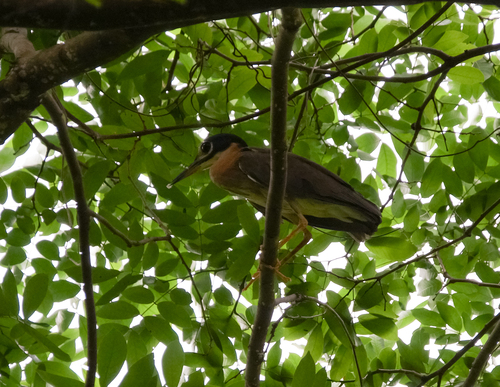 White-backed Night Heron
 Rufous-bellied Heron
In short
The most reliable field mark for separating immature White-backed Night Heron from Rufous-bellied Heron is the presence of white spots on the upperwing coverts of the former, visible in flight or when perched with wings partially open. Adults are best told apart by the White-backed Night Heron's striking white scapular triangle on the back and black-capped head, versus the Rufous-bellied Heron's overall dark grey upperparts and rufous belly. Both species show yellow legs, but the White-backed Night Heron is bulkier and has a shorter crest. Juvenile plumage and flight views are key for quick separation, especially in southern Africa where both may occur.
Identification tips
- Juvenile/immature wing pattern: Look for white spots on the upperwing coverts of immature White-backed Night Heron—these are absent in Rufous-bellied Heron of any age. This is most visible in flight or when the bird stretches its wings.
- Breast pattern in immatures: Immature White-backed Night Herons show a streaked breast, while juvenile Rufous-bellied Herons are paler and browner with no strong streaking.
- Adult back pattern: Adult White-backed Night Heron has a bold white triangular patch on the back (white scapulars), highly visible when perched or in flight. Rufous-bellied Heron lacks this mark and is uniformly dark grey above.
- Head and crest: White-backed Night Heron shows a black head with a short crest or prominent feather display, and red eyes with a white ring. Rufous-bellied Heron has a dark grey head without a crest or eye ring.
- Neck and breast color: White-backed Night Heron's neck and breast are rufous, contrasting with its white throat; Rufous-bellied Heron has a dark grey breast and head, with rufous confined to the belly, wings, and tail.
- Belly color: Rufous-bellied Heron has a distinctly rufous belly, wings, and tail, which contrasts with its dark upperparts. White-backed Night Heron's belly is whitish-brown and less contrasting.
- Leg color in flight: Both species have yellow legs, but in Rufous-bellied Heron the bright yellow legs and feet are especially striking against the dark underparts in flight. In White-backed Night Heron, the legs are yellow but do not contrast as strongly due to paler underparts.
- Size and structure: White-backed Night Heron is medium-sized and bulkier, while Rufous-bellied Heron is smaller and more compact. This can help when both are seen together or with other herons.
- Behavior: Rufous-bellied Heron often adopts a bittern-like, horizontal-billed posture when hiding and is more likely to be seen skulking in dense vegetation. White-backed Night Heron is less secretive in posture.
- Habitat preference: Rufous-bellied Heron is more likely in well-vegetated wetlands and shallow floodplains, especially on the landward side. White-backed Night Heron is more generalist but often near wooded water margins.
- Eye color and facial markings: White-backed Night Heron has large red eyes with a white ring and pale yellow lores; Rufous-bellied Heron lacks these facial contrasts.
- Crest presence: Only White-backed Night Heron has a short crest or prominent feather display on the head.
- Flight jizz: In flight, note the overall bulk and white back triangle of White-backed Night Heron versus the smaller, darker, and more uniformly colored Rufous-bellied Heron with rufous underwings and belly.
- Plumage pitfalls: Adult White-backed Night Heron's rufous neck and breast could be confused with the rufous belly of Rufous-bellied Heron, but the distribution of color (neck vs. belly) and back pattern (white triangle vs. uniform dark) are key.
- When in doubt: Focus on the upperwing pattern in immatures and the white scapular triangle in adults for the most reliable separation.
Size
The White-backed Night Heron is a medium-sized heron, measuring 50–55 cm in length, and is noticeably bulkier than the Rufous-bellied Heron, which is described as small and compact for a heron. While exact measurements for the Rufous-bellied Heron are not provided here, its overall structure is more petite and less robust than the White-backed Night Heron. In the field, this size difference can be apparent when both are seen together or compared to other herons.
Plumage
- Juveniles/Immatures: Immature White-backed Night Herons have a streaked breast and distinctive white spots on the upperwing coverts, which are absent in Rufous-bellied Heron. Juvenile Rufous-bellied Herons are paler and browner overall, lacking strong wing patterning, and darken as they mature.
- Adults: Adult White-backed Night Herons have a black head with a short crest, white-ringed red eyes, rufous neck and breast, and a diagnostic white triangular patch on the back formed by white scapulars. Their underparts are whitish-brown. In contrast, adult Rufous-bellied Herons are dark grey on the head, back, and breast, with a rufous belly, wings, and tail. The yellow legs and feet of Rufous-bellied Heron stand out in flight against the dark underparts, while the White-backed Night Heron's legs are also yellow but less contrasting due to lighter underparts. The White-backed Night Heron's throat is white, while the Rufous-bellied Heron's is not specifically described but is generally darker.
Behaviour
Rufous-bellied Heron is a skulking species, often adopting a bittern-like posture with its bill held horizontally when hiding. It prefers to hunt in shallow water or on the landward side of dense wetland vegetation and is generally sedentary, moving locally with seasonal floods. White-backed Night Heron does not have a described skulking or bittern-like posture in these notes, and is typically less secretive in its bearing. Both are crepuscular or nocturnal by family tendency, but the Rufous-bellied Heron's behavior is more specialized for concealment.
Habitat
Both species occur in sub-Saharan or southern Africa and are associated with wetlands. The Rufous-bellied Heron is more closely tied to well-vegetated wetlands and shallow floodplains, often on the landward side of dense vegetation. The White-backed Night Heron is found more broadly in sub-Saharan Africa, without a strong habitat preference noted here, but is generally associated with wooded water margins. Overlap is possible in southern Africa, so habitat alone is not always diagnostic.
White-backed Night Heron · Rufous-bellied Heron · My Tricky Birds