

Wedge-tailed Sabrewing vs Crowned Woodnymph
Pampa curvipennis versus Thalurania colombica
Play a quiz with Wedge-tailed Sabrewing and Crowned Woodnymph
 Wedge-tailed Sabrewing
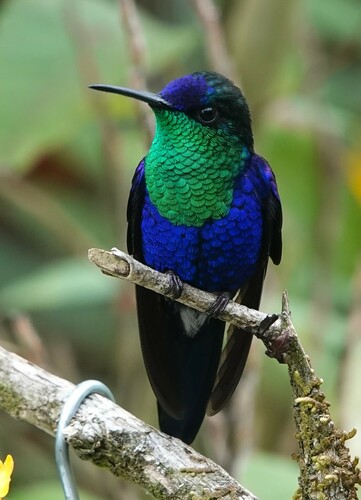 Crowned Woodnymph
In short
The most reliable field mark to separate Wedge-tailed Sabrewing from Crowned Woodnymph is tail shape and color in adults: the sabrewing has a broad, wedge-shaped tail with metallic bluish green to purplish-black tones, while the woodnymph’s tail is deeply forked and blue-black (with white tips in females and immatures). Immature birds of both species can be confusing, but the sabrewing’s larger size, stouter bill, and duller, more brownish underparts (often with a cinnamon wash in females and immatures) contrast with the woodnymph’s slimmer build and pale gray underparts. Both species can occur together in parts of Central America, so careful attention to structure and tail is critical. Vocalizations differ but are not always easily heard in the field.
Identification tips
- Tail shape and color (all ages): Sabrewing has a broad, wedge-shaped tail; woodnymph has a deeply forked tail. In females and immatures, woodnymph’s tail shows white tips on outer feathers, never present in sabrewing.
- Size and structure: Sabrewing is larger, heavier, and bulkier with a stouter, longer bill. Woodnymph is smaller, slimmer, and more delicate overall.
- Crown color (adults): Male sabrewing shows a bright violet crown; male woodnymph has a violet (or glittering green in some subspecies) crown and forehead. Female sabrewing’s crown is dull blue, while female woodnymph’s is green.
- Underparts (all ages): Sabrewing is brownish gray below, with a pale cinnamon wash in females and immatures. Woodnymph females and immatures are pale gray below, with adult males showing glittering green throat/chest and violet belly.
- Upperparts: Sabrewing upperparts are metallic green to bronze green; woodnymph males have a violet upper back and rump, females are bright green above.
- Tail feather tips (females/immatures): Woodnymph females and immatures have white tips on the outer three pairs of tail feathers; sabrewing’s outer tail feathers may show a buff wash in females/immatures, but never crisp white tips.
- Bill: Sabrewing’s bill is straight, longish, and stout; woodnymph’s is slimmer and slightly decurved.
- Face pattern: Sabrewing has a dull grayish white to gray face with a white spot behind the eye; woodnymph lacks this distinct facial contrast.
- Perched jizz: Sabrewing often appears upright and robust; woodnymph is more horizontal and dainty.
- Flight style: Sabrewing’s flight is slower and more powerful due to its size; woodnymph is quicker and more agile.
- Vocalization: If heard, a loud, complex, gurgling warble with squeaky chips points to sabrewing. Woodnymph’s song is less distinctive in the field.
- Geography: Both can occur together in Belize and Guatemala; elsewhere, check local range maps but do not rely solely on location.
- Sex and age pitfalls: Immature sabrewings resemble adult females but are duller with buff-tipped crown feathers; immature woodnymphs are dull green above and pale gray below, with limited iridescence in young males.
- Subspecies variation: Some woodnymph subspecies have green crowns or all-green backs; always check tail shape and underpart color for confirmation.
- At feeders: Sabrewing will dominate due to size; woodnymph will appear noticeably smaller and more delicate if both are present.
Size
Wedge-tailed Sabrewing is distinctly larger and heavier: males are 11.5–13.5 cm long (avg. 6.6 g), females about 5.0 g. Crowned Woodnymph males are 9.5–11.5 cm (4–5.5 g), females even smaller at 8.5–9.2 cm (3.5–4.2 g). The sabrewing appears bulkier and more robust, with a stouter bill and heavier jizz, while the woodnymph is more delicate and slim. In direct comparison, the sabrewing’s size is usually obvious if both are seen well.
Plumage
-
Immatures and Females: Immature and female Wedge-tailed Sabrewings are brownish gray below with a pale cinnamon wash, and their crown is dull blue (with buff tips in immatures). Their tail is broad and wedge-shaped, with buffy tips to the outer feathers in females/immatures. Immature Crowned Woodnymphs (both sexes) have pale gray underparts, dull green upperparts, and a deeply forked blue-black tail with white tips on the outer three pairs of feathers (females/immatures only). Immature males may show limited iridescent purple feathers on crown, throat, or underparts but are otherwise dusky.
-
Adult Males: Adult male sabrewings have a bright violet crown, metallic green to bronze green upperparts, and brownish gray underparts. Their tail is broad, wedge-shaped, and metallic bluish green to purplish black. Adult male woodnymphs have a violet forehead, crown, upper back, and belly, with a glittering green throat and chest, and a deeply forked blue-black tail. The woodnymph’s underparts are much more vividly colored and iridescent than the sabrewing’s duller, brownish gray belly.
-
Adult Females: Female sabrewings are similar to males but with a duller blue crown and more cinnamon on the underparts. Female woodnymphs are bright green above, pale gray on the throat and chest, and darker gray on the belly, with a blue-black, deeply forked tail and white tips on the outer tail feathers.
Behaviour
Both species are active, hovering hummingbirds, but the sabrewing’s larger size and heavier build give it a slower, more powerful flight and a more robust presence at feeders or flowers. Sabrewings may sing from exposed perches in the understory, often in small groups. Woodnymphs are more delicate, often feeding lower in the understory and flitting rapidly between flowers. Perched, the sabrewing often looks bulkier and more upright, while the woodnymph appears slimmer and more horizontal.
Habitat
Both species occur in humid forests and edges in Central America, and their ranges overlap in Belize and Guatemala. Wedge-tailed Sabrewing is found from Mexico’s Yucatán Peninsula through Belize, northern Guatemala, and possibly Honduras, favoring humid evergreen and semi-deciduous forests from sea level up to 1,400 m. Crowned Woodnymph ranges more widely, from Belize and Guatemala south to northern Peru, in similar forested habitats. Both can be seen at forest edges, clearings, and sometimes at feeders, so habitat alone is not diagnostic.
Voice
The Wedge-tailed Sabrewing’s song is described as a loud, prolonged, gurgling warble with squeaky chipping notes, often delivered from bare twigs in the understory. The Crowned Woodnymph’s vocalizations are not detailed in the notes provided, so voice is not a reliable separator unless the sabrewing’s complex, gurgling song is clearly heard.
Wedge-tailed Sabrewing · Crowned Woodnymph · My Tricky Birds