

Stilt Sandpiper vs Long-toed Stint
Calidris himantopus versus Calidris subminuta
Play a quiz with Stilt Sandpiper and Long-toed Stint
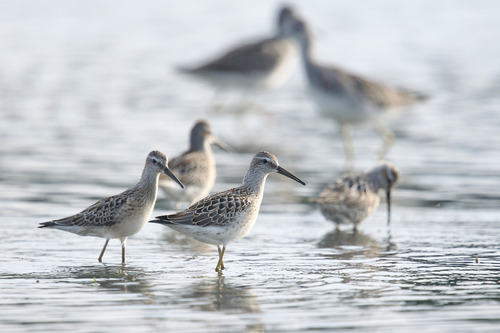 Stilt Sandpiper
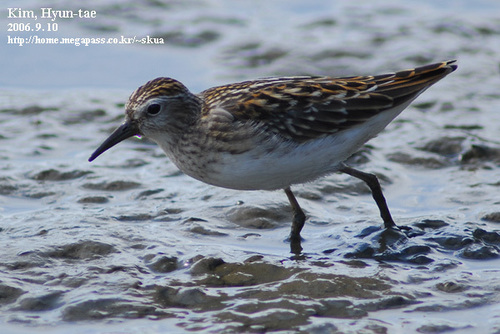 Long-toed Stint
In short
The most reliable field mark to separate Stilt Sandpiper from Long-toed Stint is size and structure: Stilt Sandpiper is much larger, with a longer neck, longer legs, and a noticeably longer, slightly downcurved bill, while Long-toed Stint is tiny, compact, and has a short, straight bill. In flight, Stilt Sandpiper lacks a wingbar, whereas Long-toed Stint may show a weak one, but this is not always obvious. Juvenile and nonbreeding birds of both species can appear similar in overall color, but Stilt Sandpiper always looks lankier and stands taller, with greenish-yellow (not bright yellow) legs. Careful attention to bill shape, leg color, and proportions is key, especially when viewing lone birds or mixed flocks.
Identification tips
- Size is the first and most obvious clue: Stilt Sandpiper is much larger and taller than Long-toed Stint. If you see a shorebird that looks lanky and stands above nearby peeps, it's likely a Stilt Sandpiper.
- Bill shape and length: Stilt Sandpiper has a long, slightly downcurved bill (not as obviously curved as Curlew Sandpiper), while Long-toed Stint has a short, straight, sharp-tipped bill. This is visible even at a distance if the bird is side-on.
- Leg color: Stilt Sandpiper's legs are greenish-yellow, while Long-toed Stint's are brighter yellow. This can be subtle in poor light, but is a useful supporting mark.
- Neck and stance: Stilt Sandpiper has a long neck and stands upright, often appearing stretched. Long-toed Stint is shorter-necked, more compact, and crouches lower to the ground.
- Flight pattern: Stilt Sandpiper lacks a wingbar in flight, while Long-toed Stint may show a weak wingbar (not always obvious). If you see a clear wingbar, it's not a Stilt Sandpiper.
- Juvenile upperparts: Juvenile Stilt Sandpiper has a strong head pattern and brownish back with white fringes, but is not barred below. Juvenile Long-toed Stint is more rufous above with white mantle stripes. Look for the head pattern and back contrast.
- Breeding plumage underparts: Adult Stilt Sandpiper is heavily barred below with blackish bars on white; Long-toed Stint is plain white below with some pale brown speckling on the breast.
- Supercilium and crown: Both have a pale supercilium, but Stilt Sandpiper's is more prominent and may be bordered by reddish-orange patches in breeding plumage. Long-toed Stint's crown is brown, and the supercilium is less striking.
- Back pattern: Stilt Sandpiper has a brown back with darker feather centers; Long-toed Stint is brown above with darker centers but is smaller and more finely built.
- Leg length: Stilt Sandpiper's legs are much longer, allowing it to wade deeper than Long-toed Stint. If the bird is foraging in water up to its belly, it's more likely a Stilt Sandpiper.
- Behavior: Stilt Sandpiper moves more slowly and deliberately, often probing deeply. Long-toed Stint is more active, picking quickly at the surface.
- Toe length: Long-toed Stint has especially long toes for its size, which may be visible when walking on mud, but this is subtle and rarely diagnostic at a distance.
- Context: If seen in North America, Stilt Sandpiper is expected; Long-toed Stint is a rare vagrant. In Eurasia, context is less helpful, but Stilt Sandpiper is still rare outside its normal range.
- Mixed flocks: If you see a much larger, longer-legged bird among small peeps or stints, suspect Stilt Sandpiper. If all birds are tiny, check for Long-toed Stint.
- When in doubt: Focus on size, bill shape, and leg color first. If possible, try to see the bird in flight for the presence or absence of a wingbar.
Size
Stilt Sandpiper is substantially larger: 18–23 cm in length and 50–70 g in weight, compared to Long-toed Stint's 13–16 cm and about 30.5 g. The Stilt Sandpiper also has a much longer wingspan (37–42 cm vs. 26.5–30.5 cm). In the field, Stilt Sandpiper appears tall and elongated, with long legs and neck, while Long-toed Stint is noticeably smaller, more compact, and delicate. This size difference is usually obvious if the two are seen together, but can be underestimated if only one species is present.
Plumage
- Juvenile/Immature birds: Stilt Sandpiper juveniles have a strong head pattern, brownish back with white fringes, and are not barred below. Long-toed Stint juveniles are brightly patterned above with rufous tones and white mantle stripes. Both can look similar at a distance, but the Stilt Sandpiper is larger and longer-necked, and its head pattern is more pronounced.
- Flight (all ages): Stilt Sandpiper lacks a wingbar in flight, while Long-toed Stint may show a weak wingbar, but this is not prominent and may be missed.
- Breeding plumage: Stilt Sandpiper adults are heavily barred below with blackish bars on white, and show reddish-orange patches above and below the white supercilium. Long-toed Stint adults are rich brown above with darker feather centers and white below, with a light supercilium and brown crown.
- Nonbreeding plumage: Both species become plainer: Stilt Sandpiper is gray above and white below, retaining a white supercilium; Long-toed Stint is gray above and white below with a pale supercilium and brown crown.
- Leg color: Stilt Sandpiper legs are greenish-yellow; Long-toed Stint legs are brighter yellow.
Behaviour
Stilt Sandpiper typically forages with a slow, deliberate gait, often wading deeper due to its longer legs. It may probe more deeply in mud or shallow water. Long-toed Stint is more active and dainty, picking at the surface and moving quickly, often in shallower water or at the edge of mudflats. The stance is distinctive: Stilt Sandpiper stands tall and upright, while Long-toed Stint is lower to the ground, with a more horizontal posture. Long-toed Stint's long toes may be visible if seen well, especially when walking on mud.
Habitat
Both species use mudflats and shallow wetlands, but Stilt Sandpiper is more likely to be found wading in deeper water due to its longer legs. Long-toed Stint prefers the edges of mudflats and shallower pools. In their normal ranges, Stilt Sandpiper is a North American migrant, while Long-toed Stint breeds in northern Asia and is a rare vagrant in Europe and North America. Context and location can help, but are not diagnostic if both are possible.
Voice
No diagnostic vocalizations are described in the provided notes for either species. Both may have distinctive calls, but these are not detailed here and should not be relied upon for separation based on the current information.