

Spotted Forktail vs Himalayan Rubythroat
Enicurus maculatus versus Calliope pectoralis
Play a quiz with Spotted Forktail and Himalayan Rubythroat
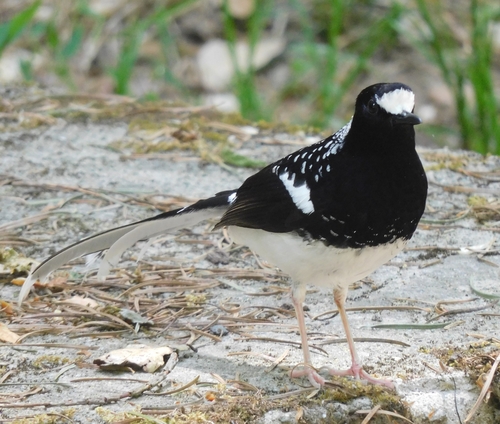 Spotted Forktail
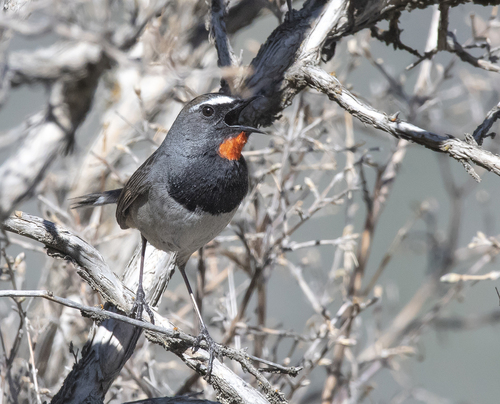 Himalayan Rubythroat
In short
The most reliable field mark to separate Spotted Forktail from Himalayan Rubythroat is the Spotted Forktail’s striking black back heavily spotted with white and its deeply forked, black-and-white tail, visible in all ages and especially obvious in flight. Himalayan Rubythroat lacks any white spotting on the back and instead shows a plain brownish or slaty upperpart, with males sporting a vivid scarlet throat patch and white tail base/tips, but no spots. Forktails are larger, longer-tailed, and always associated with running water, while rubythroats are smaller, upright, and more often found in scrub or open woodland. If you see a boldly spotted back and broad white wingbar, you have a Spotted Forktail; if the bird is plain above with a strong face pattern and, in males, a red throat, it’s a Himalayan Rubythroat.
Identification tips
- Back pattern (all ages): Spotted Forktail always has a black back with bold white spots; Himalayan Rubythroat never shows any white spotting on the back.
- Tail shape and pattern: Spotted Forktail’s tail is very long, deeply forked, and boldly patterned black and white; Himalayan Rubythroat’s tail is shorter, not forked, blackish with white base and tips (not as striking or contrasting).
- Wingbar: Spotted Forktail has a broad white wingbar visible both perched and in flight; Himalayan Rubythroat lacks any wingbar, with plain brownish wings.
- White forehead: Both species can show a white forehead, but in Forktail it is broader and set off by the black crown and spotted back; in Rubythroat, especially males, it is part of a more complex face pattern with a supercilium and (in some subspecies) a submoustachial stripe.
- Throat and underparts (males): Male Himalayan Rubythroat has a vivid scarlet throat patch bordered by black and grey, with white belly and black sides to the throat and breast; Spotted Forktail never shows any red or black on the throat or breast.
- Female/immature confusion: Female Himalayan Rubythroat is dull brownish-grey above with a diffuse supercilium and whitish throat, but still lacks any white spotting or wingbar; female/immature Forktail always shows spotted back and white wingbar.
- Habitat context: Spotted Forktail is almost never found away from fast-flowing streams; if you see a bird with a spotted back in a forest stream or boulder-strewn ravine, it is a Forktail. Himalayan Rubythroat is found in open woodland, scrub, or thickets, rarely near water.
- Behavior: Forktail is active, often flicking its long tail and moving along rocks in streams; Rubythroat is more upright, perches in the open to sing, or skulks in dense cover.
- Size and structure: Forktail is much larger and longer-tailed, with a more elongated body; Rubythroat is smaller, compact, and robin-like in shape.
- Flight view: In flight, Forktail flashes a broad white wingbar and spotted back; Rubythroat shows plain brownish wings and a less contrasting tail pattern.
- Voice: Forktail’s call is a harsh, screechy 'KREE', especially in flight; Rubythroat’s song is more musical and variable, with softer calls.
- Sex differences: Only male Rubythroat shows a red throat; Forktail sexes are alike.
- Seasonal movement: Both species can descend to lower elevations in winter, but habitat preference (stream vs. scrub) remains a strong separator.
- Common pitfalls: Do not mistake the white forehead or white in the tail of Rubythroat for the Forktail’s bold white spotting and wingbar; always check for back spots and tail shape.
- When in doubt: If you see a bird with a long, deeply forked tail and bold white spots on the back, it is a Spotted Forktail. If the bird is plain above, with a strong face pattern and (in males) a red throat, it is a Himalayan Rubythroat.
Size
Spotted Forktail is substantially larger and heavier (41 g vs. 23 g) and appears longer-bodied with a proportionally much longer, deeply forked tail. Himalayan Rubythroat is noticeably smaller and more compact, with a shorter tail and a more upright, robin-like stance. This size difference is usually obvious when seen side by side or with experience, but can be harder to judge at a distance or in isolation.
Plumage
- All ages, all seasons: Spotted Forktail always shows a black back with bold white spots and a broad white wingbar, plus a deeply forked black-and-white tail. These marks are present in both adults and immatures and are visible both perched and in flight. The white forehead is also a constant feature.
- Himalayan Rubythroat (adult male): No white spots on the back. Upperparts are slaty brown or blackish, with a white forehead and supercilium, and a striking scarlet throat patch bordered by black and grey. Tail is blackish with white base and tips, but never forked or spotted. Underparts are white with black sides to the throat and breast.
- Himalayan Rubythroat (female): Dull brownish-grey above, no white spots or wingbar, with a diffuse supercilium and smoky underparts. Throat is whitish, sometimes with a short moustachial stripe. Tail pattern (white base/tips) is subtle and not as bold as the forktail’s tail pattern.
- In flight: Spotted Forktail’s white wingbar and spotted back are visible from above, while the Himalayan Rubythroat shows plain brownish wings and upperparts with only subtle white in the tail.
Behaviour
Spotted Forktail is almost always seen along fast-flowing streams, often hopping on rocks or foraging at the water’s edge, and is frequently seen in flight over water, flashing its white tail and wingbar. Its movements are active and it often flicks its tail. Himalayan Rubythroat is shy, usually found singly or in pairs in scrubby or open woodland, often perching upright on low shrubs or singing from exposed perches. It is less likely to be seen near water and more likely to skulk in dense cover, especially females and non-breeding birds.
Habitat
Spotted Forktail is tightly tied to boulder-strewn mountain streams, forested ravines, and roadside canals in hilly or montane forest, typically at 1200–3600 m in the breeding season and descending to about 600 m in winter. It is rarely found away from running water. Himalayan Rubythroat prefers open woodland, scrub, and thickets, often at high altitudes in summer but descending to lower elevations in winter. It is not associated with streams and is more likely to be found in dry or shrubby habitats, sometimes in open areas but rarely near fast-flowing water.
Voice
Spotted Forktail gives a shrill, screechy 'KREE', especially in flight, and some squeaky notes when perched. Himalayan Rubythroat’s song is a series of squeaky, variable notes delivered from an exposed perch; females give a short, gruff note followed by an upward inflected whistle, and the alarm call is a sharp 'skyap'. The Forktail’s call is harsher and more piercing, while the Rubythroat’s vocalizations are softer and more varied.