

Motmot

Smooth-billed Ani vs Groove-billed Ani

Crotophaga ani versus Crotophaga sulcirostris

Play a quiz with Smooth-billed Ani and Groove-billed Ani
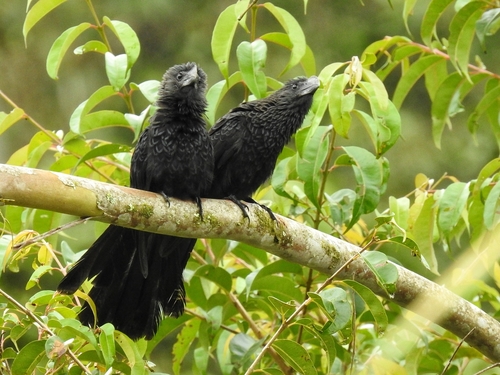
Smooth-billed Ani (Crotophaga ani) Smooth-billed Ani
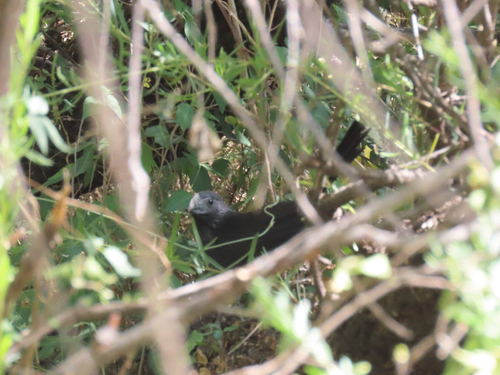
Groove-billed Ani (Crotophaga sulcirostris) Groove-billed Ani

Media

Loading…

In short

The most reliable field mark between Smooth-billed Ani and Groove-billed Ani is the bill: Smooth-billed Ani has a noticeably deeper, more swollen bill with a smoother upper ridge, while Groove-billed Ani shows distinct lengthwise grooves along the upper mandible. Both species are glossy black with long tails and can be confusing, especially as some Smooth-billed Anis show partial grooves and bill size overlaps. Size is helpful but subtle: Smooth-billed Ani is generally bulkier and heavier. Voice and range are often the most practical separators in the field, especially where both species may occur. Flight style and group behavior are similar, so careful attention to bill shape and vocalizations is key.

Identification tips

  1. Bill shape is the primary field mark: Smooth-billed Ani has a deep, swollen bill with a smooth or only faintly grooved upper ridge; Groove-billed Ani's bill is more slender and always shows distinct lengthwise grooves along the upper mandible. This mark works for all ages and sexes.
  2. Beware overlap in bill size: Some Smooth-billed Anis may have bills as small as Groove-billed, and may show faint grooves at the base. Always check for overall depth and swelling of the bill, not just grooves.
  3. Size and bulk: Smooth-billed Ani is generally heavier and bulkier (97 g vs 74.5 g), but this is subtle and best used when both species are seen together.
  4. Tail length and shape: Both species have very long, black tails nearly as long as the body. Tail shape is not a reliable separator.
  5. Plumage: Both are glossy black at all ages, with no significant color or pattern differences. Do not rely on plumage for separation.
  6. Flight style: Both species have weak, wobbly, or choppy flight with alternating flaps and glides. Flight jizz is similar and not diagnostic.
  7. Group behavior: Both are gregarious and noisy, often in groups. Social behavior does not separate them.
  8. Habitat: Both occur in open and semi-open country, including fields and pastures. Habitat is not a reliable separator where ranges overlap.
  9. Voice: Smooth-billed Ani gives a whining 'ooo-leeek' call, distinctive if heard. Groove-billed Ani's calls are different; voice is often the best separator in the field.
  10. Range: In southern Texas and northern Mexico, only Groove-billed Ani occurs. In southern Florida and the Caribbean, only Smooth-billed Ani is present. In overlap zones, use bill and voice.
  11. Iris color: Smooth-billed Ani is noted to have a brown iris, but this is subtle and not usually visible in the field.
  12. Feeding behavior: Both forage on the ground and may pick ticks from livestock; this is not a separator.
  13. Nest and breeding: Both species nest communally, but this is not a field mark for identification.
  14. Seasonal presence: Groove-billed Ani withdraws from the northern edge of its range in winter; Smooth-billed Ani is resident throughout its range.
  15. When in doubt: Focus on bill shape and grooves, and listen for calls. If both are ambiguous, consider range and season.

Size

Smooth-billed Ani is the larger of the two, with an average body mass of about 97 g compared to Groove-billed Ani's 74.5 g [wikidata]. In length, Smooth-billed averages 35 cm (14 in), while Groove-billed averages about 34 cm (13 in) [wikipedia]. The difference is subtle in the field, but Smooth-billed Ani often appears bulkier and heavier-bodied, especially when seen alongside Groove-billed. Both have long tails, but Smooth-billed's overall proportions are slightly more robust.

Plumage

Both species are glossy black overall, with no significant seasonal or age-related color differences noted in the sources. Juvenile and immature plumages are not described as distinct or diagnostic in either species, and there are no specific upperwing or flight pattern marks for young birds. The key difference is not in plumage but in bill structure: Groove-billed Ani always shows obvious grooves running lengthwise along the upper mandible, while Smooth-billed Ani's bill is deeper, more swollen, and typically smooth (though some individuals may show faint grooves at the base). Both have long, black tails and lack contrasting panels or wing marks at all ages.

Behaviour

Both species are highly social, usually found in noisy groups. They feed mostly on the ground, running rather than hopping, and often forage in open areas. In flight, both exhibit weak, wobbly, or choppy flight with alternating flaps and glides, and neither is particularly strong or direct in the air. Smooth-billed Ani is noted for being especially gregarious and conspicuous, but this is not a reliable separator from Groove-billed Ani, which also forms groups. Both species may be seen associating with grazing animals to pick off insects or ticks.

Habitat

Both anis favor open and semi-open habitats, including pastures, cultivated fields, savannas, and orchards. Smooth-billed Ani is widespread from southern Florida through the Caribbean and much of South America, while Groove-billed Ani ranges from southern Texas and Mexico through Central America to northern South America and the Pacific coast. Where their ranges overlap (e.g., parts of Central America and northern South America), habitat preferences are very similar and not a reliable field separator. Groove-billed Ani is more likely to be found at the northern edge of the range (e.g., southern Texas), while Smooth-billed is absent there.

Voice

Voice is often the most practical separator in the field. Smooth-billed Ani gives a distinctive whining 'ooo-leeek' call. Groove-billed Ani's calls are not described in detail in the sources here, but the two species are noted to be best distinguished by voice where they overlap. If you hear the characteristic Smooth-billed Ani call, it is diagnostic. Groove-billed Ani's calls are generally higher-pitched and less drawn out, but always check local guides for specifics.

Submit a better description

Use the same sections as the comparison. Your text is published immediately.

The most reliable field mark between Smooth-billed Ani and Groove-billed Ani is the bill: Smooth-billed Ani has a noticeably deeper, more swollen bill with a smoother upper ridge, while Groove-billed Ani shows distinct lengthwise grooves along the upper mandible. Both species are glossy black with long tails and can be confusing, especially as some Smooth-billed Anis show partial grooves and bill size overlaps. Size is helpful but subtle: Smooth-billed Ani is generally bulkier and heavier. Voice and range are often the most practical separators in the field, especially where both species may occur. Flight style and group behavior are similar, so careful attention to bill shape and vocalizations is key.

  1. Bill shape is the primary field mark: Smooth-billed Ani has a deep, swollen bill with a smooth or only faintly grooved upper ridge; Groove-billed Ani's bill is more slender and always shows distinct lengthwise grooves along the upper mandible. This mark works for all ages and sexes.
  2. Beware overlap in bill size: Some Smooth-billed Anis may have bills as small as Groove-billed, and may show faint grooves at the base. Always check for overall depth and swelling of the bill, not just grooves.
  3. Size and bulk: Smooth-billed Ani is generally heavier and bulkier (97 g vs 74.5 g), but this is subtle and best used when both species are seen together.
  4. Tail length and shape: Both species have very long, black tails nearly as long as the body. Tail shape is not a reliable separator.
  5. Plumage: Both are glossy black at all ages, with no significant color or pattern differences. Do not rely on plumage for separation.
  6. Flight style: Both species have weak, wobbly, or choppy flight with alternating flaps and glides. Flight jizz is similar and not diagnostic.
  7. Group behavior: Both are gregarious and noisy, often in groups. Social behavior does not separate them.
  8. Habitat: Both occur in open and semi-open country, including fields and pastures. Habitat is not a reliable separator where ranges overlap.
  9. Voice: Smooth-billed Ani gives a whining 'ooo-leeek' call, distinctive if heard. Groove-billed Ani's calls are different; voice is often the best separator in the field.
  10. Range: In southern Texas and northern Mexico, only Groove-billed Ani occurs. In southern Florida and the Caribbean, only Smooth-billed Ani is present. In overlap zones, use bill and voice.
  11. Iris color: Smooth-billed Ani is noted to have a brown iris, but this is subtle and not usually visible in the field.
  12. Feeding behavior: Both forage on the ground and may pick ticks from livestock; this is not a separator.
  13. Nest and breeding: Both species nest communally, but this is not a field mark for identification.
  14. Seasonal presence: Groove-billed Ani withdraws from the northern edge of its range in winter; Smooth-billed Ani is resident throughout its range.
  15. When in doubt: Focus on bill shape and grooves, and listen for calls. If both are ambiguous, consider range and season.

Smooth-billed Ani is the larger of the two, with an average body mass of about 97 g compared to Groove-billed Ani's 74.5 g [wikidata]. In length, Smooth-billed averages 35 cm (14 in), while Groove-billed averages about 34 cm (13 in) [wikipedia]. The difference is subtle in the field, but Smooth-billed Ani often appears bulkier and heavier-bodied, especially when seen alongside Groove-billed. Both have long tails, but Smooth-billed's overall proportions are slightly more robust.

Both species are glossy black overall, with no significant seasonal or age-related color differences noted in the sources. Juvenile and immature plumages are not described as distinct or diagnostic in either species, and there are no specific upperwing or flight pattern marks for young birds. The key difference is not in plumage but in bill structure: Groove-billed Ani always shows obvious grooves running lengthwise along the upper mandible, while Smooth-billed Ani's bill is deeper, more swollen, and typically smooth (though some individuals may show faint grooves at the base). Both have long, black tails and lack contrasting panels or wing marks at all ages.

Both species are highly social, usually found in noisy groups. They feed mostly on the ground, running rather than hopping, and often forage in open areas. In flight, both exhibit weak, wobbly, or choppy flight with alternating flaps and glides, and neither is particularly strong or direct in the air. Smooth-billed Ani is noted for being especially gregarious and conspicuous, but this is not a reliable separator from Groove-billed Ani, which also forms groups. Both species may be seen associating with grazing animals to pick off insects or ticks.

Both anis favor open and semi-open habitats, including pastures, cultivated fields, savannas, and orchards. Smooth-billed Ani is widespread from southern Florida through the Caribbean and much of South America, while Groove-billed Ani ranges from southern Texas and Mexico through Central America to northern South America and the Pacific coast. Where their ranges overlap (e.g., parts of Central America and northern South America), habitat preferences are very similar and not a reliable field separator. Groove-billed Ani is more likely to be found at the northern edge of the range (e.g., southern Texas), while Smooth-billed is absent there.

Voice is often the most practical separator in the field. Smooth-billed Ani gives a distinctive whining 'ooo-leeek' call. Groove-billed Ani's calls are not described in detail in the sources here, but the two species are noted to be best distinguished by voice where they overlap. If you hear the characteristic Smooth-billed Ani call, it is diagnostic. Groove-billed Ani's calls are generally higher-pitched and less drawn out, but always check local guides for specifics.

Discard your changes?

You have unsaved edits. If you leave now, those changes will be lost.

Smooth-billed Ani · Groove-billed Ani · My Tricky Birds