

Short-toed Rock Thrush vs Cape Rock Thrush
Monticola brevipes versus Monticola rupestris
Play a quiz with Short-toed Rock Thrush and Cape Rock Thrush
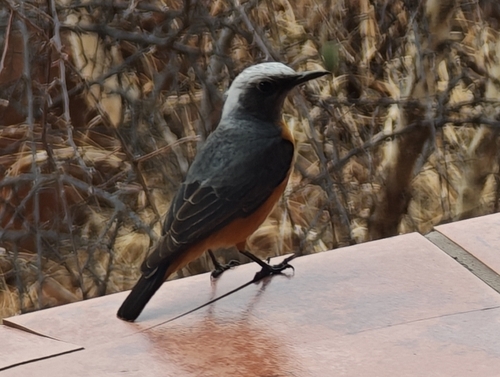 Short-toed Rock Thrush
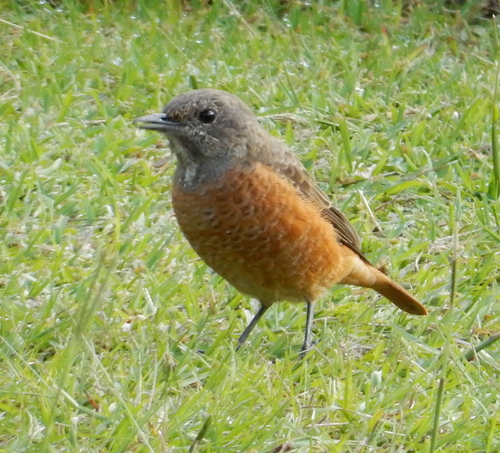 Cape Rock Thrush
In short
The most reliable field mark to separate Short-toed Rock Thrush from Cape Rock Thrush is the plumage of adult males: Cape Rock Thrush males show a blue-grey head with rich orange underparts and reddish outer tail feathers, while Short-toed Rock Thrush lacks this combination. Females and immatures of Cape Rock Thrush also have richer orange underparts than those of other rock thrushes, including Short-toed. Immature Cape Rock Thrushes show buff spots above and black scaling below, which can help in tricky juvenile/first-year encounters. Habitat can also help: Cape Rock Thrush prefers mountainous rocky areas in eastern and southern South Africa, while Short-toed is found in drier shrubland, mostly further north and west. Size is not a strong separator in the field, but Cape Rock Thrush is described as a large, stocky species.
Identification tips
- Juvenile/immature Cape Rock Thrush shows buff spots on the upperparts and black scaling on the underparts—if you see these marks, especially in a young bird, it's Cape, not Short-toed.
- Adult male Cape Rock Thrush has a blue-grey head and rich orange underparts; Short-toed males lack this combination and appear plainer.
- Reddish outer tail feathers are visible in both male and female Cape Rock Thrush; this is less obvious or absent in Short-toed, so a flash of rufous in the tail is a strong Cape clue.
- Female Cape Rock Thrushes have much richer orange underparts than Short-toed females; if the bird is a female and looks especially bright below, lean Cape.
- Cape Rock Thrush is larger and stockier than Short-toed, but this is subtle and best used as supporting evidence.
- Habitat is a strong clue: Cape Rock Thrush is almost always in rocky, mountainous terrain with scattered vegetation; Short-toed prefers dry shrubland, often away from rocky slopes.
- Range can help: Cape Rock Thrush is mostly in eastern/southern South Africa, Lesotho, and Eswatini; Short-toed is more widespread in drier parts of Angola, Botswana, Namibia, and South Africa.
- If you hear a whistled, musical song (tsee-tsee-tseet-chee-chweeeoo), it's Cape Rock Thrush; Short-toed's song is not described here, so a distinctive whistle points to Cape.
- Both species perch upright on rocks, so posture alone is not diagnostic.
- If you see a bird with a brown head and very rich orange underparts, especially with reddish tail sides, it's likely a female Cape Rock Thrush.
- If the bird is in a rocky upland or cliff habitat, especially in eastern South Africa or Lesotho, Cape is more likely; if in dry, open shrubland, especially further north or west, Short-toed is more probable.
- In mixed or ambiguous habitat, rely on plumage and tail color over context.
- Immature Cape Rock Thrushes may be confused with other spotted thrushes, but the combination of buff spots above and black scaling below is distinctive.
- If you cannot see the head color or underparts well, look for the reddish outer tail in flight or when the bird flicks its tail.
- If all else fails, consider the likelihood based on location and habitat, but be cautious—plumage is more reliable than range for these two.
Size
Short-toed Rock Thrush has a recorded body mass of 33.0g [wikidata], while Cape Rock Thrush is described as a large, stocky thrush (19–21 cm in length [wikipedia]), likely heavier and bulkier in appearance. In practice, Cape Rock Thrush will appear slightly larger and more robust, especially when perched, but this is subtle and not always reliable at a distance or in poor viewing conditions. Size alone is rarely diagnostic between these two.
Plumage
- Immatures/juveniles: Immature Cape Rock Thrushes are distinctive with buff spots on the upperparts and black scaling on the underparts. Short-toed Rock Thrush immatures are not described in detail here, but lack mention of these specific markings, so a heavily spotted/scaled juvenile is likely Cape.
- Adult males: Cape Rock Thrush males have a blue-grey head, orange underparts, and reddish outer tail feathers, with brown wings and back. Short-toed Rock Thrush males do not show this blue-grey head/orange underpart combination.
- Adult females: Female Cape Rock Thrushes have a brown head and much richer orange underparts than other female rock thrushes, including Short-toed. The outer tail feathers are reddish, like the male's. Short-toed females are less vividly marked below.
- Tail: Both sexes of Cape Rock Thrush show reddish outer tail feathers, a useful field mark if seen well. This is less pronounced or absent in Short-toed.
Behaviour
Both species are typical rock thrushes, often perching upright on rocks or prominent perches. Cape Rock Thrush is described as a resident, sometimes making altitudinal movements, but there is no specific behavioral difference noted that would reliably separate these two in the field.
Habitat
Cape Rock Thrush is found in mountainous rocky areas with scattered vegetation, primarily in eastern and southern South Africa, Lesotho, and Eswatini. Short-toed Rock Thrush prefers subtropical or tropical dry shrubland and is found in Angola, Botswana, Namibia, and South Africa, generally in drier and more open habitats than Cape Rock Thrush. Overlap is possible in South Africa, but Cape is more likely in rocky uplands, Short-toed in dry shrublands.
Voice
Cape Rock Thrush males have a whistled song described as tsee-tsee-tseet-chee-chweeeoo and may mimic other birds. There is no vocal description for Short-toed Rock Thrush here, so song is only useful if Cape's distinctive whistle is heard.