

Short-tailed Nighthawk vs Band-tailed Nighthawk
Lurocalis semitorquatus versus Nyctiprogne leucopyga
Play a quiz with Short-tailed Nighthawk and Band-tailed Nighthawk
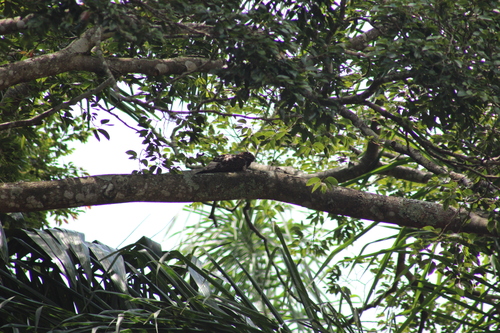 Short-tailed Nighthawk
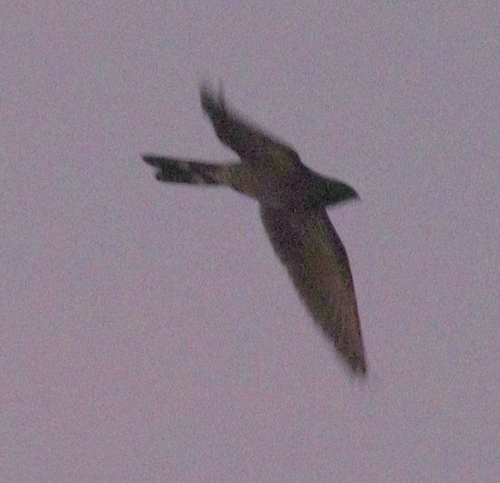 Band-tailed Nighthawk
In short
The most reliable field mark to separate Short-tailed Nighthawk from Band-tailed Nighthawk is the presence of a bold white band across the mid-tail in Band-tailed, visible in flight and when perched, which Short-tailed Nighthawk completely lacks. Both species are short-tailed, dark-plumaged nightjars with no white in the wings, but Short-tailed is larger and bulkier, with a stubbier tail and more heavily marked underparts. Band-tailed Nighthawk is smaller, more slender, and shows a slightly forked tail with a conspicuous white band; its plumage is plainer and paler in immatures. Structural differences and habitat preferences also help: Band-tailed is often seen hawking low over water at dusk, while Short-tailed prefers forested habitats and is less tied to water. Vocalizations differ, but both are subtle and rarely diagnostic in the field.
Identification tips
- White tail band (all ages): Band-tailed Nighthawk always shows a bold white band across the mid-tail, visible in flight and often when perched. Short-tailed Nighthawk never shows a mid-tail white band—look for this first in any view.
- Tail shape and length: Both have short tails, but Short-tailed Nighthawk's is especially short and square-tipped, while Band-tailed's is short but slightly forked. In flight, Band-tailed's tail may appear more pointed or forked, especially when fanned.
- Tail pattern: Short-tailed Nighthawk's tail is brown with tawny/grayish bars and a narrow buffy or whitish band at the tip (not mid-tail). Band-tailed's tail is dark with a clear white band across the middle—never at the tip.
- Wing markings: Both species lack bold white patches in the wings, unlike many other nighthawks. Do not rely on wing pattern alone to separate these two.
- Upperpart and underpart markings: Short-tailed Nighthawk is more heavily marked above and below, with rufous and buff spots and bars. Band-tailed is plainer and paler overall, especially in immatures, but both are cryptically brown.
- Throat patches: Band-tailed Nighthawk has white patches on the sides of the throat, which can be seen in good views. Short-tailed has a white throat, but not as distinctly patchy on the sides.
- Size and bulk: Short-tailed Nighthawk is noticeably larger and heavier-bodied. If seen side by side or with a good sense of scale, this can help, but beware overlap with other nightjars.
- Bill and bristles: Band-tailed has a very wide but short bill, lacking the elongated rictal bristles typical of many nightjars. This is subtle and rarely visible in the field.
- Flight style: Band-tailed Nighthawk flies rapidly and low over water with shallow wingbeats and glides. Short-tailed is more likely to be seen hawking above or along forest edges and clearings, not over open water.
- Roosting behavior: Band-tailed often roosts on thin branches near water, sometimes in small groups. Short-tailed is more solitary and forest-associated.
- Habitat preference: If the bird is seen regularly over rivers or lakes at dusk, Band-tailed is far more likely. In deep forest or away from water, Short-tailed is favored.
- Vocalizations: If heard, Short-tailed gives a sharp, spaced "ewIT" or "gweek"; Band-tailed gives a low, frog-like, continuous call. Use with caution, as both are subtle.
- Sex and age: Both species show weak sexual dimorphism, and immature Band-tailed are only slightly paler and plainer than adults. The white tail band is present in all ages of Band-tailed.
- Pitfalls: Do not confuse the narrow buffy or whitish terminal band of Short-tailed's tail with the bold mid-tail band of Band-tailed. In poor light, the white tail band of Band-tailed is often the only reliable mark.
- When in doubt: Focus on tail pattern and habitat context—these are the most consistently diagnostic features for field separation.
Size
Short-tailed Nighthawk is distinctly larger, measuring 19–21 cm in length and weighing 79–89 g [wikipedia]. Band-tailed Nighthawk is smaller at 16.5–19 cm and weighs 23–28 g [wikipedia]. The size difference is noticeable in direct comparison, with Short-tailed appearing bulkier and heavier-bodied, while Band-tailed is more slender and lightweight. Both have short tails, but the Short-tailed's is proportionally even shorter and squarer. Wingspan data is only available for Band-tailed (12.9–14.1 cm), but both species have long, pointed wings relative to their size.
Plumage
- Juvenile/immature plumage: Band-tailed Nighthawk immatures are slightly plainer and paler than adults, but still show the diagnostic white tail band, which is present from a young age [wikipedia]. Short-tailed Nighthawk immatures are not described in detail, but no mention is made of a white tail band or any comparable feature.
- Adult plumage: Short-tailed Nighthawk is dark brown to blackish above, with rufous and buff spots and speckles, and a brown tail with tawny/grayish bars and a narrow buffy or whitish terminal band (not a mid-tail band). Underparts are heavily marked with brown, buff, and tawny. The wings are dark with muted spots, lacking any bold white markings [wikipedia]. Band-tailed Nighthawk is cryptically brown with long, pointed wings and a short, somewhat forked tail. The key feature is the white band across the mid-tail (on the three outermost tail feathers), and white patches on the sides of the throat. The wings have no white markings. Both sexes are similar in both species, and sexual dimorphism is weak.
Behaviour
Band-tailed Nighthawk is often seen flying low and rapidly over rivers, lakes, and other bodies of water at dusk, feeding in continuous flight with rapid, shallow wingbeats and glides [wikipedia]. It frequently roosts on thin horizontal branches near water, sometimes in small groups. Short-tailed Nighthawk forages mostly at dusk as well, but is more often associated with lowland evergreen forest, forest edges, and clearings rather than open water. Its flight is less tied to watercourses and more to forested habitats. Both species are aerial insectivores, but their preferred foraging contexts differ.
Habitat
Short-tailed Nighthawk is found in a wide range across Central and South America, primarily inhabiting lowland evergreen forests, forest edges, clearings, and occasionally secondary forests or plantations [wikipedia]. It is less commonly found near open water. Band-tailed Nighthawk, in contrast, is strongly associated with habitats near water—rivers, streams, marshes, lakes, and adjacent lowland forests or savannahs, always at low elevations below 200–300 m [wikipedia]. If you see a nighthawk regularly flying low over water at dusk, Band-tailed is much more likely.
Voice
Short-tailed Nighthawk gives a "constantly repeated but well-spaced ewIT ... ewIT ... ewIT ..." or a sharp, slightly liquid "g'wik" or "gweek" call, both in flight and when perched [wikipedia]. Band-tailed Nighthawk's call is a low-volume, frog-like "gole-kwoik-kwak" repeated steadily [wikipedia]. Both are subtle and can be hard to distinguish in the field, but Short-tailed's call is sharper and more spaced out, while Band-tailed's is lower and more continuous. Vocalizations are not usually the most reliable field mark unless heard well.
Short-tailed Nighthawk · Band-tailed Nighthawk · My Tricky Birds