

Shore Lark vs Bimaculated Lark
Eremophila alpestris versus Melanocorypha bimaculata
Play a quiz with Shore Lark and Bimaculated Lark
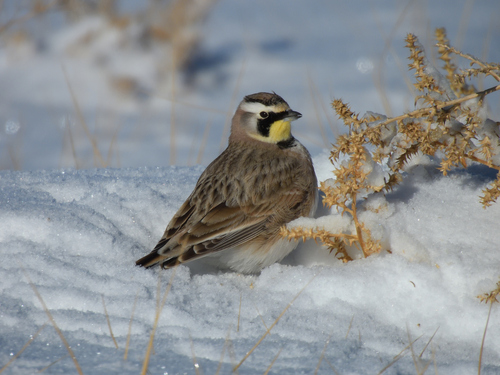 Shore Lark
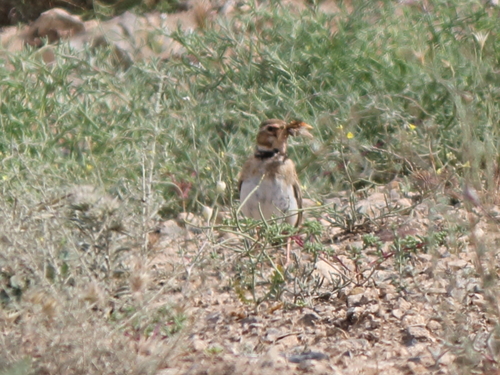 Bimaculated Lark
In short
The most reliable field mark between Shore Lark and Bimaculated Lark is the head and face pattern: Shore Lark shows a striking black-and-yellow (or black-and-white in some races) mask with small 'horns' on males, while Bimaculated Lark has a much plainer face. In flight, Shore Lark displays a strong black tail with pale body contrast, whereas Bimaculated Lark shows a short tail with a white tip but no white edges, and short, broad wings with grey-brown underwings. Bimaculated Lark is also noticeably heavier and bulkier. Voice and habitat can help, but the head pattern and tail/wing contrasts are most decisive.
Identification tips
- Head and face pattern: Shore Lark (all ages, especially adult males) shows a bold black-and-yellow (or black-and-white in some races) face mask with a black line through the eye and a black bib; males have small black 'horns' (tufts). Bimaculated Lark has a plain face with no mask or horns.
- Tail pattern in flight: Shore Lark has a mostly black tail with only the central feathers paler, creating a sharp contrast with the body, visible in all ages and seasons. Bimaculated Lark's tail is short with a white tip but lacks white edges and is not strongly contrasting with the body.
- Wing shape and underwing: Bimaculated Lark has short, broad wings with grey-brown underwings; Shore Lark's wings are longer and more pointed, lacking the broad, blunt look.
- Body size and bulk: Bimaculated Lark is noticeably heavier and bulkier than Shore Lark. If birds are side by side, the size difference is clear, but beware of lone birds or distant views.
- Bill and jizz: Shore Lark is more slender, with a finer bill and more upright stance. Bimaculated Lark appears stockier and heavier, with a thicker bill and a more horizontal posture.
- Plumage above and below: Both are brown-grey above and pale below, but only Shore Lark has the strong face and tail contrast; Bimaculated Lark is overall plainer.
- Sex and age variation: Male Shore Lark in breeding plumage is most distinctive, but even females and immatures show some facial pattern and the black tail. Bimaculated Lark is always plain-faced.
- Flight style: Shore Lark often sings in flight with undulating, buoyant movements; Bimaculated Lark's flight is more direct and less showy.
- Habitat context: Shore Lark is found in open, often cold or coastal habitats; Bimaculated Lark prefers warm, dry steppe or arable land. If the setting is cold and open, suspect Shore Lark; if dry and continental, suspect Bimaculated Lark.
- Vocalization: If you hear high-pitched, tinkling calls or a weak ascending trill, this supports Shore Lark. Bimaculated Lark's voice is not described here, so absence of these calls is not diagnostic.
- Pitfalls: Immature Shore Larks can appear less boldly marked but will still show some face pattern and the black tail. Distant Bimaculated Larks may seem to have a pale face in strong light, but never show the mask or horns.
- Seasonal confusion: In winter, Shore Lark's face pattern may be duller, but still present; Bimaculated Lark remains plain year-round.
- Flock behavior: Both may be seen in flocks, but Shore Lark flocks are often on bare ground or shorelines, while Bimaculated Lark flocks are on steppe or farmland.
- Geographic context: Shore Lark is widespread across the northern hemisphere, especially in cold or alpine zones; Bimaculated Lark is restricted to warmer steppe from Turkey eastwards.
- When in doubt: Prioritize the head pattern and tail contrast in flight; these are the most reliable marks for all ages and seasons.
Size
Bimaculated Lark is substantially heavier (body mass ~54g [wikidata]) than Shore Lark (28–48g [wikipedia]), and appears bulkier overall. Shore Lark is smaller (16–20 cm length) and more slender, with a proportionally longer tail. Bimaculated Lark's wings are short and broad, giving it a stockier look in flight, while Shore Lark is more streamlined.
Plumage
- Juvenile/immature/flight views: Shore Lark of all ages shows a strong contrast between a mostly black tail (except for the central feathers) and a paler body, especially visible in flight. Bimaculated Lark in flight shows a short tail with a white tip (but not white edges) and grey-brown underwings; its wing and tail pattern is distinctive from Shore Lark, lacking the black tail contrast.
- Adult breeding plumage: Male Shore Lark is unmistakable with its black-and-yellow (or black-and-white in some races) face mask and small black 'horns' (tufts). Bimaculated Lark lacks any such head pattern, appearing much plainer.
- Non-breeding/female/immature: Shore Lark still shows some face pattern, though less bold, and the black tail remains a strong mark. Bimaculated Lark remains plain-faced throughout the year.
- Upperparts: Shore Lark is brown-grey above, paler below; Bimaculated Lark is similar but lacks the bold facial contrast and tail pattern.
Behaviour
Shore Lark often feeds and moves in open, bare ground or shorelines, sometimes in small flocks. Its flight is undulating and often accompanied by song-flights, especially in breeding season. Bimaculated Lark is more likely to be found in steppe or arid farmland, moving in a more direct, less buoyant flight, and is less likely to display aerial song flights.
Habitat
Shore Lark is found on open ground, often near shorelines in winter (hence the European name), and in tundra or alpine meadows in summer. Bimaculated Lark prefers warm temperate steppe, arid plains, or cultivated fields in its range from Turkey to Central Asia. Overlap is rare, but habitat context can help: Shore Lark is more likely in cold, open, or coastal settings; Bimaculated Lark in drier, warmer, more continental steppes.
Voice
Shore Lark gives high-pitched, lisping or tinkling calls and a weak, ascending warbling trill in flight. These are generally softer and higher than the typical lark calls. Bimaculated Lark's voice is not described in the provided sources, so vocalization is less reliable for separation unless Shore Lark's distinctive high, tinkling calls are heard.