

Shining Honeycreeper vs Purple Honeycreeper
Cyanerpes lucidus versus Cyanerpes caeruleus
Play a quiz with Shining Honeycreeper and Purple Honeycreeper
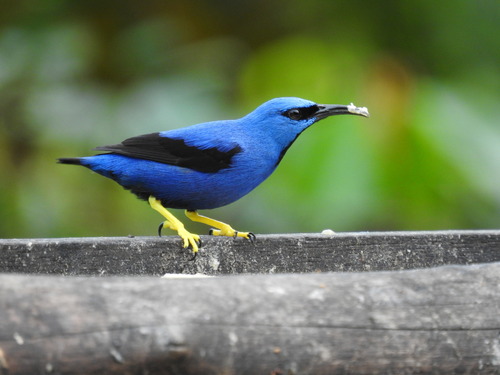 Shining Honeycreeper
 Purple Honeycreeper
In short
The most reliable field mark between Shining Honeycreeper and Purple Honeycreeper is the difference in adult male plumage: Shining Honeycreeper males are a vivid ultramarine blue with a lighter, more azure head, while Purple Honeycreeper males are a deeper violet-blue to purplish overall. Females are trickier: Shining Honeycreeper females are mostly grass-green with a blue or greenish crown, whereas Purple Honeycreeper females have a green crown and nape but show a distinctive cinnamon-buff supercilium and ear coverts, plus a brighter blue malar stripe. Both species have similar slender, decurved bills and yellowish legs, but subtle differences in leg color and face pattern can help. Juveniles resemble adult females in both species, so focus on face pattern and underpart streaking. Range is also a strong clue: Shining Honeycreeper is found north to Mexico and into Colombia, while Purple Honeycreeper ranges from Panama south through most of South America and onto Trinidad.
Identification tips
- Adult male color: Shining Honeycreeper males are a vivid ultramarine blue with a paler, more azure head and a small black mask; Purple Honeycreeper males are deeper violet-blue or purplish, with a slightly lighter face and a narrow black mask. This is the quickest field check for adult males.
- Head contrast in males: Shining Honeycreeper males have a noticeably lighter blue head compared to the body; Purple Honeycreeper males are more uniform in tone, with only a slightly lighter face.
- Female face pattern: Shining Honeycreeper females have a grass-green head with a blue or greenish crown/nape and thin white stripes on the forecrown; Purple Honeycreeper females show a distinctive cinnamon-buff supercilium and ear coverts, buffy lores and eye-ring, and a brighter blue malar stripe. Look for the cinnamon-buff tones on the face for Purple.
- Female underparts: Shining Honeycreeper females have grayish green underparts with blue streaks on the breast and a buff chin/throat; Purple Honeycreeper females have a buffy throat, off-white breast/flanks with greenish olive streaks, yellow belly, and white undertail coverts. The presence of yellow and white below is a Purple Honeycreeper clue.
- Female upperparts: Shining Honeycreeper females are dull grass green above; Purple Honeycreeper females are green above but with a more complex face pattern and less blue on the crown/nape.
- Leg color: Males of both species have bright yellow legs; females' legs are yellowish green (Shining) or light green to olive-yellow (Purple). This is subtle and best used in good light.
- Bill shape: Both have slender, decurved black bills; bill length varies by subspecies but is not a reliable field mark between these two species in most cases.
- Juvenile confusion: Juveniles resemble adult females in both species. For Purple Honeycreeper, juveniles are plainer on the breast/flanks. Use face pattern and underpart color to separate.
- Underwing color: Shining Honeycreeper females have dull yellow underwing coverts; Purple Honeycreeper females have dusky flight feathers with yellow-green edges. This is only visible in certain views.
- Tail and wing: Both have short tails and black wings/tails in adult males; no distinctive flight pattern differences are described.
- Range: If seen north of Panama (Mexico to Honduras), it is Shining Honeycreeper. If south of Panama (Trinidad, Venezuela, Amazonia, etc.), it is Purple Honeycreeper. In Panama and northwest Colombia, both may occur.
- Habitat: Both prefer humid forests and edges, often in the canopy or subcanopy. Habitat is not a separator, but context (range, elevation) may help.
- Behavior: Both are active, often in mixed flocks, and visit feeders for fruit/nectar. Behavioral differences are subtle and not reliable for separation.
- Sexual dimorphism: Both are sexually dimorphic, but the female face pattern and underpart coloration are the most useful for separating females.
- Subspecies variation: Some Purple Honeycreeper subspecies are paler or more purplish, and bill length varies, but these are not reliable for field ID unless in known range.
Size
Both species are very similar in size, with Shining Honeycreeper averaging about 11.4 g in mass and 10–11 cm in length, while Purple Honeycreeper ranges from 9.3–11.4 cm and 7.8–14 g. In the field, size is not a reliable separator; both appear as small, slender tanagers with long, decurved bills and short tails. Subspecies variation in Purple Honeycreeper can make some individuals slightly larger or smaller, but this is subtle and not useful for most field encounters.
Plumage
-
Juvenile and Immature Plumage: Both species' juveniles resemble adult females, lacking the bold adult male colors. Juvenile Purple Honeycreepers are plainer on the breast and flanks than adult females, but otherwise share the green upperparts and buffy underparts. No distinctive upperwing or flight pattern differences are described for immatures.
-
Adult Males: Shining Honeycreeper males are mostly ultramarine blue with a lighter azure head, small black mask, black throat and upper breast, and black wings/tail. Purple Honeycreeper males are violet-blue to purplish, with a slightly lighter face, black lores and mask, black throat center, and black wings/tail. The overall tone is more purple in Purple Honeycreeper, more blue in Shining Honeycreeper, and the head is paler in Shining Honeycreeper.
-
Adult Females: Shining Honeycreeper females are grass-green above with a grayish blue or greenish crown/nape, thin white stripes on the forecrown, brownish dusky lores, and a blue malar stripe. Underparts are grayish green with blue streaks on the breast, buff chin/throat, and dull yellow underwing coverts. Purple Honeycreeper females have a green crown/nape, buffy lores and eye-ring, bright blue malar stripe, cinnamon-buff supercilium and ear coverts, green upperparts/tail, buffy throat, off-white breast/flanks with greenish olive streaks, yellow belly, and white undertail coverts. Their flight feathers are dusky with yellow-green edges.
-
Legs and Bill: Both have slender, decurved black bills. Male legs are bright yellow in both species; females are yellowish green (Shining) or light green to olive-yellow (Purple).
Behaviour
Both species are active, canopy-foraging tanagers that often join mixed-species flocks. Purple Honeycreeper is noted for its energetic foraging in pairs or small groups, frequently visiting feeders for fruit and nectar, and taking insects from twigs and foliage. Shining Honeycreeper's behavior is similar, though less is detailed. In the field, their jizz is much alike: quick, agile movements in the subcanopy and canopy, often with other tanagers or honeycreepers.
Habitat
Shining Honeycreeper is found from southern Mexico through Central America (except El Salvador) into Colombia, while Purple Honeycreeper ranges from Panama south through most of South America and onto Trinidad. Their ranges overlap only in Panama and northwest Colombia. Both inhabit humid forests and edges, but if you are north of Panama, only Shining Honeycreeper is expected; south and east of Panama, Purple Honeycreeper predominates. Habitat preference is otherwise similar, so range is a strong separator.
Shining Honeycreeper · Purple Honeycreeper · My Tricky Birds