

Shining Honeycreeper vs Purple Honeycreeper
Cyanerpes lucidus contro Cyanerpes caeruleus
Fai un quiz con Shining Honeycreeper e Purple Honeycreeper
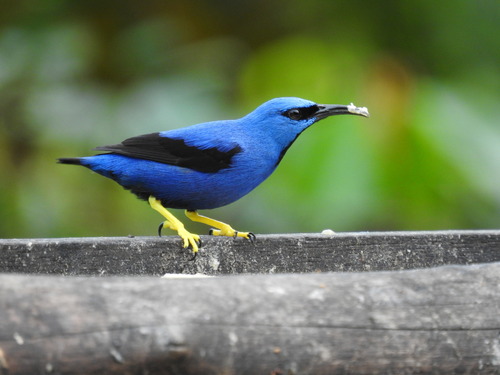 Shining Honeycreeper
 Purple Honeycreeper
In breve
Il segno di campo più affidabile tra il Shining Honeycreeper e il Purple Honeycreeper è la differenza nel piumaggio degli adulti maschi: i maschi di Shining Honeycreeper sono di un blu ultramarino vivido con una testa più chiara e azzurra, mentre i maschi di Purple Honeycreeper sono di un blu-violetto più profondo. Le femmine sono più difficili da distinguere: le femmine di Shining Honeycreeper sono per lo più di un verde erba con una corona blu o verdastra, mentre le femmine di Purple Honeycreeper hanno una corona e una nuca verdi ma mostrano un supercilium e copritrici auricolari di un distintivo color cannella, oltre a una striscia malare blu più brillante. Entrambe le specie hanno becchi simili, snelli e ricurvi, e zampe giallastre, ma sottili differenze nel colore delle zampe e nel motivo del viso possono aiutare. I giovani assomigliano alle femmine adulte in entrambe le specie, quindi concentrati sul motivo del viso e sulle striature delle parti inferiori. L'areale è anche un forte indizio: il Shining Honeycreeper si trova a nord fino al Messico e in Colombia, mentre il Purple Honeycreeper si estende da Panama a sud attraverso la maggior parte del Sud America e fino a Trinidad.
Consigli di identificazione
- Colore degli adulti maschi: I maschi di Shining Honeycreeper sono di un blu ultramarino vivido con una testa più chiara e azzurra e una piccola maschera nera; i maschi di Purple Honeycreeper sono di un blu-violetto più profondo, con un viso leggermente più chiaro e una stretta maschera nera. Questo è il controllo di campo più veloce per gli adulti maschi.
- Contrasto della testa nei maschi: I maschi di Shining Honeycreeper hanno una testa blu visibilmente più chiara rispetto al corpo; i maschi di Purple Honeycreeper sono più uniformi nel tono, con solo un viso leggermente più chiaro.
- Motivo del viso delle femmine: Le femmine di Shining Honeycreeper hanno una testa verde erba con una corona/nuca blu o verdastra e sottili strisce bianche sulla fronte; le femmine di Purple Honeycreeper mostrano un distintivo supercilium e copritrici auricolari color cannella, lore buffy e anello oculare, e una striscia malare blu più brillante. Cerca i toni color cannella sul viso per il Purple.
- Parti inferiori delle femmine: Le femmine di Shining Honeycreeper hanno parti inferiori verde grigiastro con striature blu sul petto e un mento/gola color buff; le femmine di Purple Honeycreeper hanno una gola color buff, petto/fianchi bianco sporco con striature verde oliva, ventre giallo, e copritrici sottocoda bianche. La presenza di giallo e bianco sotto è un indizio per il Purple Honeycreeper.
- Parti superiori delle femmine: Le femmine di Shining Honeycreeper sono di un verde erba opaco sopra; le femmine di Purple Honeycreeper sono verdi sopra ma con un motivo del viso più complesso e meno blu sulla corona/nuca.
- Colore delle zampe: I maschi di entrambe le specie hanno zampe gialle brillanti; le zampe delle femmine sono verde giallastro (Shining) o verde chiaro fino a giallo oliva (Purple). Questo è sottile e meglio utilizzato in buona luce.
- Forma del becco: Entrambi hanno becchi neri, snelli e ricurvi; la lunghezza del becco varia per sottospecie ma non è un segno di campo affidabile tra queste due specie nella maggior parte dei casi.
- Confusione giovanile: I giovani assomigliano alle femmine adulte in entrambe le specie. Per il Purple Honeycreeper, i giovani sono più semplici sul petto/fianchi. Usa il motivo del viso e il colore delle parti inferiori per separare.
- Colore delle ali inferiori: Le femmine di Shining Honeycreeper hanno copritrici delle ali inferiori gialle opache; le femmine di Purple Honeycreeper hanno piume da volo scure con bordi giallo-verdi. Questo è visibile solo in alcune angolazioni.
- Coda e ali: Entrambi hanno code corte e ali nere/coda negli adulti maschi; non sono descritte differenze distintive nel pattern di volo.
- Areale: Se visto a nord di Panama (Messico fino all'Honduras), è Shining Honeycreeper. Se a sud di Panama (Trinidad, Venezuela, Amazonia, ecc.), è Purple Honeycreeper. In Panama e nel nord-ovest della Colombia, entrambe le specie possono verificarsi.
- Habitat: Entrambi preferiscono foreste umide e margini, spesso nella chioma o nel sottobosco. L'habitat non è un separatore, ma il contesto (areale, elevazione) può aiutare.
- Comportamento: Entrambi sono attivi, spesso in stormi misti, e visitano i mangiatoie per frutta/nectar. Le differenze comportamentali sono sottili e non affidabili per la separazione.
- Dimorfismo sessuale: Entrambi sono sessualmente dimorfici, ma il motivo del viso delle femmine e la colorazione delle parti inferiori sono i più utili per separare le femmine.
- Variazione delle sottospecie: Alcune sottospecie di Purple Honeycreeper sono più chiare o più violacee, e la lunghezza del becco varia, ma queste non sono affidabili per l'identificazione sul campo a meno che non siano in areali noti.
Taglia
Both species are very similar in size, with Shining Honeycreeper averaging about 11.4 g in mass and 10–11 cm in length, while Purple Honeycreeper ranges from 9.3–11.4 cm and 7.8–14 g. In the field, size is not a reliable separator; both appear as small, slender tanagers with long, decurved bills and short tails. Subspecies variation in Purple Honeycreeper can make some individuals slightly larger or smaller, but this is subtle and not useful for most field encounters.
Piumaggio
-
Juvenile and Immature Plumage: Both species' juveniles resemble adult females, lacking the bold adult male colors. Juvenile Purple Honeycreepers are plainer on the breast and flanks than adult females, but otherwise share the green upperparts and buffy underparts. No distinctive upperwing or flight pattern differences are described for immatures.
-
Adult Males: Shining Honeycreeper males are mostly ultramarine blue with a lighter azure head, small black mask, black throat and upper breast, and black wings/tail. Purple Honeycreeper males are violet-blue to purplish, with a slightly lighter face, black lores and mask, black throat center, and black wings/tail. The overall tone is more purple in Purple Honeycreeper, more blue in Shining Honeycreeper, and the head is paler in Shining Honeycreeper.
-
Adult Females: Shining Honeycreeper females are grass-green above with a grayish blue or greenish crown/nape, thin white stripes on the forecrown, brownish dusky lores, and a blue malar stripe. Underparts are grayish green with blue streaks on the breast, buff chin/throat, and dull yellow underwing coverts. Purple Honeycreeper females have a green crown/nape, buffy lores and eye-ring, bright blue malar stripe, cinnamon-buff supercilium and ear coverts, green upperparts/tail, buffy throat, off-white breast/flanks with greenish olive streaks, yellow belly, and white undertail coverts. Their flight feathers are dusky with yellow-green edges.
-
Legs and Bill: Both have slender, decurved black bills. Male legs are bright yellow in both species; females are yellowish green (Shining) or light green to olive-yellow (Purple).
Comportamento
Entrambe le specie sono attive, tangari che foraggiano nella chioma e spesso si uniscono a stormi misti. Il Purple Honeycreeper è noto per la sua foraggiatura energica in coppie o piccoli gruppi, visitando frequentemente i mangiatoie per frutta e nettare, e prendendo insetti da rami e fogliame. Il comportamento del Shining Honeycreeper è simile, anche se sono forniti meno dettagli. Sul campo, il loro comportamento è molto simile: movimenti rapidi e agili nel sottobosco e nella chioma, spesso con altri tangari o honeycreepers.
Habitat
Il Shining Honeycreeper si trova dal sud del Messico attraverso l'America Centrale (eccetto El Salvador) fino in Colombia, mentre il Purple Honeycreeper si estende da Panama a sud attraverso la maggior parte del Sud America e fino a Trinidad. I loro areali si sovrappongono solo a Panama e nel nord-ovest della Colombia. Entrambi abitano foreste umide e margini, ma se ti trovi a nord di Panama, ci si aspetta solo il Shining Honeycreeper; a sud e a est di Panama, prevale il Purple Honeycreeper. La preferenza per l'habitat è altrimenti simile, quindi l'areale è un forte separatore.
Shining Honeycreeper · Purple Honeycreeper · I miei uccelli difficili