

shining honeycreeper vs saí-de-perna-amarela
Cyanerpes lucidus versus Cyanerpes caeruleus
Jogue um quiz com shining honeycreeper e saí-de-perna-amarela
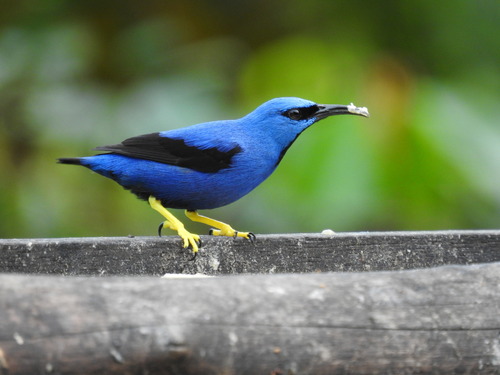 shining honeycreeper
 saí-de-perna-amarela
Em resumo
A marca de campo mais confiável entre o shining honeycreeper e o saí-de-perna-amarela é a diferença na plumagem dos machos adultos: os machos de shining honeycreeper são de um azul ultramarino vívido com uma cabeça mais clara e mais azulada, enquanto os machos de saí-de-perna-amarela são de um azul-violeta mais profundo a purpurado no geral. As fêmeas são mais complicadas: as fêmeas de shining honeycreeper são principalmente verde-grama com uma coroa azul ou esverdeada, enquanto as fêmeas de saí-de-perna-amarela têm uma coroa e nuca verdes, mas apresentam um supercílio e coberturas auriculares distintivos em canela e buff, além de uma faixa malar azul mais brilhante. Ambas as espécies têm bicos finos e curvados semelhantes e pernas amareladas, mas diferenças sutis na cor das pernas e no padrão facial podem ajudar. Os juvenis se assemelham às fêmeas adultas em ambas as espécies, então concentre-se no padrão facial e nas listras das partes inferiores. A distribuição também é uma pista forte: o shining honeycreeper é encontrado ao norte até o México e na Colômbia, enquanto o saí-de-perna-amarela se estende do Panamá para o sul através da maior parte da América do Sul e até Trinidad.
Dicas de identificação
- Cor do macho adulto: Os machos de shining honeycreeper são de um azul ultramarino vívido com uma cabeça mais clara e mais azulada e uma pequena máscara preta; os machos de saí-de-perna-amarela são de um azul-violeta mais profundo ou purpurado, com um rosto ligeiramente mais claro e uma máscara preta estreita. Esta é a verificação de campo mais rápida para machos adultos.
- Contraste da cabeça nos machos: Os machos de shining honeycreeper têm uma cabeça azul visivelmente mais clara em comparação com o corpo; os machos de saí-de-perna-amarela são mais uniformes em tom, com apenas um rosto ligeiramente mais claro.
- Padrão facial das fêmeas: As fêmeas de shining honeycreeper têm uma cabeça verde-grama com uma coroa/nuca azul ou esverdeada e finas listras brancas na coroa; as fêmeas de saí-de-perna-amarela apresentam um supercílio e coberturas auriculares distintivos em canela e buff, lores e anel ocular em buff, e uma faixa malar azul mais brilhante. Procure os tons canela e buff no rosto para o saí-de-perna-amarela.
- Partes inferiores das fêmeas: As fêmeas de shining honeycreeper têm partes inferiores verde-acinzentadas com listras azuis no peito e um queixo/garganta em buff; as fêmeas de saí-de-perna-amarela têm uma garganta em buff, peito/flancos off-white com listras verde-oliva, barriga amarela, e coberturas de cauda brancas. A presença de amarelo e branco abaixo é uma pista para o saí-de-perna-amarela.
- Partes superiores das fêmeas: As fêmeas de shining honeycreeper são de um verde-grama opaco acima; as fêmeas de saí-de-perna-amarela são verdes acima, mas com um padrão facial mais complexo e menos azul na coroa/nuca.
- Cor das pernas: Os machos de ambas as espécies têm pernas amarelas brilhantes; as pernas das fêmeas são verde-amareladas (Shining) ou verde claro a amarelo-oliva (Purple). Isso é sutil e melhor utilizado em boa luz.
- Forma do bico: Ambas têm bicos finos e curvados pretos; o comprimento do bico varia por subespécie, mas não é uma marca de campo confiável entre essas duas espécies na maioria dos casos.
- Confusão juvenil: Os juvenis se assemelham às fêmeas adultas em ambas as espécies. Para o saí-de-perna-amarela, os juvenis são mais simples no peito/flancos. Use o padrão facial e a cor das partes inferiores para separar.
- Cor da parte inferior da asa: As fêmeas de shining honeycreeper têm coberturas de asa inferiores amarelas opacas; as fêmeas de saí-de-perna-amarela têm penas de voo escuras com bordas amarelo-verdosas. Isso é visível apenas em certas vistas.
- Cauda e asa: Ambas têm caudas curtas e asas/caudas pretas em machos adultos; não são descritas diferenças distintivas no padrão de voo.
- Distribuição: Se visto ao norte do Panamá (México a Honduras), é shining honeycreeper. Se ao sul do Panamá (Trinidad, Venezuela, Amazônia, etc.), é saí-de-perna-amarela. No Panamá e no noroeste da Colômbia, ambas podem ocorrer.
- Habitat: Ambas preferem florestas úmidas e bordas, frequentemente no dossel ou subdossel. O habitat não é um separador, mas o contexto (distribuição, elevação) pode ajudar.
- Comportamento: Ambas são ativas, frequentemente em bandos mistos, e visitam comedouros para frutas/néctar. As diferenças comportamentais são sutis e não confiáveis para separação.
- Dimorfismo sexual: Ambas são sexualmente dimórficas, mas o padrão facial da fêmea e a coloração das partes inferiores são os mais úteis para separar as fêmeas.
- Variação de subespécies: Algumas subespécies de saí-de-perna-amarela são mais claras ou mais purpuradas, e o comprimento do bico varia, mas essas não são confiáveis para identificação em campo, a menos que na distribuição conhecida.
Tamanho
Both species are very similar in size, with Shining Honeycreeper averaging about 11.4 g in mass and 10–11 cm in length, while saí-de-perna-amarela ranges from 9.3–11.4 cm and 7.8–14 g. In the field, size is not a reliable separator; both appear as small, slender tanagers with long, decurved bills and short tails. Subspecies variation in saí-de-perna-amarela can make some individuals slightly larger or smaller, but this is subtle and not useful for most field encounters.
Plumagem
-
Juvenile and Immature Plumage: Both species' juveniles resemble adult females, lacking the bold adult male colors. Juvenile Purple Honeycreepers are plainer on the breast and flanks than adult females, but otherwise share the green upperparts and buffy underparts. No distinctive upperwing or flight pattern differences are described for immatures.
-
Adult Males: Shining Honeycreeper males are mostly ultramarine blue with a lighter azure head, small black mask, black throat and upper breast, and black wings/tail. saí-de-perna-amarela males are violet-blue to purplish, with a slightly lighter face, black lores and mask, black throat center, and black wings/tail. The overall tone is more purple in saí-de-perna-amarela, more blue in Shining Honeycreeper, and the head is paler in Shining Honeycreeper.
-
Adult Females: Shining Honeycreeper females are grass-green above with a grayish blue or greenish crown/nape, thin white stripes on the forecrown, brownish dusky lores, and a blue malar stripe. Underparts are grayish green with blue streaks on the breast, buff chin/throat, and dull yellow underwing coverts. saí-de-perna-amarela females have a green crown/nape, buffy lores and eye-ring, bright blue malar stripe, cinnamon-buff supercilium and ear coverts, green upperparts/tail, buffy throat, off-white breast/flanks with greenish olive streaks, yellow belly, and white undertail coverts. Their flight feathers are dusky with yellow-green edges.
-
Legs and Bill: Both have slender, decurved black bills. Male legs are bright yellow in both species; females are yellowish green (Shining) or light green to olive-yellow (Purple).
Comportamento
Ambas as espécies são ativas, tanagers que forrageiam no dossel e frequentemente se juntam a bandos de espécies mistas. O saí-de-perna-amarela é conhecido por sua forrageamento energético em pares ou pequenos grupos, visitando frequentemente comedouros para frutas e néctar, e pegando insetos de galhos e folhagens. O comportamento do shining honeycreeper é semelhante, embora menos seja detalhado. No campo, seu jizz é muito semelhante: movimentos rápidos e ágeis no subdossel e dossel, frequentemente com outras tanagers ou honeycreepers.
Habitat
O shining honeycreeper é encontrado do sul do México através da América Central (exceto El Salvador) até a Colômbia, enquanto o saí-de-perna-amarela se estende do Panamá para o sul através da maior parte da América do Sul e até Trinidad. Suas distribuições se sobrepõem apenas no Panamá e no noroeste da Colômbia. Ambas habitam florestas úmidas e bordas, mas se você estiver ao norte do Panamá, apenas o shining honeycreeper é esperado; ao sul e leste do Panamá, o saí-de-perna-amarela predomina. A preferência de habitat é de outra forma semelhante, então a distribuição é um forte separador.
shining honeycreeper · saí-de-perna-amarela · Minhas aves difíceis