

Mielerito Reluciente vs Mielerito Cerúleo
Cyanerpes lucidus frente a Cyanerpes caeruleus
Juega un quiz con Mielerito Reluciente y Mielerito Cerúleo
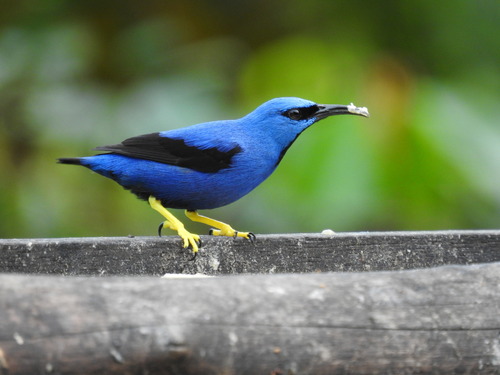 Mielerito Reluciente
 Mielerito Cerúleo
En breve
La marca de campo más confiable entre el Mielerito Reluciente y el Mielerito Cerúleo es la diferencia en el plumaje de los machos adultos: los machos de Mielerito Reluciente son de un azul ultramarino vívido con una cabeza más clara y más azur, mientras que los machos de Mielerito Cerúleo son de un azul-violeta más profundo a purpúreo en general. Las hembras son más complicadas: las hembras de Mielerito Reluciente son principalmente de color verde hierba con una corona azul o verdosa, mientras que las hembras de Mielerito Cerúleo tienen una corona y nuca verdes pero muestran un supercilio y coberturas de oído distintivos de color canela-buff, además de una franja malar azul más brillante. Ambas especies tienen picos delgados y curvados similares y patas amarillentas, pero diferencias sutiles en el color de las patas y el patrón facial pueden ayudar. Los juveniles se asemejan a las hembras adultas en ambas especies, así que concéntrate en el patrón facial y las rayas en la parte inferior. El rango también es una pista fuerte: el Mielerito Reluciente se encuentra al norte hasta México y en Colombia, mientras que el Mielerito Cerúleo se extiende desde Panamá hacia el sur a través de la mayor parte de América del Sur y hasta Trinidad.
Consejos de identificación
- Color del macho adulto: Los machos de Mielerito Reluciente son de un azul ultramarino vívido con una cabeza más clara y más azur y una pequeña máscara negra; los machos de Mielerito Cerúleo son de un azul-violeta más profundo o purpúreo, con una cara ligeramente más clara y una máscara negra estrecha. Esta es la verificación de campo más rápida para los machos adultos.
- Contraste de cabeza en machos: Los machos de Mielerito Reluciente tienen una cabeza azul notablemente más clara en comparación con el cuerpo; los machos de Mielerito Cerúleo son más uniformes en tono, con solo una cara ligeramente más clara.
- Patrón facial de la hembra: Las hembras de Mielerito Reluciente tienen una cabeza verde hierba con una corona/nuca azul o verdosa y delgadas rayas blancas en la frente; las hembras de Mielerito Cerúleo muestran un supercilio y coberturas de oído distintivos de color canela-buff, lóbulos y anillo ocular de color buff, y una franja malar azul más brillante. Busca los tonos canela-buff en la cara para el Mielerito Cerúleo.
- Partes inferiores de la hembra: Las hembras de Mielerito Reluciente tienen partes inferiores de color verde grisáceo con rayas azules en el pecho y una barbilla/garganta de color buff; las hembras de Mielerito Cerúleo tienen una garganta de color buff, pecho/flancos de color blanco sucio con rayas de oliva verdosas, vientre amarillo y coberturas de cola blancas. La presencia de amarillo y blanco abajo es una pista para el Mielerito Cerúleo.
- Partes superiores de la hembra: Las hembras de Mielerito Reluciente son de un verde hierba apagado por encima; las hembras de Mielerito Cerúleo son verdes por encima pero con un patrón facial más complejo y menos azul en la corona/nuca.
- Color de las patas: Los machos de ambas especies tienen patas amarillas brillantes; las patas de las hembras son de un verde amarillento (Mielerito Reluciente) o de un verde claro a amarillo oliva (Mielerito Cerúleo). Esto es sutil y se utiliza mejor con buena luz.
- Forma del pico: Ambas tienen picos delgados y curvados negros; la longitud del pico varía por subespecie pero no es una marca de campo confiable entre estas dos especies en la mayoría de los casos.
- Confusión juvenil: Los juveniles se asemejan a las hembras adultas en ambas especies. Para el Mielerito Cerúleo, los juveniles son más simples en el pecho/flancos. Usa el patrón facial y el color de las partes inferiores para separarlos.
- Color de la parte inferior del ala: Las hembras de Mielerito Reluciente tienen coberturas de ala inferiores de color amarillo apagado; las hembras de Mielerito Cerúleo tienen plumas de vuelo oscuras con bordes amarillo-verdosos. Esto solo es visible en ciertas vistas.
- Cola y ala: Ambas tienen colas cortas y alas/colas negras en los machos adultos; no se describen diferencias distintivas en el patrón de vuelo.
- Rango: Si se ve al norte de Panamá (México a Honduras), es Mielerito Reluciente. Si al sur de Panamá (Trinidad, Venezuela, Amazonia, etc.), es Mielerito Cerúleo. En Panamá y el noroeste de Colombia, ambos pueden ocurrir.
- Hábitat: Ambas prefieren bosques y bordes húmedos, a menudo en el dosel o subdosel. El hábitat no es un separador, pero el contexto (rango, elevación) puede ayudar.
- Comportamiento: Ambos son activos, a menudo en bandadas mixtas, y visitan comederos para fruta/néctar. Las diferencias de comportamiento son sutiles y no confiables para la separación.
- Dimorfismo sexual: Ambos son dimórficos sexualmente, pero el patrón facial de la hembra y la coloración de las partes inferiores son los más útiles para separar a las hembras.
- Variación de subespecies: Algunas subespecies de Mielerito Cerúleo son más pálidas o más purpúreas, y la longitud del pico varía, pero estas no son confiables para la identificación de campo a menos que estén en un rango conocido.
Tamaño
Both species are very similar in size, with Mielerito Reluciente averaging about 11.4 g in mass and 10–11 cm in length, while Mielerito Cerúleo ranges from 9.3–11.4 cm and 7.8–14 g. In the field, size is not a reliable separator; both appear as small, slender tanagers with long, decurved bills and short tails. Subspecies variation in Mielerito Cerúleo can make some individuals slightly larger or smaller, but this is subtle and not useful for most field encounters.
Plumaje
-
Juvenile and Immature Plumage: Both species' juveniles resemble adult females, lacking the bold adult male colors. Juvenile Purple Honeycreepers are plainer on the breast and flanks than adult females, but otherwise share the green upperparts and buffy underparts. No distinctive upperwing or flight pattern differences are described for immatures.
-
Adult Males: Mielerito Reluciente males are mostly ultramarine blue with a lighter azure head, small black mask, black throat and upper breast, and black wings/tail. Mielerito Cerúleo males are violet-blue to purplish, with a slightly lighter face, black lores and mask, black throat center, and black wings/tail. The overall tone is more purple in Mielerito Cerúleo, more blue in Mielerito Reluciente, and the head is paler in Mielerito Reluciente.
-
Adult Females: Mielerito Reluciente females are grass-green above with a grayish blue or greenish crown/nape, thin white stripes on the forecrown, brownish dusky lores, and a blue malar stripe. Underparts are grayish green with blue streaks on the breast, buff chin/throat, and dull yellow underwing coverts. Mielerito Cerúleo females have a green crown/nape, buffy lores and eye-ring, bright blue malar stripe, cinnamon-buff supercilium and ear coverts, green upperparts/tail, buffy throat, off-white breast/flanks with greenish olive streaks, yellow belly, and white undertail coverts. Their flight feathers are dusky with yellow-green edges.
-
Legs and Bill: Both have slender, decurved black bills. Male legs are bright yellow in both species; females are yellowish green (Shining) or light green to olive-yellow (Purple).
Comportamiento
Ambas especies son tangaras activas que forrajean en el dosel y a menudo se unen a bandadas de especies mixtas. El Mielerito Cerúleo es conocido por su forrajeo enérgico en parejas o pequeños grupos, visitando frecuentemente comederos para fruta y néctar, y tomando insectos de ramas y follaje. El comportamiento del Mielerito Reluciente es similar, aunque se detalla menos. En el campo, su comportamiento es muy parecido: movimientos rápidos y ágiles en el subdosel y el dosel, a menudo con otras tangaras o mieleritos.
Hábitat
El Mielerito Reluciente se encuentra desde el sur de México a través de América Central (excepto El Salvador) hasta Colombia, mientras que el Mielerito Cerúleo se extiende desde Panamá hacia el sur a través de la mayor parte de América del Sur y hasta Trinidad. Sus rangos se superponen solo en Panamá y el noroeste de Colombia. Ambas habitan en bosques y bordes húmedos, pero si estás al norte de Panamá, solo se espera el Mielerito Reluciente; al sur y al este de Panamá, predomina el Mielerito Cerúleo. La preferencia de hábitat es de otro modo similar, por lo que el rango es un separador fuerte.
Mielerito Reluciente · Mielerito Cerúleo · Mis aves difíciles